
浙江之源资产评估有限责任公司
Do natural diamonds and synthetic diamonds each have their own niche? Why the rush to compete with each other?
Release time:
2016-09-30
Source:
www.jewellery.org.cn
Since humans first discovered diamonds, this dazzling gemstone has been endowed with immense value—owing to its flawless quality and rarity. Moreover, the formation and discovery of gem-quality diamonds are exceedingly rare events. As a result, natural diamonds have consistently occupied the pinnacle of the jewelry consumption pyramid.
But what if humanity were to master the ability to “create” diamonds? Synthetic diamond technology emerged in the mid-20th century. Over the past decade, rapid technological advancements have propelled synthetic diamonds far beyond the stage of mere research and exploration. Today, scientists are producing ever more synthetic diamonds—each one purer and purer. Their physical and chemical properties are indistinguishable from those of natural diamonds. Without the aid of highly sophisticated instruments, the only noticeable differences between synthetic and natural diamonds might be that synthetic ones are more abundant, cheaper, and even closer to perfection.
Faced with the challenge posed by synthetic diamonds, where will natural diamonds go from here?
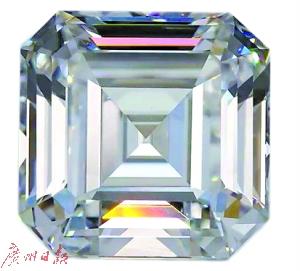
A Russian diamond synthesis company has used the high-pressure, high-temperature method to synthesize a 32.2-carat rough diamond.
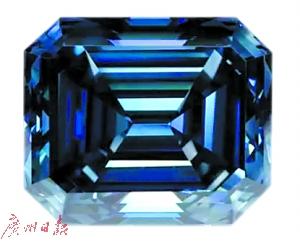
Russia’s New Diamond Technologies recently announced the successful synthesis of a 10.07-carat blue diamond.
Past and Present Lives
Synthetic diamonds were invented by the inventor.
Scared to the point of "weak knees."
Since the 18th-century French chemist Antoine Laurent de Lavoisier discovered that natural diamonds are actually crystalline forms of carbon, scientists have been trying to synthesize diamonds.
The world’s first synthetic diamond was created in the 1950s. Dr. Hall, head of General Electric’s “Superpressure Project” in the United States, used his laboratory to produce a batch of sparkling little diamonds by heating carbon to 5,000 degrees Fahrenheit and subjecting it to extremely high hydraulic pressure. According to a description in The New York Times, when Dr. Hall realized he truly had the ability to synthesize diamonds, he was so “frightened” that his knees buckled and he nearly fell over.
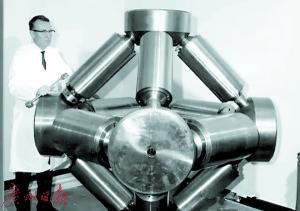
Hall and the HPHT diamond synthesis machine of that time
The diamonds synthesized by Dr. Hall have the same chemical composition as natural diamonds, but due to their brownish hue, they are used exclusively in industrial applications. Nevertheless, this advancement has already prompted a large number of countries to recognize the commercial opportunities, and Germany, France, Sweden, and the former Soviet Union have all begun developing synthetic diamonds.
In 1971, General Electric produced the first batch of high-quality synthetic diamonds that met jewelry-grade standards. However, these high-temperature and high-pressure synthetic diamonds required substantial energy input, and their manufacturing costs far exceeded their selling prices, making it difficult to promote them commercially.
It wasn't until four years ago that the quality and commercial viability of lab-grown diamonds truly began to rival those of natural diamonds. In 2012, a diamond company called Gemesis used chemical vapor deposition (commonly referred to as CVD) to produce Type IIa diamonds. It's worth noting that only about 2% of natural diamonds worldwide achieve this particular grade; Queen Elizabeth and Elizabeth Taylor were among the very few individuals who owned such naturally occurring diamonds. In 2014, the company started selling these diamonds to more than 350 stores across the United States, at prices 20% to 30% lower than those of similarly graded natural diamonds.
Once the technology caught up, the market for synthetic diamonds has been steadily growing. According to a market report, in 2014 the global synthetic diamond market totaled US$15.7 billion, with a combined production of 360,000 carats of synthetic diamonds. By 2023, this figure is estimated to rise to US$28.8 billion. Just a few months ago, several synthetic diamond companies even formed an industry alliance called the “International Synthetic Diamond Association,” seemingly signaling that the battle between synthetic and natural diamonds has fully kicked off.
Compared to each other
It's not difficult to distinguish subtly using instruments.
The rarity of natural diamonds remains unchallenged.
Four years ago, the China Jewelry and Jade Accessories Industry Association issued an industry notice stating that two batches of CVD synthetic diamonds had been successively discovered in China. At the time, our newspaper’s reporter interviewed Liang Weizhang, a diamond industry research expert, who expressed his concern to the reporter, saying: “You could say that synthetic diamonds and natural diamonds are like clones and humans—because they have identical physical and chemical properties, it’s even more challenging to distinguish between them.”
“At that time, I felt synthetic diamonds posed a significant threat to natural diamonds—but now, I’m completely calm,” Liang Weizhang said in a recent follow-up interview. “The concerns from those days stemmed, on the one hand, from the traditional natural diamond industry’s lack of preparedness for the sudden rise of synthetic diamonds; and on the other hand, from the technical challenges at the time, especially the difficulty in identifying small-grain, set-in samples. But four years have passed, and with advances in science and technology, I can confidently say that identifying synthetic diamonds is no longer a challenge.”
Lu Taijin, chief researcher at the Jewelry and Ornament Management Center of the Ministry of Natural Resources and国土资源部, also told reporters that in 2012, the NGTC (National Gem and Jewelry Quality Supervision and Inspection Center) discovered CVD synthetic diamonds without proper labeling during routine testing. The center immediately issued a warning to the industry, convened a national conference, and conducted training and seminars for quality inspection agencies and technical personnel across the country. In the summer of 2015, the NGTC laboratory detected small particles of colorless to nearly colorless HPHT synthetic diamonds mixed in diamond jewelry. Following this discovery, the center promptly launched a series of industry-wide measures—such as developing new smart instruments for detection and screening—effectively and swiftly bringing the issue under control.
“Although synthetic diamonds and natural diamonds are essentially identical in terms of chemical composition, crystal structure, and fundamental physicochemical properties, due to differences in their growth conditions, history, and processes, their internal characteristics—such as mineral inclusions, lattice defects, trace and ultra-trace elements, and spectral features—still exhibit subtle or even extremely subtle differences from those of natural diamonds. Professional jewelry-testing institutions equipped with specialized instruments, such as NGTC and GIA, can accurately and scientifically distinguish between them. For example, when it comes to colorless HPHT synthetic diamonds, CVD synthetic diamonds, and natural diamonds, their differences can be clearly identified by their fluorescence and phosphorescence characteristics. HPHT synthetic colorless diamonds typically display a blue-green hue and show distinct block-like growth zoning; CVD synthetic diamonds tend to emit orange, green, blue, blue-green, or orange colors and exhibit parallel layer-like growth patterns; whereas natural diamonds often appear in shades of blue or blue-green and frequently feature quadrilateral banding, reticulated patterns, or banded structures. Moreover, the phosphorescence characteristics of these three types also differ significantly. Additionally, when exposed to ultraviolet light using standard gemstones, colorless HPHT synthetic diamonds usually exhibit stronger short-wave fluorescence than long-wave fluorescence, emitting yellow or yellow-green fluorescence; colorless CVD synthetic diamonds typically show stronger short-wave fluorescence than long-wave fluorescence, emitting yellow, orange, or yellow-green fluorescence; while natural colorless diamonds generally display stronger long-wave fluorescence than short-wave fluorescence.”
“You could say that the natural attributes of natural diamonds—such as the geological processes that gave rise to them—are extremely difficult or impossible to replicate in synthetic diamonds,” said Lu Taijin. “The rarity and uniqueness of natural diamonds remain unchallenged.”
Each with its own positioning
Natural diamonds are luxury items.
Are synthetic diamonds decorative items?
But what inevitably prompts us to keep asking is this: When the boundary between laboratory-produced creations and nature’s own handiwork becomes so subtle that it can only be discerned with highly sophisticated instruments, does such a distinction still hold any meaning?
As for synthetic diamonds, there’s a widely circulated “legend” that a Chinese-American scholar named Mao Heguang once used the chemical vapor deposition (CVD) method. Starting with a tiny diamond as a substrate, he allowed carbon molecules from methane to continuously deposit onto the diamond base, causing the synthetic diamond to grow layer by layer and rapidly “mature.” Mao Heguang pointed out that, in theory, the raw materials for making synthetic diamonds could be extremely inexpensive—such as cow dung. After all, what’s needed to make diamonds is methane, and methane can entirely be produced through the fermentation of cow dung.
Lu Taijin pointed out that, at least so far, despite researchers’ efforts to improve the technology and reduce costs, the production of gem-quality synthetic diamonds remains expensive. In fact, the output of gem-grade synthetic diamonds is limited—especially those with large crystals—and due to their high costs, their prices are comparable to those of natural diamonds. However, smaller-sized synthetic diamonds do indeed cost less than their natural counterparts, and as technology continues to advance and costs are better controlled, there is still potential for synthetic diamond prices to fall further. But even so, will the mere reduction in the cost of synthetic diamonds necessarily enable them to replace natural diamonds?
Liang Weizhang stated that synthetic diamonds are not the first synthetic gemstones to appear on the market. The emergence of other synthetic gems, such as synthetic quartz and synthetic rubies and sapphires, has not significantly impacted the natural gemstone market.
“Even in Europe and the U.S., where synthetic gemstones are highly regarded, the value of natural gemstones hasn’t been diminished by the growing popularity of synthetics,” says jewelry designer Peng Youcheng. “That’s because our perception tends to categorize synthetics as mere decorative items, while reserving natural, precious gemstones for the status of luxury goods—leaving the two categories largely separate and non-interfering with each other.”
“If we simply believe that ‘rarity drives value,’ there will still be a world of difference between natural diamonds and lab-grown diamonds. As everyone knows, several major international diamond mining companies continue to tacitly maintain the supply-and-demand balance in the natural diamond market, and currently, humanity’s access to diamond resources is extremely limited. With advances in technology, the number of lab-grown diamonds will inevitably increase, and their prices will inevitably fall,” said Liang Weizhang. In his view, the contrast between scarcity and abundance will naturally lead natural diamonds and lab-grown diamonds down divergent paths.
Future trends
There's no need to blur the boundaries between the two.
Accurately identify the identity of synthetic diamonds
Links:
Address: Room 909, 9th Floor, Science & Technology Building, Eastern Software Park, No. 90 Wensan Road, Hangzhou City, Zhejiang Province Telephone:0571-85115488

Scan with your phone
Open the mobile website