
浙江之源资产评估有限责任公司
Small, colorless, high-temperature, high-pressure synthetic diamonds have been discovered in the domestic market—NGTC is fully committed to ensuring the safety of the diamond market.
Release time:
2015-08-21
Source:
Ministry of Natural Resources Jewelry, Gemstones, and Ornament Management Center Date: 2015-08-07
Recently, the Shenzhen Laboratory of the National Gem and Jewelry Quality Supervision and Inspection Center (NGTC) detected colorless small particles—high-pressure/high-temperature (HPHT) synthetic diamonds—mixed in the setting stones of seven batches of gemstone (including diamond) jewelry submitted by different clients. These seven batches totaled 139 pieces, with each batch containing between 10 and 40 pieces. A total of 36 tiny colorless HPHT synthetic diamonds were found mixed in these samples. The National Gem and Jewelry Quality Supervision and Inspection Center now publicly releases this information to raise awareness among the public. We urge all relevant organizations to take preventive measures in their daily operations, and we advise consumers to be vigilant when purchasing jewelry and to request certification reports issued by accredited testing institutions, thereby safeguarding their own rights and interests.
Small-grain high-pressure/high-temperature (HPHT) synthetic diamonds are used as setting stones in jewelry.
Starting in the 1950s, several countries—including the United States, the former Soviet Union, China, and Japan—began producing high-pressure/high-temperature (HPHT) synthetic single-crystal diamonds, primarily yellow diamonds of Type Ib, for industrial applications. As synthesis technology has continued to improve and evolve, HPHT diamond synthesis has now reached maturity, enabling the production of high-quality gem-grade diamonds of varying sizes. Nevertheless, these products have yet to make significant inroads into the gem market on a large scale.
In May 2015, the Shenzhen Laboratory of the National Gem and Jewelry Quality Supervision and Inspection Center (NGTC) discovered that some small particle samples among the diamonds set in a batch of ruby jewelry contained numerous black, dot-like and cloud-like inclusions. During fluorescence testing, these samples exhibited strong phosphorescence. This prompted inspectors to become alert, and the observed characteristics indicated that further examination was required for this batch of samples. Following the inspection procedures for complex samples, the laboratory conducted infrared spectroscopy, UV-Vis spectroscopy, and DiamondView tests on the samples. TM Fluorescence observation, Raman scattering spectroscopy, photoluminescence spectroscopy, and other tests have confirmed that five of the gemstones in this batch are HPHT synthetic diamonds. Since May, the Shenzhen Laboratory of the National Jewelry and Jade Quality Supervision and Inspection Center has identified a total of seven batches of samples containing small, undisclosed HPHT synthetic diamonds. This indicates that nearly colorless high-temperature and high-pressure synthetic diamonds are gradually entering the gemstone market and being sold mixed with natural diamonds.
The National Jewelry and Jade Quality Supervision and Inspection Center is fully committed to ensuring the safety of the diamond market.
Since March 2011, when the Shenzhen and Beijing laboratories of the National Gem and Jewelry Quality Supervision and Inspection Center (NGTC) first detected batches of CVD (chemical vapor deposition)-grown synthetic diamonds, they have been closely monitoring the emergence of CVD-grown and HPHT-grown synthetic diamonds in China’s jewelry market. Once large quantities of unmarked CVD-grown and HPHT-grown synthetic diamonds enter the diamond market, they could cause significant harm to the market. Following four years of continuous monitoring, the NGTC has now developed a specialized procedure to inspect jewelry pieces—such as mounted diamonds and cluster-set diamonds—to determine whether they contain small particles of synthetic diamonds. This ensures the integrity and safety of the natural diamond market.
Authoritative Interpretation: On Small-Particle Colorless High-Temperature and High-Pressure (HTHP) Synthetic Diamonds
What are HPHT (High-Temperature High-Pressure) synthetic diamonds? When it comes to small, colorless HPHT synthetic diamonds, what are the key laboratory identification characteristics? Where do they originate from, and how are they traded? Experts from the National Gem and Jewelry Quality Supervision and Inspection Center have provided an authoritative explanation on these questions.
What are high-pressure, high-temperature (HPHT) synthetic diamonds?
NGTC: High-temperature and high-pressure (HTHP) synthesis is one of the fundamental methods for producing synthetic diamonds. The basic principle behind this synthesis involves subjecting graphite to a highly controlled, artificially created environment of extreme temperature and pressure, inducing a phase transformation that results in the formation of diamond. Typically, such conditions require pressures exceeding 10 GPa and temperatures above 3,000°C. However, when metallic catalysts—such as Fe, Ni, Co, Mn, and their alloys—are present, the conditions needed for graphite to transform into diamond are significantly reduced; usually, pressures as low as 5.4 GPa and temperatures around 1,400°C suffice. Currently, the major producers of synthetic diamonds for jewelry include Russia, China, the United States, the United Kingdom, Ukraine, Japan, and other countries. The equipment and technologies used for HTHP diamond synthesis vary depending on the country and manufacturer. In the past, foreign manufacturers predominantly employed two-stage split-ball presses (commonly referred to as BARS) and BELT belt presses, whereas Chinese scientists and manufacturers have largely adopted domestically produced six-anvil presses. By carefully selecting appropriate metal catalysts and additives, it is now possible to successfully synthesize single-crystal diamonds of types Ib, IIa, IIb, and high-nitrogen diamonds. Both the output volume and technological capabilities have reached internationally advanced levels. The quality of HTHP-synthesized diamonds is remarkably similar to that of natural diamonds, making them difficult to distinguish with the naked eye. Therefore, specialized laboratory testing instruments are required to differentiate between the two.
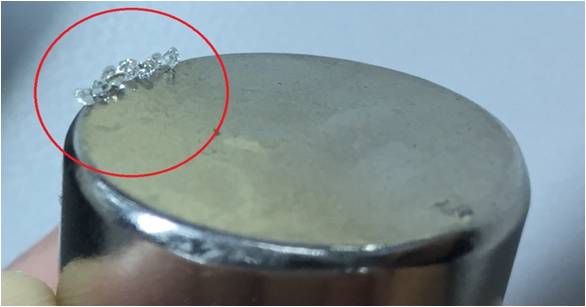
The image shows that diamonds synthesized under high temperature and high pressure contain ferromagnetic inclusions that can be attracted by a magnet.
What are the main identification characteristics of nearly colorless, small-grain high-pressure/high-temperature (HPHT)-synthesized diamonds?
NGTC : The following identification characteristics are primarily found in near-colorless high-pressure/high-temperature (HPHT) synthetic diamonds during laboratory testing:
1、 Quality: Ranging from 0.008 to 0.015 carats, according to available data, domestically synthesized near-colorless high-pressure/high-temperature (HPHT) diamond rough stones can currently reach up to 3 carats.
2、 Color: Colorless—Nearly Colorless
3、 Inclusion characteristics: Visible iron and nickel metal inclusions give it magnetic properties.
4 Ultraviolet fluorescence: Inert—yellow-green, with shorter wavelengths stronger than longer wavelengths.
5 Small-grain diamond automatic screening machine ( AMS ): The test result is “refer Type II.”
6 ultraviolet - Visible - Near-infrared spectroscopy: Absorption lines related to nickel at 685 nm and 880 nm
7、 DiamondView TM Fluorescence observation: Blue-to-blue-green fluorescence, with a few visible geometric growth zones; extremely strong blue phosphorescence (visible under ambient light after excitation).
8 Infrared spectroscopy detection: Weak 2802 cm can be detected. -1 Boron-related absorption peak;
Why do nearly colorless high-pressure, high-temperature (HPHT) synthetic diamonds often appear in small-grain inclusions?
NGTC : Because the cost of large-sized (0.1 carat and above) colorless HPHT synthetic diamonds is relatively high—indeed, even higher than that of natural diamonds of the same quality—large-sized colorless HPHT synthetic diamonds are currently seldom used as gemstones. In contrast, small-sized colorless HPHT synthetic diamonds, with their relatively low production costs—some even lower than the production costs of small-sized colorless CVD synthetic diamonds—have seen a substantial increase in output and thus hold greater potential in the gemstone market.
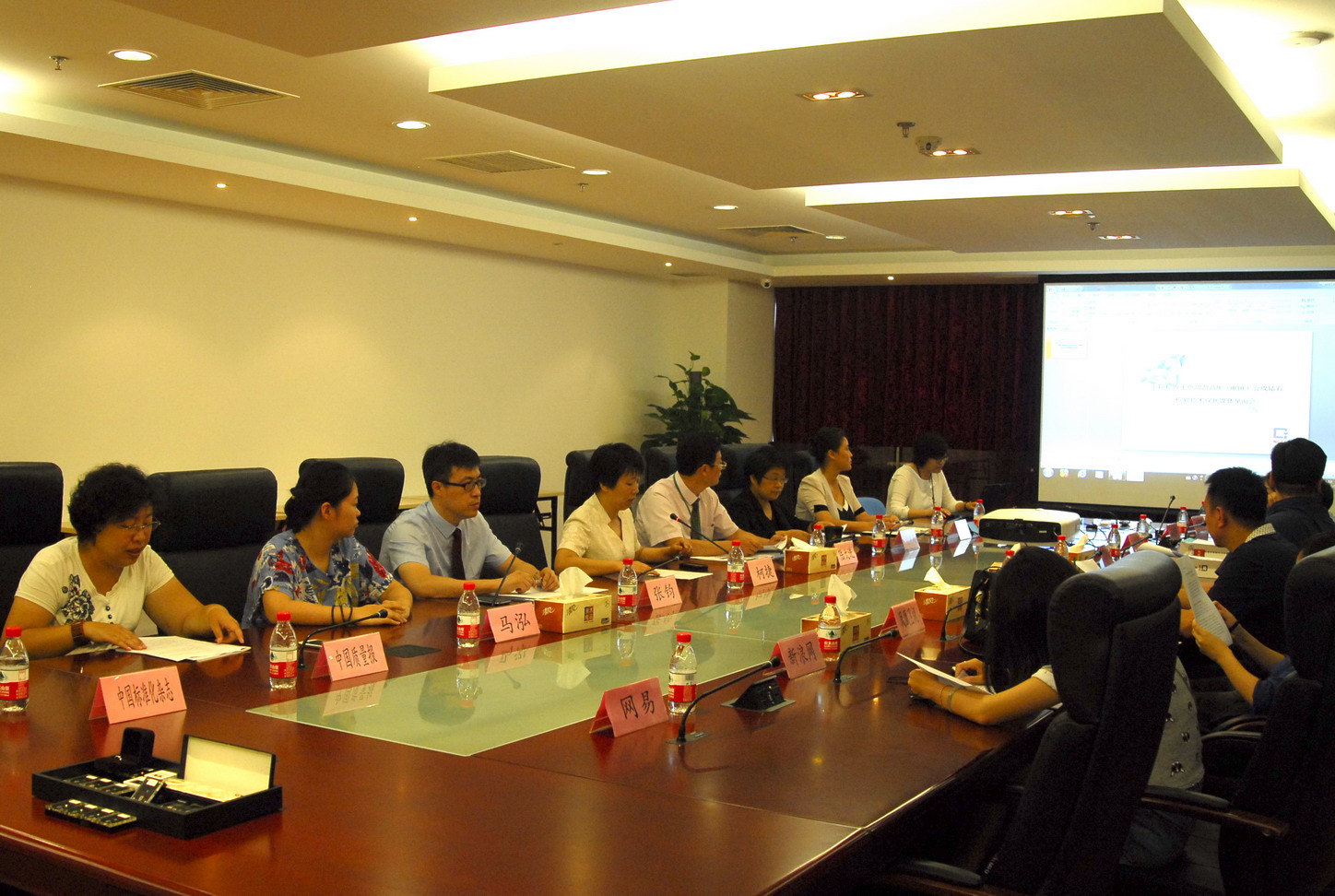 NGTC leaders and media representatives jointly discuss.
All sectors of society are joining forces to jointly promote the healthy development of the diamond market.
To better ensure the healthy and orderly development of the natural diamond market, the National Jewelry and Jade Quality Supervision and Inspection Center offers the following recommendations to industry practitioners, enterprises, and quality inspection agencies:
1 Buy diamonds from reputable companies and institutions.
A reliable supplier of diamond raw materials is particularly important in the diamond-related trade. It is essential to seek dependable sources of supply to ensure that the purchased diamond raw materials—whether loose diamonds or rough stones—are of consistent, high quality and fully traceable.
2 The enterprise itself establishes a screening and investigation agency.
Enterprises need to place great importance on product quality and pay close attention to quality control throughout the production process. Before introducing raw materials into the production line, enterprises should thoroughly inspect diamond raw materials to prevent synthetic diamonds from being inadvertently mixed in, thereby safeguarding their corporate reputation and brand image. By leveraging the spectral and magnetic characteristics of these synthetic diamonds, enterprises can employ simple yet effective inspection and screening methods—such as automated small-diamond analyzers (AMS) and magnets that detect the magnetic properties of metal inclusions—to identify and remove substandard diamonds efficiently.
Currently, the Automated Microscopic Screening System (AMS) is fully capable of detecting unmounted synthetic diamonds—including both CVD-grown and HPHT-grown synthetic diamonds—with an extremely high accuracy rate.
3 Enterprises that do not have the capability to conduct their own inspections must entrust qualified quality inspection agencies to carry out the inspection and screening.
For businesses lacking the necessary capabilities, it is still advisable to rely on competent jewelry and jade appraisal institutions to screen raw diamond materials in small particle form. This will help avoid unnecessary material waste after the finished products have been inspected, or prevent such materials from directly entering the market and damaging the company’s reputation.
4、 Recommendations for Quality Inspection Agencies
For inlaid jewelry, especially jewelry featuring pavé settings, magnetic testing, conventional infrared spectroscopy, ultraviolet-visible spectroscopy, and other large-scale instrumental techniques are highly effective. These synthetic diamonds can also be identified based on their characteristic UV fluorescence and luminescence images, as well as their magnetic properties.
In summary, jewelry and jade testing institutions need to strengthen specialized technical training for their staff, streamline and review the screening and selection processes, and ensure adequate allocation of basic instrumental resources (such as the AMS small-grain diamond detector, UV-Vis-NIR spectrometer, and DiamondView). TM Fluorescence detectors, X-ray fluorescence spectrometers, and other similar instruments are used to avoid potential missed or false detections during analysis, thereby ensuring the accuracy and reliability of the final conclusions.
[Editor's Attention]
NGTC National Jewelry and Jade Quality Supervision and Inspection Center
NGTC is a gemstone and jewelry quality inspection agency legally authorized by the Chinese government. For over 20 years, it has been dedicated to serving consumers and the jewelry industry at large, establishing a highly respected and authoritative reputation within China.
In 2011, NGTC first detected CVD-grown diamonds in routine testing and promptly made the discovery public. This played a positive role in purifying the domestic diamond market and protecting consumers’ rights and interests.
Previous page
Links:
Address: Room 909, 9th Floor, Science & Technology Building, Eastern Software Park, No. 90 Wensan Road, Hangzhou City, Zhejiang Province Telephone:0571-85115488

Scan with your phone
Open the mobile website