
浙江之源资产评估有限责任公司
Six Charts to Understand the NGTC Amber Identification Certificate
Release time:
2015-08-03
Source:
In recent years, amber has attracted widespread attention from consumers, and the market is rife with all sorts of methods for identifying the authenticity of amber—some of which are downright unconventional. The classic techniques passed down through folk tradition... “Saline Specific Gravity Method,” “Burn It and Smell the Aroma Method,” “Touch It—If Heated, It Gives Off a Fragrant Scent Method” ……Are these methods all useful?
We’ve really been trying hard to find and consult experts about reliable, naked-eye identification methods. But the experts always firmly emphasize: “Any naked-eye detection method can only be applied to a very narrow category of specimens—and when you move on to other imitation products, that same method might simply stop working. Even we ourselves are often amazed during our inspections: ‘Wow, this piece of plastic is made to look so much like amber!’ We can’t even guarantee that we ourselves can reliably distinguish between genuine and fake amber just by looking at it with the naked eye. That’s why we absolutely have to rely on scientific instruments to ensure the accuracy of our test results.”
Therefore, as consumers, the simplest approach is to ask for a certification certificate when making a purchase, carefully examine and understand the certificate, and know how to verify its authenticity—thus safeguarding our legitimate rights and interests.
Most important—look at the name.
The most important part of any certification is the “inspection conclusion”—it’s also listed as the first item in all the various sections of the certificate!
The common names for natural amber include: amber, honey amber, blood amber, golden amber, green amber, blue amber, insect amber, and plant amber.
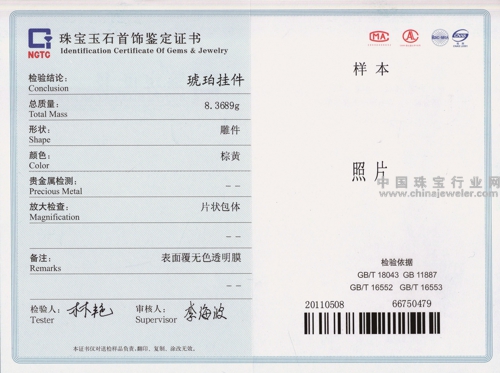
Amber Certificate
Amber
If the identification certificate you’ve received lists “amber” or “copal, blood amber, golden amber, green amber, blue amber, insect amber, or plant amber,” then congratulations! This is natural amber that has not been artificially treated.
Also, please pay attention to the notes—sometimes they’ll highlight certain optimization methods, such as applying a colorless, transparent film to the surface or undergoing compression treatment. These optimization techniques are widely accepted and fall within the normal range; you can rest assured when making your purchase.
They are solid pieces of amber, but they have been treated.
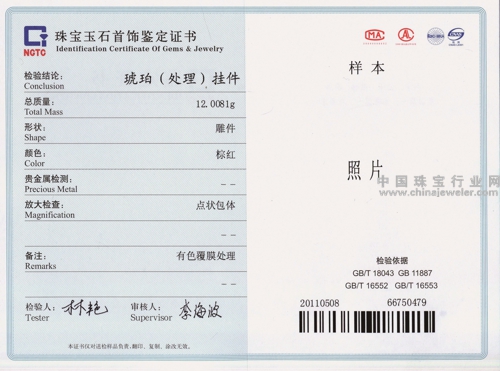
Amber (Treated) Certificate
Amber (treated)
If the term “Amber (treated)” or “XXX Amber” or “Amber XXX” (where XXX represents the name of the treatment method, such as dyeing, colored coating, filling, or heat-and-pressure color enhancement) appears in the “Inspection Conclusion,” it indicates that the item is still amber but has undergone treatments that may not be widely accepted. According to the national standard (GB/T 16552-2010, “Names of Jewelry and Jadeite”), dyeing, colored coating, filling, and heat-and-pressure color enhancement will be explicitly listed in the “Remarks” section. When making a purchase, consumers should pay close attention to the specific treatment methods used and consider whether they can accept them.
They are small pieces of amber (or fragments), but they’ve been put back together.

Recreated Amber Certificate
Recreated Amber
If you come across such an inspection result—duang!—it’s time to sound the alarm. This means that the amber has been artificially compressed from fragments or scraps of genuine amber. This type of amber is commonly referred to as “pressed amber.” At this point, be sure to pay close attention to the “Magnified Inspection” option in the certificate summary—it will reveal the internal structure of the amber.
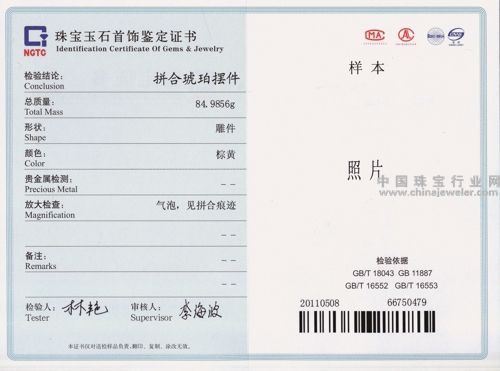
Amber mosaic
Amber mosaic
As the name suggests, when you see such a conclusion, it means the amber has been reassembled like a jigsaw puzzle. If the piece is examined under magnification, the certificate will reveal traces of joining. The materials used for joining may be partially or entirely amber itself.
They’re not amber at all!
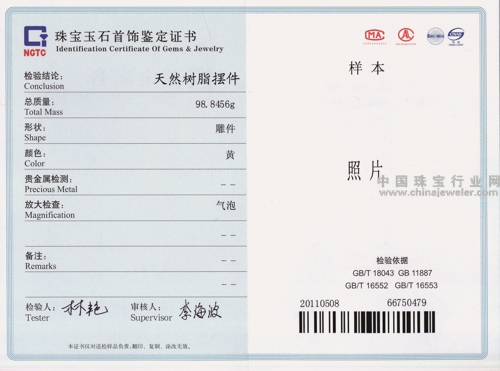
Natural resin
Natural resin
If the certificate states “natural resin,” it means that this sample has a relatively short fossilization age and hasn’t yet reached the stage of amber. However, it’s still natural! This distinction sets it apart from artificially produced amber imitations.
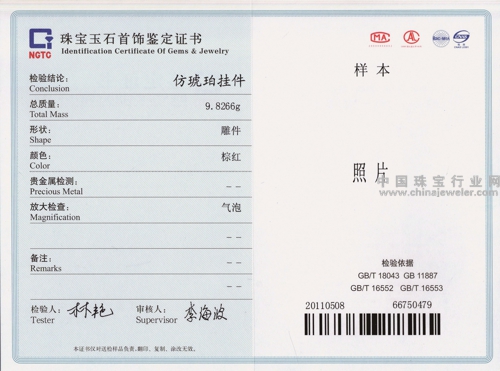
Amber imitation
Amber imitation
Seeing such a conclusion, you can be 100% certain that it’s not amber—it’s an artificial material that looks remarkably like amber, such as the most common member of the plastic family. These materials closely resemble amber in appearance, but given their wide variety, there’s no need to list them all individually. Just remember the inspection results and be cautious when making your purchase!
Tip: Check online to ensure the certificate is genuine and reliable.
The certificate from the National Gem and Jewelry Quality Supervision and Inspection Center (NGTC) can be verified online for authenticity:
Click here:
NGTC official website: www.ngtc.com.cn
China Jewelry Industry Network: www.chinajeweler.com
Links:
Address: Room 909, 9th Floor, Science & Technology Building, Eastern Software Park, No. 90 Wensan Road, Hangzhou City, Zhejiang Province Telephone:0571-85115488

Scan with your phone
Open the mobile website