
浙江之源资产评估有限责任公司
2017 China Mining Companies Ranking
Release time:
2017-09-19
Source:
2017-08-03 Sunshine Chuangyi
According to Fortune China, Fortune China released its latest Fortune China Top 500 list on July 31, Beijing time. The list was compiled in collaboration between Fortune (Chinese edition) and the Wealth Management Division of CICC, and it takes into account the performance and achievements of the largest Chinese publicly listed companies worldwide over the past year.
At the top of the list, we still see a three-way rivalry among Sinopec, PetroChina, and China Construction. The combined revenues of the first two companies exceed one-tenth of the total revenue generated by all 500 listed companies. Following closely behind these industry giants, SAIC Motor continues to maintain and even expand its lead as the domestic automaker with the highest sales volume. After making its debut in the top ten last year, China Ping An has once again climbed to fifth place this year, remaining firmly at the top of the insurance sector and the top position among non-state-owned enterprises.
For the 14th consecutive year, the number of Chinese companies on the list has grown, reaching 115 this year. Of these, 109 are based in mainland China (including Hong Kong but excluding Taiwan). Ten Chinese companies made their debut on the list this year: Anbang Insurance Group, Hengli Group, Sunshine Golden Control, Alibaba, Country Garden, Tencent, Suning Cloud Commerce, Xiamen C&D Group, China National Trade & Investment Corporation, and Xinjiang Guanghui. The industry with the most new entrants was trade (3 companies), followed by two companies from the internet services and retail sectors—Alibaba and Tencent. When it comes to real estate, people usually think of either Wanda or Vanke, but this year the landscape has changed. Greentree Group, thanks to its outstanding performance in 2016, has entered the Fortune Global 500 for the first time, ranking 23rd and immediately becoming the leader in China’s real estate industry. Another company that has drawn widespread attention also made its debut on the list—and landed at No. 112—namely SF Express, which boasts an extensive express delivery network.
In the mining and metallurgical sector, a total of 56 mining companies made it onto the Fortune 500 list. Among them, 21 were non-ferrous metal companies, 20 were steel companies, and 15 belonged to the coal industry. Comparing the total profits of the listed mining companies, the 15 coal enterprises achieved profits totaling 35.103 billion yuan—far exceeding those of the steel and non-ferrous metal companies. Among China’s coal, steel, and mining enterprises, China Metallurgical Science & Technology Group ranked highest, with revenues reaching 219.558 billion yuan and profits as high as 5.376 billion yuan. Of the 21 non-ferrous metal mining companies on the list, three reported losses: China Daye Nonferrous Metals, Minmetals Resources, and Yunnan Chihong Zinc & Germanium Co., Ltd.
1. In the nonferrous metals sector, China Minmetals Group ranked first and won the top spot.
Among the 21 listed non-ferrous mining companies, three reported losses: China Daye Nonferrous Metals, Minmetals Resources, and Yunnan Chihong Zinc & Germanium Co., Ltd. The company with the highest revenue was China Metallurgical Industry News & Technology Corporation, which also ranked highest this year, with revenues reaching 219.558 billion yuan and profits soaring to 5.376 billion yuan, placing it at No. 26 on the list.
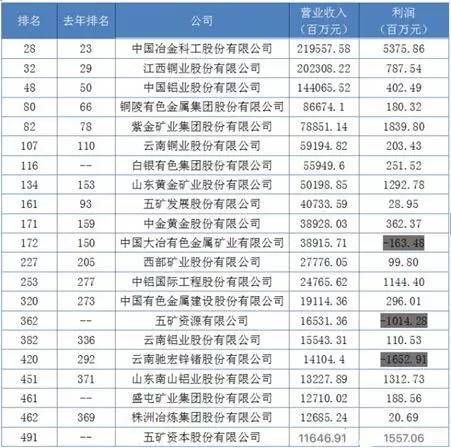
Five listed companies under China Minmetals Group made the list: China Metallurgical Science & Industry Technology Research Institute (28), China Minmetals Development (161), China Minmetals Resources (362), Zhuzhou Smelter Group (462), and China Minmetals Capital (491).
2. In the coal industry, China Shenhua took the top spot with a profit of 22.7 billion yuan.
Among the 14 listed coal companies that made a profit, one listed coal company—Yangmei Chemical—reported a loss. Its net loss for 2016 amounted to 908 million yuan. Overall, the rankings of the 15 listed mining companies declined compared to last year. The company with the highest profit was China Shenhua, with a profit of 22.712 billion yuan, placing it at No. 36 on the list.

3. In the steel industry, Baosteel leads by a wide margin in profitability.
This year, a total of 20 steel companies were selected, one fewer than last year (due to the full integration of Wugang Shares into Baosteel Shares). Among them, Baosteel Shares and Hebei Iron and Steel Shares both made it into the top 100. Shougang Shares delivered an outstanding performance, climbing 139 places to rank 156th.

Image source: China Iron and Steel News Network
Among the 20 listed steel companies, 18 achieved profitability, representing a 90% success rate—a significant improvement from last year’s 28.6%. The steel company with the highest profit was Baoshan Iron & Steel Co., Ltd., whose profit reached 8.9655 billion yuan; meanwhile, Fujian Sansteel Mingguang Co., Ltd. had the highest profit margin, at 6.56%.
4. Steel Profit Analysis
Who has been siphoning off the profits from the steel industry? The answer is that soaring iron-ore prices upstream have been matched by only limited increases in steel prices downstream, squeezing the profit margins of steel companies to the point where they can earn just five cents per kilogram of steel. According to data from Xiben New Line, the Platts 62% iron-ore index—a key industry benchmark—stood at $42.7 per ton on January 4, 2016, but by December 30, 2016, it had surged to $79.65 per ton, representing an increase of 86.53%. Entering 2017, the index continued its upward trajectory, reaching $95.05 per ton on February 21—a new high for the Platts 62% iron-ore index in the past 30 months. Meanwhile, the four major mining companies reported net profits of at least $13 billion in 2016, equivalent to roughly 89.7 billion yuan. The substantial profits earned by these four mining giants are closely tied to China’s economic recovery last year, which in turn is inseparable from the growth in real estate and infrastructure investment.
In response, an industry insider lamented: “Over 70% of the output from the four major mining companies is supplied to the Chinese market. Given their dazzling profits, it’s clear that they’ve squeezed the revenue right out of domestic steelmakers.” The author believes that, judging from the financial data released one after another by these four mining giants, they earned at least 89.7 billion yuan last year—far exceeding the over 40 billion yuan in profits reported by China’s steel companies last year, suggesting they’ve made far too much money. Last year, all four major mining companies managed to turn a profit from losses and saw their profits soar dramatically. It’s no exaggeration to say that these four mining giants have outperformed 500 Chinese steel companies.
Why have the four major mining companies managed to outperform 500 steel enterprises? It’s because Chinese steel companies are typically fragmented and operate independently, giving the mining companies greater leverage. Moreover, last year, with the recovery of the real estate and infrastructure sectors, demand for iron ore surged, allowing iron ore companies to achieve victory even without much effort. As for domestic steel companies struggling to escape the awkward situation of earning only half a dollar per ton of steel, in addition to aggressively continuing capacity reduction, most steel firms will likely need to focus on product upgrades—shifting from low-end manufacturing toward high-end steel products. Only by doing so can the steel industry’s rebound truly signify a genuine recovery.
Attachment: List of China's Top 500 Enterprises in 2017:


Source: Mining and Metallurgy Park
Links:
Address: Room 909, 9th Floor, Science & Technology Building, Eastern Software Park, No. 90 Wensan Road, Hangzhou City, Zhejiang Province Telephone:0571-85115488

Scan with your phone
Open the mobile website