
浙江之源资产评估有限责任公司
The mining industry is buzzing: China’s era of mining M&A has arrived.
Release time:
2016-05-11
Source:
Mining Industry 2016-05-11
The mining industry is boiling over.
Luoyang Molybdenum is about to take off!
The Logic Behind the $2.65 Billion Merger and Acquisition
The typhoon is coming—are you ready to soar together?
01
The mining industry is boiling over.
Today, the mining industry has been flooded with news about Luoyang Molybdenum.
U.S. mining giant Freeport-McMoRan announced on Monday that it has agreed to sell its entire stake in Tenke Fungurume, Congo’s largest copper-cobalt mine, to Luoyang Luanchuan Molybdenum Industry Group Co., Ltd. (referred to as “Luoyang Molybdenum”), for a cash consideration of US$2.65 billion. This marks the second major merger and acquisition deal struck by Luoyang Molybdenum Group in less than two weeks. At the end of last month, the group had just announced its acquisition of Anglo American’s niobium and phosphate assets in Brazil for US$1.5 billion.
Senior executives at Luoyang Molybdenum stated that now is the right time to seize high-quality assets from struggling Western competitors, and the company currently has over $4 billion in funds available for asset acquisitions.
02
Luoyang Molybdenum is about to take off!
Luoyang Molybdenum announced externally that this transaction has made the Group one of the world’s leading copper producers and the largest cobalt producer, while also adding a rare, world-class, producing copper-cobalt mine with significant growth potential to the Group’s asset portfolio. As a result, the Group’s asset portfolio has achieved regional diversification and secured a strategic foothold in the Central African Copperbelt.
Tenke is a world-class, producing copper-cobalt mine located in the Democratic Republic of the Congo, situated within the mineral-rich Central African Copperbelt. In 2015, Tenke produced 204,000 tons of copper metal and 16,000 tons of cobalt metal (on a 100% basis). The net cash cost of copper was approximately US$1.21 per pound. As of December 31, 2015, Tenke held proven and probable reserves totaling 3.8 million tons of copper metal and 500,000 tons of cobalt metal, which can support approximately 25 years of mining operations.
In addition, the proven and controlled reserves contain 13.1 million tons of copper metal and 1.3 million tons of cobalt metal, while the inferred reserves amount to 11.6 million tons of copper metal and 1.3 million tons of cobalt metal (based on a 100% recovery rate). This indicates tremendous potential for future development.
Relevant mining industry experts’ comments:
There’s nothing wrong with this mine—it’s been producing steadily for many years. In Kruvich, Katanga Province, the security situation is also pretty good. The only downside is that the timing for taking over the operation wasn’t ideal. Also, this mine is located deep inland, so there are transportation costs involved. In Kruvich, there are mines operated by China Railway and Glencore as well. I’ve spent many years there, and Zhejiang Huayou Cobalt is also operating there.
Eighteen Bronze Figures Review:
This is the finest asset Chinese mining professionals have acquired since China began its large-scale overseas expansion—a truly world-class asset, a world-class resource with copper grades that are unparalleled. Anyone who’s ever studied copper knows just how rich the copper deposits in the Democratic Republic of Congo are; even the tailings from our own mines probably don’t match the quality of this project’s ore. Moreover, this project boasts world-class operations—Freeport is the world’s premier non-state-owned copper company, undeniably holding the top spot globally.
More importantly, Luoyang Molybdenum acquired an asset that every mining company around the world has been coveting—at precisely the right time and at the right price. Just this alone is enough to make everyone take a second look. To reach this moment, Luoyang Molybdenum had been patiently preparing for two whole years. While others were busy doing this or that, Luoyang Molybdenum focused on one single thing—saving money.
Everyone can take a look at their financial statements: it’s the cash holdings—exceeding 15 billion RMB—that have enabled them to make decisive, rapid moves in the very short term, allowing them to acquire high-quality assets worth a total of 4 billion USD in one go. Among all companies—including state-owned enterprises—how many actually possess this kind of strength? During these two quiet years, Luomolybdenum hasn’t been idle either; they’ve reviewed numerous projects but haven’t made any acquisitions because the company has its own stringent criteria. They simply refuse to buy anything that doesn’t meet those standards, rigorously adhering to their established acquisition guidelines. They’re completely uninterested in coveting others’ deals. This level of composure alone is something that all domestic mining companies could—and should—study closely.
Finally, Luomolybdenum actually doesn't know whether commodity prices have already bottomed out—no one does. But right now, this position is relatively safe. The value of high-quality assets in production lies precisely in the fact that, by acting now, you can at least ensure that the project’s cash flow will cover its financial interest payments. And once prices start to rise, the potential gains will be enormous. For a bunch of mining companies that have been playing dead on the floor, having the courage to make a move is something everyone should learn from.
03
The Logic Behind the $2.65 Billion Merger and Acquisition
What has supported Luoyang Molybdenum’s recent acquisition? High-quality assets, a well-established industrial chain, and leveraging favorable government policies to go global...
These are all perspectives from a corporate standpoint; the real driving forces, however, lie in industry development and market demand. In 2014, China’s production and sales of new-energy vehicles experienced explosive growth, with output increasing by 479% year-on-year and sales rising by 425% year-on-year. In 2015, production and sales continued to thrive, with projections indicating year-on-year growth rates of 381% and 401%, respectively. In the lithium-battery sector, while China has many companies producing negative-electrode materials, there are very few firms specializing in positive-electrode materials such as niobium and cobalt—and China lacks pricing power in this area. The Tenke mine, recently acquired by Luoyang Molybdenum, accounted for approximately 16% of the global cobalt market share based on its 2015 cobalt production volume.
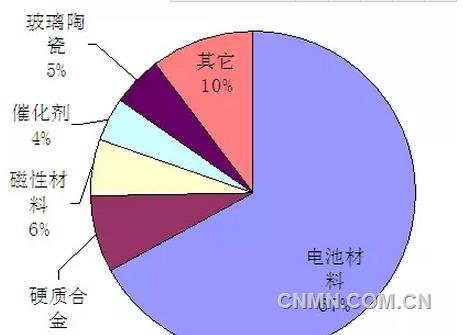
China's Cobalt Consumption Structure
According to the national development goals for new-energy vehicles, by 2020, China’s stock of electric vehicles will reach 5 million units, with an additional 2 million units added in 2020 alone. By 2025, the annual increase is expected to reach 3 million units. Undoubtedly, the development of new-energy electric vehicles will also boost demand in the cobalt market.
According to a forecast by Xingye Securities, by 2020, the demand for cobalt in lithium-ion batteries will reach 64,600 tons, of which approximately 27,900 tons will be driven by new energy vehicles. If calculated based on low-nickel NCM111, the demand for cobalt in lithium-ion batteries will rise to 171,600 tons by 2020.
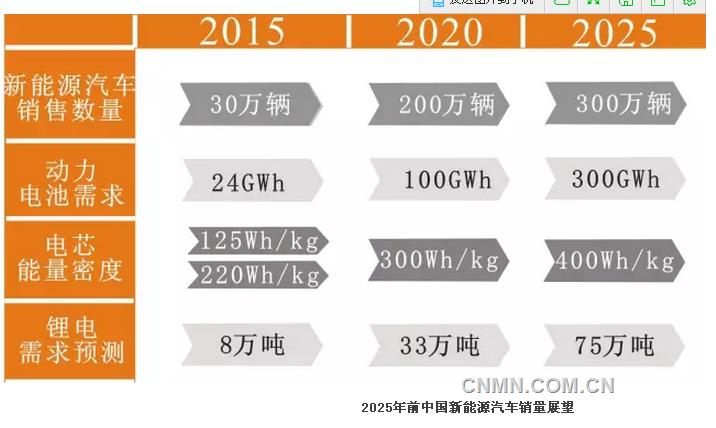
Outlook for China's New Energy Vehicle Sales by 2025
Global cobalt consumption is concentrated primarily in China, the United States, Japan, South Korea, and European Union countries. Among these, China accounts for more than 30% of global consumption. However, China’s cobalt reserves amount to only 1/90th of the world’s total, and just 1/42nd of those in the Democratic Republic of the Congo (DRC). Due to factors such as reduced mine production and the rapid growth of new-energy vehicles, cobalt is expected to experience a slight supply deficit this year—a trend that hasn’t been seen in recent years. As a result, cobalt prices are likely to rebound, potentially mirroring a smaller-scale version of the lithium market rally. This year, the cobalt market is forecast to see a supply-demand gap of 400 tons (with oversupply in the first half and undersupply in the second half)—the first time such a gap has emerged in recent years. In 2017, the supply-demand gap was even more pronounced, reaching an estimated 4,300 tons.
04
The typhoon is coming—are you ready to soar together?
Relying on an increasingly favorable policy environment, taking advantage of the opportune moment presented by asset depreciation, and armed with substantial capital resources, Chinese enterprises have unleashed an unprecedented wave of mergers and acquisitions in overseas markets.
Data shows that in 2015, Chinese enterprises’ overseas M&A deals totaled US$123.9 billion, surpassing the US$100 billion mark for the first time and marking the sixth consecutive year of growth in M&A deal value. According to a statistical report by PwC, last year Chinese companies carried out a total of 394 M&A deals in overseas markets, representing a 40% increase over the previous year and setting a new historical record. As a result, the number of ongoing overseas M&A deals involving Chinese enterprises reached 9,420. In the first two months of this year, global M&A deal volume fell by 23% year-on-year. However, Chinese companies initiated 102 overseas M&A deals, with transaction values totaling US$81.5 billion—compared to just 72 deals and US$11 billion in the same period last year. This figure not only exceeded any previous year’s record but also accounted for 47% of the global cross-border M&A market share. Based on these trends, two leading global consulting firms, Deloitte and PwC, have independently predicted that Chinese companies’ overseas M&A deal volume will grow by more than 50% this year compared to last year, and continue to maintain a 50% growth rate in the coming years. Without a doubt, an M&A storm originating from China has already begun sweeping across the globe.
In fact, over the past decade, the mining market has experienced two peaks—first from 2002 to 2008, and second from 2010 to 2012—and two troughs—first from 2008 to 2009, and second beginning in the second half of 2013, with no clear end date yet in sight. Yet regardless of whether the market is at a peak or a trough, Chinese enterprises’ interest in mineral resources worldwide has never waned—especially among private enterprises. The difference is that overseas iron ore and coal projects, once highly sought after by Chinese companies, may no longer be as popular; instead, gold and copper mines have taken their place.
April 2014
A consortium comprising China Minmetals Resources Co., Ltd., a subsidiary of China Minmetals Corporation, Guoxin International Investment Co., Ltd., and CITIC Metals Co., Ltd. has signed an equity acquisition agreement with Glencore for the Pampas Project.
May 2015
During the mining downturn, Zijin Mining successfully acquired large gold and copper mines from Barrick and Ivanhoe.
April 2016
China Gold Group Corporation and Canada’s Eldorado Gold Corporation have officially signed an agreement to acquire an 82% stake in the JinFeng Gold Mine in Guizhou Province.
April 2016
China Sichuan Road & Bridge Mining Investment & Development Company has officially acquired a 60% stake in Eritrea’s Asmara Mining Company, held by Canada’s Sunridge Gold Corporation, for US$65 million.
When talking about his own success, Lei Jun once said, “When the typhoon comes, even pigs can fly.” Today, the typhoon of overseas M&A by Chinese enterprises has already begun to take shape. For Chinese mining companies, this truly represents a rare opportunity—now it’s up to you: Will you choose to soar in the wind, or remain silent and stay grounded?
Links:
Address: Room 909, 9th Floor, Science & Technology Building, Eastern Software Park, No. 90 Wensan Road, Hangzhou City, Zhejiang Province Telephone:0571-85115488

Scan with your phone
Open the mobile website