
浙江之源资产评估有限责任公司
China’s largest overseas mining acquisition project has begun operations, after previously being halted due to local protests.
Release time:
2016-03-23
Source:
Sunshine Chuanyi Language Translation, March 22, 2016
According to a report by Xinhua Net from Nanjing on March 20, at around 5 p.m. that day, the first shipment of 11,330 tons of copper concentrate—produced after the completion and commissioning of the Bongas copper mine in Peru, which was jointly acquired by China Minmetals, China National Investment Holding, and CITIC Group at a total investment of 10.5 billion U.S. dollars—arrived smoothly at the Port of Nanjing. Reporters learned from the Huining Wharf in Nanjing that the copper concentrate delivered this time boasts a copper grade as high as 48.50% and an silver content of 293.00 g/MT, making it of exceptionally high quality—a premium copper mining asset acquired by China overseas.
“This marks a tangible achievement for what is, to date, the largest overseas acquisition project ever undertaken in China’s metal mining industry. It also signifies that Chinese enterprises’ efforts—responding to the central government’s call to ‘go global,’ establishing overseas resource bases, ensuring the supply of domestically scarce resources, and supporting the new framework for China-Latin America cooperation and a new model of capacity cooperation—have finally paid off,” said He Wenbo, Chairman and Party Secretary of China Minmetals Corporation.
Data shows that China is the world’s largest consumer of copper. However, its resource endowment is relatively poor, with severely insufficient copper reserves and low-grade ore. Jiao Jian, a member of the Party Leadership Group and Deputy General Manager of China Minmetals Corporation, told reporters, “Copper has become one of the most scarce bulk mineral commodities in China. Over the past decade, China’s reliance on foreign sources for copper has remained consistently above 75%, and monthly imports of copper concentrate have exceeded one million tons.”
Jiangxi Copper Co., Ltd. is the buyer of this batch of copper concentrate resources. Deng Hualiang, General Manager of the company’s Commercial Operations Department, stated that the Bumbas copper mine provides China with a substantial and long-term stable supply of copper resources. Currently, only 10% of the mine’s total area has been explored, yet the identified copper reserves already exceed 10 million tons—equivalent to one-eighth of China’s total domestic reserves. After the project goes into production, the average annual copper output over the first five years will be approximately 450,000 tons, representing 20% of China’s total domestically produced copper in 2015.
The Bangpes Project boasts a significant investment-driven ripple effect, creating win-win outcomes for multiple stakeholders. The Bangpes copper mine is a large-scale construction project that is highly intensive in terms of mining machinery, equipment, and technology, generating enormous demand for such equipment. In collaboration with Chinese equipment suppliers, the project is “going global,” and this year will see U.S.$100 million worth of domestically produced equipment exported overseas. Most of the project’s products are transported by Chinese shipping companies, making a substantial contribution to the development of China’s transportation industry. The refined copper concentrate produced by the project is delivered by China Minmetals Corporation to leading domestic smelting enterprises such as Jiangxi Copper Co., Ltd., fostering strong partnerships that ensure the full utilization of high-quality resources and a stable supply of refined copper concentrate needed by these smelters.
“As Peru’s largest-ever investment project to date, the Tambopata copper mine will propel Peru to become the world’s second-largest copper producer,” said He Wenbo. Over the next 10 years, the Tambopata project is also expected to boost Sino-Latin American trade by US$30 billion and attract an additional US$4 billion in investment for subsequent mine development.
“The successful commissioning of the Antamina project and the smooth return of copper concentrate resources will effectively alleviate China’s current shortage of domestic copper resources and significantly enhance our country’s strategic capacity to secure copper supplies,” said He Wenbo. “The Antamina project has achieved its goals of being completed and put into operation on schedule and within budget, and of delivering copper concentrate to China as planned. This signifies that Chinese companies now possess world-class competitiveness in the construction, commissioning, and operation of large-scale overseas mining projects, thereby genuinely strengthening China’s influence in the international copper market.”
At the end of September last year, The Bumbas project experienced a brief suspension of operations due to protests by residents in southern Peru.
The incident occurred on September 28, 2015, local time, in the Apurimac region of Peru, where protests against local mining activities led to a violent clash between local police and protesters.
Following the incident, Peruvian President Humala declared a 30-day state of emergency in the southern Andean highlands on September 29, 2015. The military began conducting patrols, and the state of emergency will be enforced in six provinces across the Apurímac region and the neighboring Cusco region.
According to an announcement released by Minmetals Resources Co., Ltd. on October 6, 2015, Peruvian authorities have now confirmed that the protests held on September 28 and 29, 2015 resulted in 3 deaths and 16 injuries. A notice on the official website of the Minmetals Group also indicated that this incident has had a direct impact on the Antamina copper mining project.
A source familiar with the Bangbas Project responded on October 9, 2015: “This protest wasn’t directed at the MMG Group or the project itself; rather, it was aimed at certain aspects of the local government’s work in the community. However, this incident did affect us—we experienced a brief suspension of operations, but we’ve now largely resumed normal activities.”
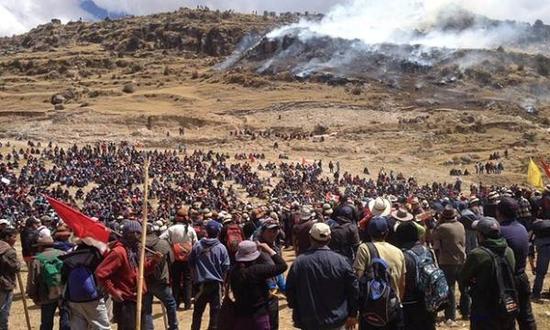 Conflict Scene
 Following this incident, the issue of risks associated with Chinese-funded enterprises’ overseas investments has once again sparked widespread debate. Speaking to The Paper, a researcher specializing in overseas investment said, “Currently, there are two main types of risks associated with overseas investments: one is political risk, which primarily includes foreign exchange controls, government expropriation and currency conversion restrictions, as well as war and civil unrest; the other is commercial risk, which involves a wide range of issues—for example, a lack of understanding of local environmental policies, or failure to factor in many relevant considerations when preparing project budgets.”
Previous page
Links:
Address: Room 909, 9th Floor, Science & Technology Building, Eastern Software Park, No. 90 Wensan Road, Hangzhou City, Zhejiang Province Telephone:0571-85115488

Scan with your phone
Open the mobile website