
浙江之源资产评估有限责任公司
2018-2022 China Graphite Electrode Market Forecast and Analysis
Release time:
2018-06-27
Source:
CIC Investment Consulting Network, 2018-05-21
Factor Analysis
I. Favorable Factors
(1) Downstream electric furnace steel enjoys considerable profits, leading to strong demand for graphite electrodes.
Starting from the fourth quarter of 2016, as the supply-side reform policies in the steel industry were advanced, cracking down on "di tiao gang" (illegal, substandard steel) quickly became a top priority for eliminating outdated production capacity. On January 10, 2017, the deputy director of the National Development and Reform Commission stated at the 2017 Council Meeting of the China Iron and Steel Association that all "di tiao gang" must be completely eliminated by June 30, 2017. In 2017, China's total electric furnace steel capacity was approximately 120 million tons, of which about 86.6 million tons were in operation, while around 15.6 million tons were temporarily shut down. As of the end of October 2017, the capacity of electric arc furnaces that had resumed or restarted operations reached approximately 26.5 million tons, with about 30% of this capacity having been restored. Affected by the capacity reduction efforts targeting medium-frequency furnaces, electric furnace steel production has become more active, and the economic benefits of electric furnace steel have become increasingly evident. Consequently, demand for high- and ultra-high-power graphite electrodes used in electric furnace steel production has surged, and buyers have shown heightened enthusiasm for procurement.
(2) There is a significant gap in the international market for graphite electrodes.
In recent years, amid an unfavorable macroeconomic environment, six globally renowned graphite electrode manufacturers have successively shut down operations. Some companies have even dismantled part of their equipment, making it extremely difficult to resume production. As a result, the capacity gap has reached nearly 200,000 tons, leading to a situation of supply shortage in the international market. Currently, driven by robust global demand, both volume and prices for exports are rising—indeed, some overseas customers have even proactively requested higher prices in order to secure supplies.
In 2017, China’s graphite electrode production reached 590,900 tons, representing a substantial year-on-year increase of 17.22%. In the same year, China’s graphite electrode exports totaled 237,300 tons, up sharply by 47.39% over the previous year. Consequently, China’s apparent consumption of graphite electrodes in 2017 was 353,600 tons, with a modest year-on-year growth of only 3.06%. This indicates that domestic demand for graphite electrodes had limited impact on boosting production levels. Instead, the growing demand from overseas electric arc furnaces emerged as the primary driver behind the expansion of China’s graphite electrode production.
(3) Intensive environmental inspections have led to a supply-demand imbalance that will be difficult to ease in the short term.
1
II. Adverse Factors
(1) Environmental protection inspections limit graphite electrode production.
As environmental protection becomes increasingly important, relevant national authorities have adopted a series of measures to reduce emissions, combat smog, and safeguard the environment. Since the fourth quarter of 2016, the Ministry of Environmental Protection has conducted intensified inspections on air pollution control in 28 cities across the Beijing-Tianjin-Hebei region and its surrounding areas—a campaign that ranks as the largest-scale operation ever directly organized by the national government in China’s history of environmental protection efforts. On May 18, 2017, the Ministry of Environmental Protection issued another notice titled “Announcement on Implementing Special Emission Limits for Air Pollutants in the Beijing-Tianjin-Hebei Region and Surrounding Areas.” These environmental inspections will become even stricter, cover a broader scope, and carry greater intensity, with the primary focus on four provinces: Hebei, Henan, Shandong, and Shanxi. These four provinces happen to be major carbon-producing regions where carbon enterprises are particularly concentrated; thus, the impact on carbon production is readily foreseeable.
(2) The production cycle for graphite electrodes is relatively long, resulting in a delayed response to market changes.
In previous years, due to poor profit margins for graphite electrodes, most companies had been reducing production, leaving them unprepared for the sudden surge in demand in the graphite electrode market. Starting from March 2017, companies began increasing their output, with supplies gradually entering the market around September and October. Consequently, as we entered the fourth quarter, the graphite electrode market experienced a rapid downturn. However, when the heating season arrived and Henan, Hebei, and Shandong provinces imposed production restrictions and shutdowns, graphite electrode prices started to rebound once again.
(3) Low capacity utilization rate of domestic graphite electrode production.
As of May 2017, China had 42 enterprises with graphite electrode production capacities exceeding 10,000 tons, with a total capacity of approximately 1.1 million tons. These enterprises are mainly located in regions including North China, Central China, East China, Northeast China, and Northwest China. Among these, North China is the region with the highest concentration of graphite electrode production capacity in China, hosting 15 enterprises (each with a capacity exceeding 10,000 tons, the same applies hereinafter), with a total capacity of 327,000 tons, accounting for 29.5% of the country’s total capacity. Most of these enterprises are small- and medium-sized. Next is the Northeast region, which has 6 graphite electrode enterprises and a total capacity of 240,000 tons, representing 22% of the national capacity. Among them, Jilin Carbon accounts for 120,000 tons, or half of the regional capacity (the 60,000-ton Changchun base has already been completely shut down). Following that is the Northwest region, with 3 graphite electrode enterprises and a total capacity of 155,000 tons, accounting for 14% of the national capacity. The leading enterprise in this region is Fangda Carbon’s Lanzhou headquarters, with a capacity of 130,000 tons. Additionally, Central China and East China have capacities of 150,000 tons and 154,000 tons, respectively. In terms of output, China’s graphite electrode production reached 500,000 tons in 2016, and from January to May 2017, production totaled 215,000 tons. Overall, the national capacity utilization rate remained below 50%.
Production forecast
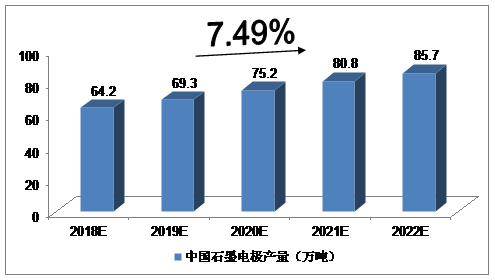
In 2017, China’s graphite electrode production reached 590,900 tons, representing a substantial year-on-year increase of 17.22%. We forecast that China’s graphite electrode production will reach 642,000 tons in 2018. Over the next five years (2018–2022), the average annual compound growth rate is expected to be around 7.49%, and by 2022, graphite electrode production is projected to reach 8.57 million tons.
The chart shows Zhongtou Consultants’ forecast for China’s graphite electrode production from 2018 to 2022.
Links:
Address: Room 909, 9th Floor, Science & Technology Building, Eastern Software Park, No. 90 Wensan Road, Hangzhou City, Zhejiang Province Telephone:0571-85115488

Scan with your phone
Open the mobile website