
浙江之源资产评估有限责任公司
Analysis of Gold Price Trends in June 2016
Release time:
2016-07-25
Source:
International Market Commodity Price Network
I. Overview of the June Gold Price Trend
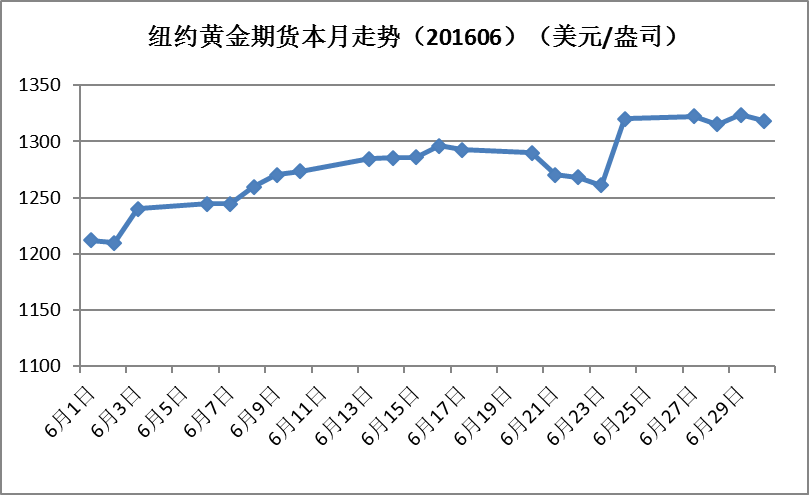
6 Gold prices on the New York Mercantile Exchange showed an upward trend this month. The June futures contract for gold on the New York Mercantile Exchange closed at $1,211.9 per ounce on June 1 and at $1,318.4 per ounce on June 30, representing an 8.79% increase from the beginning of the month to the end of the month. The highest gold price this month was recorded on June 29, closing at $1,323.9 per ounce, while the lowest price was on June 2, closing at $1,209.8 per ounce. (See the chart below for details.)
II. Reasons for the Fluctuations in Gold Prices in June
First, Brexit is the primary reason for the rise in gold prices.
With the dust settling on the UK’s Brexit referendum, the public has ultimately chosen to leave the European Union, forcing Prime Minister Cameron to resign and dealing the gravest blow yet to the post-World War II project of European unity.
Following the UK’s Brexit referendum, which sent shockwaves through global markets and triggered economic and political uncertainty, gold prices surged by as much as 8% on the 24th, reaching their highest level in over two years—a gain that marked the largest increase since the global financial crisis of 2008. At one point, gold prices climbed to $1,358.20 per ounce.
Second, the global stock market decline has led to a rise in gold prices.
Global stock markets declined, with Asian stock markets recording their largest drop in over four months on the 13th. The yen rose as high-risk assets came under pressure, boosting gold prices. On the 13th, gold closed at $1,284.4 per ounce, reaching a four-week high.
Third, the decline of the U.S. dollar continues to drive up gold prices.
Ahead of major central bank meetings and the UK’s Brexit referendum, aided by declining U.S. Treasury yields and a weaker dollar, risk assets such as stocks and the British pound were sold off. Investors have almost completely ruled out the possibility of the Federal Reserve raising interest rates at its policy meeting. Demand for safe-haven assets has surged, and gold—typically viewed as a hedge against economic and financial risks—has continued to rise, following the upward trend of other safe-haven assets like U.S. Treasuries.
Fourth, weaker-than-expected U.S. employment data boosted gold prices.
Due to U.S. employment data falling far short of expectations—U.S. job growth in May was the slowest in more than five and a half years—with significant declines in manufacturing and construction employment, indicating a cooling labor market and a sharp drop in nonfarm payrolls, this has helped boost gold prices.
III. Overview and Forecast of Gold Price Trends
Following the announcement of the UK’s referendum results, stock markets, bond markets, and foreign exchange markets all suffered heavy losses. As a result, demand for gold—a safe-haven asset—rose sharply, driving June gold prices up by 8.7%. In the first half of this year, gold prices have already surged by 24.4%. However, with expectations that U.S. employment data reports and further monetary stimulus measures from central banks will ease the situation, the sharp upward trend in New York gold futures prices is likely to moderate in July.
Links:
Address: Room 909, 9th Floor, Science & Technology Building, Eastern Software Park, No. 90 Wensan Road, Hangzhou City, Zhejiang Province Telephone:0571-85115488

Scan with your phone
Open the mobile website