
浙江之源资产评估有限责任公司
Statistical Bulletin on National Economic and Social Development 2015 (Part II)
Release time:
2016-03-10
Source:
11. Health and Social Services
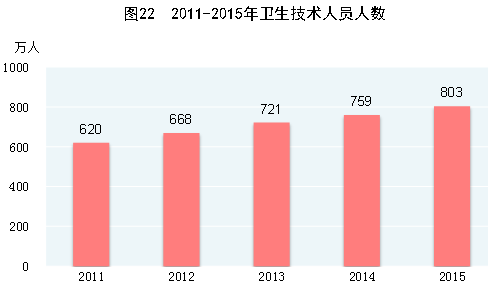
At the end of the year, the country had a total of 990,248 medical and health institutions, including 27,215 hospitals, 36,869 township health centers, 34,588 community health service centers (stations), 195,866 clinics (health stations and medical offices), 644,751 village health rooms, 3,492 disease prevention and control centers, and 3,097 health supervision institutes (centers). There were 8.03 million health technicians, including 3 million practicing physicians and practicing assistant physicians, and 3.28 million registered nurses. The total number of hospital beds in medical and health institutions was 7.08 million, of which 5.34 million were in hospitals and 1.21 million were in township health centers.
At the end of the year, there were 32,000 social service institutions nationwide providing various types of accommodation, including 28,000 elderly care service institutions. The number of social service beds is... [47] 6.763 million beds, including 6.698 million nursing care beds. At year-end, there were a total of 24,000 community service centers and 125,000 community service stations.
XII. Resources, Environment, and Safe Production
Total supply of state-owned construction land nationwide for the year [48] 530,000 hectares, a decrease of 12.5% over the previous year. Among these, land for industrial, mining, and warehousing purposes totaled 120,000 hectares, down 15.2%; real estate land... [49] 120,000 hectares, down 20.9%; other land uses, including infrastructure, totaled 290,000 hectares, down 7.1%.
The total annual water resources amounted to 2,830.6 billion cubic meters. The average annual precipitation was 644 millimeters. At year-end, the total reservoir storage in the 614 large reservoirs monitored nationwide reached 364.5 billion cubic meters, essentially unchanged from the level at the end of the previous year. Total water consumption for the year totaled 618 billion cubic meters, an increase of 1.4% over the previous year. Among these, domestic water use rose by 3.1%, industrial water use by 1.8%, agricultural water use by 0.9%, and ecological replenishment by 1.7%. Water consumption per 10,000 yuan of GDP... [50] 104 cubic meters, down 5.1% from the previous year. Water consumption per 10,000 yuan of industrial value added was 58 cubic meters, a decrease of 3.9%. Per capita water consumption was 450 cubic meters, up 0.9% from the previous year.
Throughout the year, 6.32 million hectares of afforestation were completed, of which 2.42 million hectares were planted under key forestry ecological projects, accounting for 38.2% of the total afforestation area. By year-end, the number of nature reserves reached 2,740, including 428 national-level nature reserves. An additional 54,000 square kilometers of land were treated to control soil and water erosion, and an additional 20,000 square kilometers of areas previously affected by soil and water erosion were placed under protective closure.
The annual average temperature is 10.5℃, and a total of six typhoons made landfall.
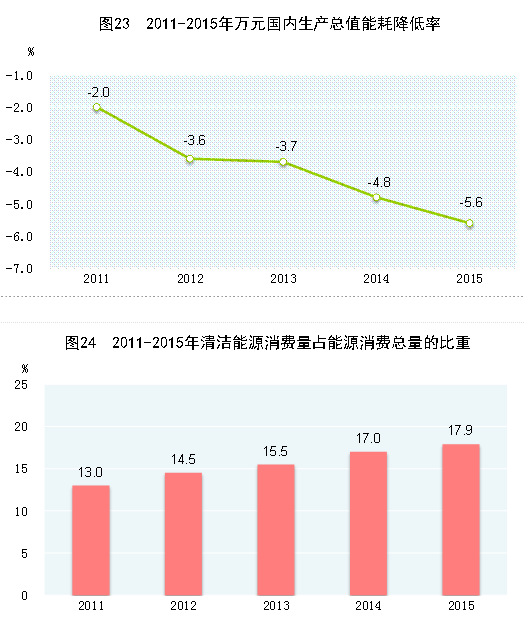
Preliminary calculations show that total energy consumption for the year reached 4.30 billion tons of standard coal, an increase of 0.9% over the previous year. Coal consumption declined by 3.7%, while crude oil consumption rose by 5.6%, natural gas consumption grew by 3.3%, and electricity consumption increased by 0.5%. Coal accounted for 64.0% of total energy consumption, whereas consumption of clean energy sources—including hydropower, wind power, nuclear power, and natural gas—made up 17.9% of total energy consumption. Nationally, energy consumption per 10,000 yuan of GDP fell by 5.6%. For industrial enterprises, comprehensive energy consumption per ton of crude copper decreased by 0.79%, comprehensive energy consumption per ton of steel fell by 0.56%, comprehensive energy consumption per ton of caustic soda dropped by 1.41%, comprehensive energy consumption per ton of cement declined by 0.49%, and standard coal consumption per kilowatt-hour of thermal power generation fell by 0.95%.
Ten Major River Basins [51] Among the 700 water quality monitoring sections, the proportion of sections with Class I to III water quality reached 72.1%, while the proportion of sections with water quality below Class V accounted for 8.9%. Overall, the water quality in the ten major river basins remains mildly polluted, and the water quality has remained stable.
Among the 301 seawater quality monitoring sites in nearshore waters, 70.4% met the national Class I and Class II seawater quality standards, 7.6% were classified as Class III, and 21.9% were classified as Class IV or worse.
Among the 338 cities monitored, 21.6% met the air quality standards, while 78.4% did not meet the standards.
Among the 321 cities monitored, 4.0% had good urban acoustic environmental quality, 68.5% had relatively good quality, 26.2% had average quality, 0.9% had poor quality, and 0.3% had very poor quality.
By year-end, the daily wastewater treatment capacity of urban sewage treatment plants reached 137.84 million cubic meters, an increase of 5.3% over the previous year-end. The urban wastewater treatment rate rose to 91.0%, up 0.8 percentage points. The harmless treatment rate for urban domestic waste reached 92.5%, an increase of 0.7 percentage points. The area covered by centralized urban heating services totaled 6.42 billion square meters, representing a growth of 5.1%. The green space area in built-up urban areas reached 1.89 million hectares, up 3.7%; the green space coverage rate in built-up areas climbed to 36.3%, an increase of 0.05 percentage points; and the per capita park green space area stood at 13.16 square meters, an increase of 0.08 square meters.
Throughout the year, the area of crops affected by disasters reached 21.77 million hectares, of which 2.23 million hectares suffered complete crop failure. The total direct economic losses caused by floods and geological disasters throughout the year amounted to 92 billion yuan; those caused by drought totaled 48.6 billion yuan; those caused by low temperatures, freezing, and snowstorms totaled 8.9 billion yuan; and those caused by marine disasters totaled 7.2 billion yuan. In the mainland region, there were a total of 14 earthquakes of magnitude 5 or higher throughout the year, 12 of which resulted in disasters, causing direct economic losses of 18 billion yuan. Throughout the year, a total of 2,936 forest fires occurred, affecting 13,000 hectares of forestland.
A total of 66,182 people died in various types of production safety accidents throughout the year. The number of deaths from production safety accidents per 100 million yuan of GDP was 0.098, down 8.4% from the previous year. The number of deaths from production safety accidents per 100,000 employees in industrial, mining, commercial, and trade enterprises was 1.071, a decrease of 19.4%. The number of deaths from road traffic accidents per 10,000 vehicles was 2.1, down 4.5%. The number of deaths per million tons of coal mined was 0.162, a decrease of 36.5%.
Note:
[1] The data presented in this bulletin are preliminary statistics. All statistical figures exclude the Hong Kong Special Administrative Region, the Macao Special Administrative Region, and Taiwan Province. Due to rounding, some data may not exactly match the sum of their component parts.
[2] The absolute figures for GDP, value added in each industry, and per capita GDP are calculated at current prices, while the growth rates are calculated at constant prices.
[3] Gross National Income, formerly known as Gross National Product, refers to the total amount of primary income distributed to all resident units in a country or region over a given period. It is equal to Gross Domestic Product plus net factor income from abroad.
[4] The population separated from their household registration refers to those whose place of residence differs from the township or subdistrict where their household registration is located, and who have been away from their registered place of residence for six months or longer.
[5] The floating population refers to the population separated from their household registration, excluding those who are separated within the administrative boundaries of a city. The population separated within the administrative boundaries of a city refers to those whose place of residence and registered household address are located in different townships or subdistricts within the jurisdiction of a municipality directly under the central government or a prefecture-level city.
[6] At the end of 2015, the population aged 0-14 (including those under 15 years old) was 227.15 million, and the population aged 15-59 (including those under 60 years old) was 925.47 million.
[7] The annual number of migrant workers includes two groups: migrant workers who have been employed outside their hometowns for six months or more during the year, and local migrant workers who have been engaged in non-agricultural industries within their hometowns for six months or more.
[8] Total factor productivity is the ratio of gross domestic product (calculated at 2010 prices) to the total number of employed persons.
[9] The producer price of agricultural products refers to the price at which agricultural producers sell their products directly.
[10] Housing prices include the costs of building and renovation materials, housing rents, owner-occupied housing, as well as utilities such as water, electricity, and fuel.
[11] In accordance with the requirements for improving the government budget system, in 2015, 11 government funds—those used to provide basic public services and primarily intended for personnel and institutional operations—were transferred from government funds budgets to the general public budget. To this end, the impact of transferring these 11 government funds to the general public budget must be deducted when calculating the growth rate on a comparable basis.
[12] The six high-energy-consuming industries include petroleum processing, coking and nuclear fuel processing, manufacturing of chemical raw materials and chemical products, non-metallic mineral products industry, ferrous metal smelting and rolling industry, non-ferrous metal smelting and rolling industry, and the electricity and heat production and supply industry.
[13] High-tech manufacturing includes pharmaceutical manufacturing, manufacturing of aircraft and aerospace vehicles and equipment, manufacturing of electronic and telecommunications equipment, manufacturing of computer and office equipment, manufacturing of medical instruments and apparatus, and manufacturing of information chemicals.
[14] The equipment manufacturing industry includes the metal products industry, the general equipment manufacturing industry, the special equipment manufacturing industry, the automobile manufacturing industry, the railway, shipbuilding, aerospace, and other transportation equipment manufacturing industry, the electrical machinery and equipment manufacturing industry, the computer, communications, and other electronic equipment manufacturing industry, and the instrument and meter manufacturing industry.
[15] Natural gas includes gas field natural gas, oilfield natural gas (which is further divided into gas from oil reservoirs and dissolved gas associated with oil fields), and coalbed methane (also known as coalbed gas).
[16] The steel production data include approximately 344 million tons of steel that has been repeatedly processed among different enterprises.
[17] Small-scale power generation capacities (such as geothermal energy) are not listed in the text.
[18] The aggregate figure for fixed-asset investment calculated by region—eastern, central, western, and northeastern—falls short of the national total because some cross-regional investments have not been included in the regional data. Specifically, the eastern region comprises the 10 provinces (and municipalities) of Beijing, Tianjin, Hebei, Shanghai, Jiangsu, Zhejiang, Fujian, Shandong, Guangdong, and Hainan; the central region comprises the 6 provinces of Shanxi, Anhui, Jiangxi, Henan, Hubei, and Hunan; the western region comprises the 12 provinces (autonomous regions and municipalities) of Inner Mongolia, Guangxi, Chongqing, Sichuan, Guizhou, Yunnan, Tibet, Shaanxi, Gansu, Qinghai, Ningxia, and Xinjiang; and the northeastern region comprises the 3 provinces of Liaoning, Jilin, and Heilongjiang.
[19] Infrastructure investment refers to expenditures on the construction or acquisition of projects and facilities that provide basic, public services for social production and daily life. In this article, infrastructure investment includes investments in transportation and postal services, telecommunications, radio and television, and satellite transmission services, the internet and related service industries, as well as investments in water conservancy, environmental protection, and public utilities management.
[20] Private fixed-asset investment refers to investments made by domestic enterprises and institutions of collective, private, or individual ownership, as well as by enterprises controlled by such entities (including those with absolute control and relative control), for the construction or acquisition of fixed assets.
[21] Investment in high-tech industries includes investment in six major categories of high-tech manufacturing—such as pharmaceutical manufacturing and aerospace vehicle and equipment manufacturing—and investment in nine major categories of high-tech services—such as information services and e-commerce services.
[22] Real estate investment, in addition to real estate development investment, also includes housing constructed by the construction entities themselves, as well as property management, agency services, and other types of real estate investments.
[23] High-speed railways are railways with a maximum operating speed of 200 kilometers per hour or higher.
[24] Online retail sales refer to the retail sales of goods and services realized through public online trading platforms (including self-built websites and third-party platforms). Among these, service-based products included in online retail sales, as well as a small portion of goods used for production and business purposes or resold, are not counted in the total retail sales of consumer goods.
[25] Goods trade and foreign investment absorption are priced in RMB. Due to technical reasons, service trade, outbound investment, and overseas contracting projects still primarily use the U.S. dollar for pricing.
[26] The statistics on imports and exports of services are compiled according to the standards set forth in the “Balance of Payments Manual (Sixth Edition)” and exclude government services. Growth rates are calculated using comparable bases.
[27] The “Belt and Road” refers to the “Silk Road Economic Belt” and the “21st-Century Maritime Silk Road.”
[28] In 2015, the calculation methods and statistical definitions for highway passenger and freight volumes and turnover volumes were revised; growth rates are calculated using comparable bases.
[29] The total volume of postal and telecommunications services is calculated at 2010 prices.
[30] The capacity of a mobile telephone switch refers to the maximum number of users that the mobile telephone switch can simultaneously serve, as calculated based on a specific traffic model and the switch’s processing capabilities.
[31] Fixed broadband internet access subscribers refer to users registered with telecom operators at the end of the reporting period, who access the public internet via xDSL, FTTx+LAN, FTTH/0, and other broadband access technologies as well as dedicated lines.
[32] Mobile broadband subscribers refer to users who, as of the end of the reporting period, have usage information recorded in the billing system and are currently connected to the network, occupying 3G or 4G network resources.
[33] The number of mobile internet users refers to the number of Chinese residents aged 6 and above who have accessed and used the internet via mobile phones over the past six months.
[34] The software and information technology services industry includes sectors such as software development, information system integration services, information technology consulting services, data processing and storage services, integrated circuit design services, and other information technology services.
[35] The incremental scale of social financing refers to the total amount of funds that the real economy obtains from the financial system over a given period.
[36] A non-public offering, also known as a targeted offering, does not include any portion subscribed with assets.
[37] Corporate credit bonds include debt financing instruments issued by non-financial enterprises, corporate bonds, and corporate notes, as well as convertible bonds.
[38] Original insurance premium income refers to the premium income from original insurance contracts recognized by insurance enterprises.
[39] The median per capita income refers to the per capita income of the household located exactly in the middle when all surveyed households are arranged in ascending (or descending) order according to their per capita income levels.
[40] Rural Five-Guarantees Support refers to the living care and material assistance provided to villagers who are elderly, disabled, or under the age of 16—villagers who are unable to work, have no source of livelihood, and have no legally obligated caregivers for support, maintenance, or upbringing; or whose legally obligated caregivers lack the ability to provide such support, maintenance, or upbringing—in terms of food, clothing, housing, medical care, and funeral arrangements.
[41] Secondary vocational education includes regular secondary vocational schools, adult secondary vocational schools, vocational high schools, and technical schools.
[42] The National Emerging Industries Venture Capital Program refers to activities aimed at fostering and promoting the development of emerging industries by leveraging special central government funds—either through co-founding venture capital firms together with local government funds and social capital, or by directly investing in start-up enterprises via equity investment models.
Links:
Address: Room 909, 9th Floor, Science & Technology Building, Eastern Software Park, No. 90 Wensan Road, Hangzhou City, Zhejiang Province Telephone:0571-85115488

Scan with your phone
Open the mobile website