
浙江之源资产评估有限责任公司
After a sharp drop in July, the China Iron Ore Price Index (CIOPI) has rebounded somewhat, but is expected to continue exhibiting volatile trends in the coming period.
Release time:
2015-09-07
Source:
China Metallurgical Mining Network, Date: 2015.8.05
Affected by Steel Due to oversupply in the market and the continuous decline in steel prices, 7 In the early part of the month, iron ore prices experienced a sharp decline. However, as steel production remained at a high level, iron ore prices rebounded somewhat in the mid-to-late July. Later on, due to the September military parade, steel mills’ production restrictions, and... Steel demand Due to factors such as continued weakness, the demand for iron ore will likely decline somewhat, and prices are expected to remain volatile.
I. The China Iron Ore Price Index First Declined and Then Rose
After a rapid decline in domestic iron ore prices in early July, prices rebounded with fluctuations in the mid-to-late part of the month. At the end of July, the China Iron Ore Price Index (CIOPI) stood at 201.43 points, down 16.05 points from the previous month, representing a decrease of 7.38%. Specifically: the domestic iron ore price index was 206.29 points, down 5.26 points from the previous month, with a decline rate of 2.49%; the imported iron ore price index was 200.07 points, down 19.07 points from the previous month, with a decline rate of 8.70%. (See the table below.)
Table of Changes in the CIOPI China Iron Ore Price Index
|
Project
|
End of July
|
End of June
|
Month-on-month change
|
Amplitude %
|
|
CIOPI China Iron Ore Price Index
|
201.43
|
217.48
|
-16.05
|
-7.38
|
|
1. Domestic Iron Ore Price Index
|
206.29
|
211.55
|
-5.26
|
-2.49
|
|
2. Import Iron Ore Price Index
|
200.07
|
219.14
|
-19.07
|
-8.70
|
Looking at the monthly average, the China Iron Ore Price Index (CIOPI) came in at 194.39 points, down 31.04 points from the previous month’s average, representing a decline of 13.77%. Specifically: the average index for domestically produced iron ore stood at 206.05 points, falling by 8.57 points, or 3.99%; while the average index for imported iron ore was 191.11 points, dropping by 37.35 points, or 16.35%.
II. The price fluctuations of imported iron ore are greater than those of domestically produced ore.
At the end of July, the tax-inclusive price of domestically produced iron ore concentrate was 530.82 yuan per ton, down 13.52 yuan per ton from the previous month, representing a decline of 2.48%. The landed price of imported fine ore was 54.04 U.S. dollars per ton, down 5.15 U.S. dollars per ton from the previous month, with a decline rate of 8.70%. (See the chart below.)
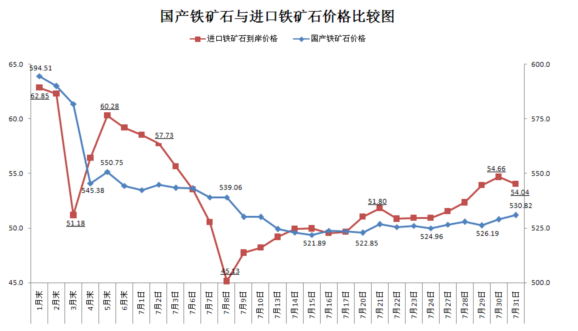
Domestic iron ore fines showed a trend of first declining and then rising, with the monthly average price including tax coming in at 530.21 yuan per ton—a decrease of 22.03 yuan per ton from the previous month, representing a drop of 3.99%. Specifically: From July 1 to July 15, the price fell from 544.34 yuan per ton to 521.89 yuan per ton, a decline of 4.12%; from July 15 to July 31, the price rebounded from 521.89 yuan per ton to 530.82 yuan per ton, an increase of 1.71%.
The price of imported fines has experienced relatively large fluctuations. The average landed price for the entire month was $51.62 per ton, down $10.09 per ton from the previous month’s average, representing a decline of 16.35%. Specifically: From July 1 to 8, the price plummeted rapidly from $59.19 per ton to $45.13 per ton, a drop of 23.75%, reaching a new low for the year; from July 8 to the end of the month, the price fluctuated upward from $45.13 per ton to $54.04 per ton, an increase of 19.74%. (See the table below.)
Table of Price Changes for Domestic Iron Concentrate and Imported Iron Ore

III. Analysis of the Later Trend in Iron Ore Prices
Since the second half of the year began, market demand has remained sluggish, and steel prices have continued to decline. Affected by the military parade activities, some construction sites in North China have suspended operations, and steel enterprises in the region have reduced production. As a result, demand for iron ore in the market is expected to decrease, and iron ore prices will likely fluctuate in the coming period.
1. Steel production declined month-on-month, and demand for iron ore is trending downward.
According to the bi-weekly report from the Iron and Steel Association, in the first half of July, the cumulative daily crude steel production of member iron and steel enterprises reached 1.8481 million tons, down 6.09% from the previous period. In August, affected by the "military parade" event, steel production is expected to decline somewhat. At the end of July, the CSPI domestic steel price index stood at 62.73 points, down 3.96 points from the previous period, representing a decline of 5.94%. Demand for iron ore in the domestic market is trending downward.
2. Port inventories of imported iron ore have risen, and overall supply exceeds demand for iron ore.
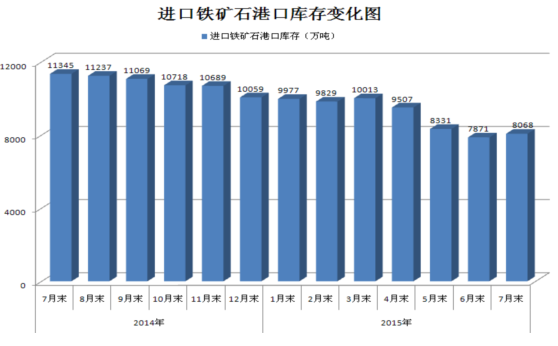
According to statistics from the Iron and Steel Association, as of the end of July, iron ore inventories at 26 key enterprises totaled 22.0516 million tons, down only 0.09% month-on-month, essentially remaining flat. Nationwide port inventories of imported iron ore stood at 80.68 million tons, up 2.50% month-on-month. In June, domestic iron ore production (raw ore) rose by 9.19% month-on-month, indicating a slowdown in the decline of output. From January to June, national pig iron production fell by 83.2 million tons year-on-year, while iron ore imports declined by only 39 million tons year-on-year. The iron ore market continues to be characterized by oversupply. (See the chart below.)
3. Steel companies are struggling to turn a profit, and iron ore prices are expected to fluctuate in the coming period.
According to statistics from the Iron and Steel Association, from January to June, member steel enterprises achieved a profit of 1.64 billion yuan after offsetting profits and losses, a year-on-year decrease of 73.33%. The sales profit margin stood at only 0.11%, and the proportion of loss-making enterprises reached 42.6%. Under the circumstances of sharp fluctuations in ore prices and continued downward pressure on steel prices, the operating and production situation for steel enterprises has become even more severe. In the coming period, iron ore prices are unlikely to see significant upward momentum and will likely continue to fluctuate.
Attachment: Trend Chart of the China Iron Ore Price Index (CIOPI)


Links:
Address: Room 909, 9th Floor, Science & Technology Building, Eastern Software Park, No. 90 Wensan Road, Hangzhou City, Zhejiang Province Telephone:0571-85115488

Scan with your phone
Open the mobile website