
浙江之源资产评估有限责任公司
2022 China Nickel Processing Industry: A Panoramic View of the Upstream, Midstream, and Downstream Markets and Enterprise Analysis
Release time:
2022-07-18
Source:
China Business Industry Research Institute
According to a report by Zhongshang Intelligence Network: Nickel is a hard, ductile metal with ferromagnetic properties. It can be highly polished and is resistant to corrosion. Nickel is a siderophile element. The Earth's core is primarily composed of iron and nickel.
I. Industrial Chain
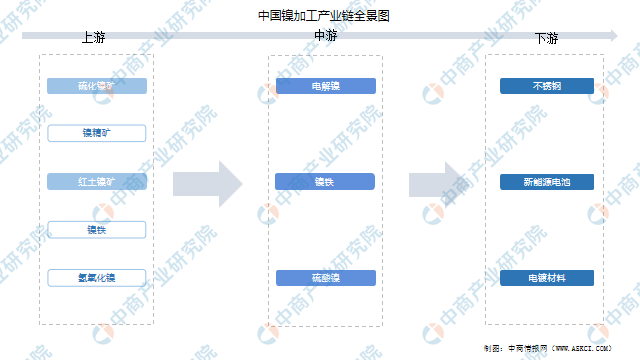
The upstream of the nickel processing industry chain involves nickel mining. Nickel ores are classified into sulfide nickel ores and laterite nickel ores. Sulfide nickel ores can be processed into nickel concentrates, while laterite nickel ores can be used to produce ferronickel and nickel hydroxide. The midstream involves smelting, which primarily includes electrolytic nickel, ferronickel, and nickel sulfate. The downstream applications include stainless steel production. New energy Car Battery production and electroplating material production.
II. Upstream Analysis
1. Global distribution of nickel deposits
(1) Nickel sulfide ore
Globally, nickel sulfide deposits are primarily concentrated in South Africa, Canada, and Russia, accounting for approximately 64% of the total—more than half of the world’s reserves. Each of these three countries accounts for over 15% of global reserves: South Africa holds the largest share at 28.1%, followed by Canada at 18.6%, and Russia at 17.3%. Australia, China, the United States, and Finland each hold more than 4% of the world’s nickel sulfide resources, with shares of 10.1%, 5.1%, 4.3%, and 4.1%, respectively.

III. Midstream Analysis
1. Production Status
(1) Nickel sulfate
Nickel sulfate is primarily used in the electroplating and battery industries, serving as the main nickel salt for both electroplated nickel and chemical nickel. In recent years, driven by the substantial increase in demand for ternary cathode materials for power batteries and the trend toward higher-nickel content in batteries, the demand for nickel sulfate has experienced explosive growth.
In 2020, China's nickel sulfate production reached 130,000 tons in terms of nickel metal content. Of this total, 64,000 tons were produced from primary raw materials, 30,000 tons were produced by dissolving nickel beans, and 37,000 tons were produced from waste materials.
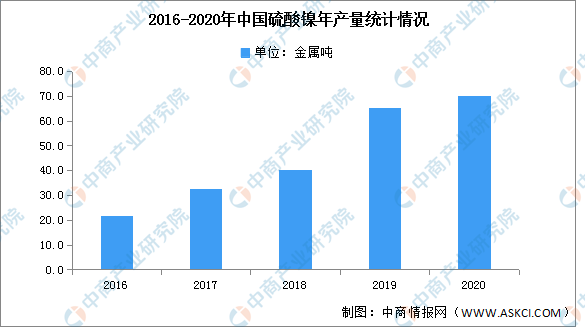
Data source: SMN, compiled by the China Business Industry Research Institute
(2) Electrolytic nickel
In the first three quarters of 2021, China’s electrolytic nickel production reached 120,700 tons. In September, the country’s electrolytic nickel output was approximately 14,300 tons, down 2.79% month-on-month and about 410 tons lower than in August. The primary reduction in output stemmed from a shutdown for maintenance at a smelter in Jilin Province; smelters in other regions maintained relatively stable production levels.

Data source: SMN, compiled by the China Business Industry Research Institute
2. Consumption
In recent years, China's nickel consumption has been increasing year by year. From 1.0896 million tons in 2016, China's nickel consumption rose to 1.3043 million tons in 2019, with an average annual compound growth rate of 6.18%. Driven by the rapid development of downstream new-energy batteries, nickel consumption is expected to further increase to 1.483 million tons in 2022.

Data Source: Compiled by the China Business Industry Research Institute
3. Competitive Landscape
The global nickel industry exhibits low concentration, with Russian Nickel and Vale each holding a market share exceeding 5%, at 8.5% and 7.7% respectively. Following them are Glencore, BHP Billiton, Sherritt, Anglo American, and South32, with market shares of 4.5%, 3.1%, 2.5%, 1.6%, and 1.5% respectively.

Data sources: USGS, compiled by the China Business Industry Research Institute
(2) Lateritic nickel ore
Globally, lateritic nickel deposits are primarily concentrated in Indonesia, Australia, and the Philippines, accounting for approximately 46% of the total. Each of these three countries—Indonesia, Australia, and the Philippines—contributes more than 10% to the global total, with Indonesia accounting for 18.7%, Australia for 17.7%, and the Philippines for 10.1%. Cuba, New Caledonia, and Brazil also have significant shares of lateritic nickel resources, each exceeding 8%, at 9.1%, 8.4%, and 8.3%, respectively.

Data sources: USGS, compiled by the China Business Industry Research Institute
2. Distribution of nickel deposits in China
China’s nickel ore reserves are highly concentrated, with most of them being sulfide nickel ores, which account for 86% of the country’s total proven reserves. The majority of domestic nickel ore deposits—88.9%—are located in western China, of which the northwest region accounts for 76.8% and the southwest region for 12.1%. Gansu Province holds the largest share of China’s nickel ore reserves, accounting for as much as 66%. The next major regions are Xinjiang, Yunnan, Jilin, Hubei, and Sichuan, with shares of 12%, 9%, 5%, 4%, and 4%, respectively.

4. Analysis of Key Enterprises

Source: Compiled by the China Business Industry Research Institute
5. Enterprise Thermal Distribution Map

IV. Downstream Analysis
1. Stainless steel
In recent years, China's stainless steel production has maintained steady growth. In 2021, China's stainless steel output reached 30.632 million tons, representing a year-on-year increase of 1.64%.

Data Source: Stainless Steel Branch of the China Special Steel Enterprises Association, compiled by the China Business Industry Research Institute.
2. New energy batteries
From January to December, China’s cumulative production of power batteries reached 219.7 GWh, representing a year-on-year increase of 163.4%. Among them, the cumulative production of ternary batteries totaled 93.9 GWh, accounting for 42.7% of the total output and increasing by 93.6% year-on-year. Phosphoric acid The cumulative production of lithium iron batteries reached 125.4 GWh, accounting for 57.1% of total production, with a year-on-year cumulative increase of 262.9%.

Links:
Address: Room 909, 9th Floor, Science & Technology Building, Eastern Software Park, No. 90 Wensan Road, Hangzhou City, Zhejiang Province Telephone:0571-85115488

Scan with your phone
Open the mobile website