
浙江之源资产评估有限责任公司
Building a New Normal for Standardization Work That Looks Toward the Future—Experts Interpret the “Plan for Deepening Reform of Standardization Work”
Release time:
2015-03-30
Source:
Xinhua News Agency, Beijing, March 26 (Reporter Xu Qingsong) — On the 26th, the State Council released the "Plan for Deepening Reform of Standardization Work." The plan emphasizes that the reform will adhere to the principles of streamlining administration and delegating power, combining deregulation with regulation, aligning with international standards, and promoting coordinated advancement, and it outlines reform measures in six key areas. A reporter interviewed Tang Wanjin, Deputy Director of the Chinese Academy of Standardization, on related issues.
Highlighting the bottom line: Stricter mandatory standards
The proposal suggests integrating and streamlining mandatory standards. Existing national, industry, and local mandatory standards will be gradually consolidated into a single set of national mandatory standards. National mandatory standards shall be approved and issued by the State Council or authorized to be approved and issued by it.
Tang Wanjin said that mandatory standards serve as the bottom line for safeguarding health and safety and protecting the environment. Currently, the prominent issues in China’s practice of managing mandatory standards mainly manifest themselves in the following ways: fragmented management across different administrative sectors, overlapping and contradictory indicators, difficulties in coordinating key standards, and the issuance of standards beyond their proper scope. These problems have resulted in China’s mandatory standards being “not strong” and lacking scientific rigor and authority.
Since mandatory standards pertain to public interests such as safety and environmental protection and are closely linked to people’s well-being, it is essential to fully leverage the role of mandatory standards in setting a “bottom-line” safeguard. Tang Wanjin stated that through this reform, the state will strengthen the unified management of mandatory standards and establish a comprehensive, unified system of mandatory standards. Standards approved and issued by the State Council or authorized for issuance will enhance their authority and seriousness, thereby more effectively promoting the nationwide implementation of mandatory standards.
Meeting market demands: Group standards are more flexible.
The proposal suggests fostering the development of group standards. It encourages social organizations—such as learned societies, associations, chambers of commerce, and federations—as well as industry and technology alliances that possess the requisite capabilities to coordinate with relevant market players in jointly developing standards that meet market and innovation needs, thereby increasing the effective supply of standards.
Group standards are standards developed by influential and capable professional organizations—such as societies, associations, chambers of commerce, federations, and industry-technology alliances—in specific fields to meet the rapidly changing and diverse demands of the market and technological advancements.
Tang Wanjin said that group standards developed relatively maturely abroad. Countries such as the United States, the United Kingdom, Germany, France, Japan, and Russia all have numerous professional social organizations dedicated to standard-setting. Group standards are not only an important component of these countries’ national standard systems but also a highly dynamic and market-oriented type of standard. As China’s industrial alliances, learned societies, associations, chambers of commerce, and federations—these various social organizations—are thriving, some of these organizations have already actively explored the development of group standards and achieved remarkable results.
Tang Wanjin believes that fostering and developing group standards is essential to meet the diverse needs of the market. With the growing trend toward personalized consumption and the diversification of the market, relying solely on a single government-supplied model can no longer satisfy market demands. By establishing group standards, we can effectively increase the supply of standards.
Highlighting technological advancement: Enterprise standards are higher.
The proposal suggests liberalizing and revitalizing enterprise standards. It calls for establishing a system of self-declaration and public disclosure of enterprise product and service standards, as well as a supervisory mechanism. Over time, government filing and approval requirements for enterprise product standards will be gradually eliminated, thereby reinforcing enterprises’ primary responsibility for standardization.
Tang Wanjin said that the competition between enterprises in terms of quality and technology is, at its core, a competition of enterprise standards. Enterprise standards reflect an enterprise’s manufacturing capabilities and technological level. Practice has proven that standardization is an important pathway for enterprises to tap their potential, innovate, transform, and foster creativity—and also a crucial means of continuously enhancing their technological prowess.
Tang Wanjin believes that, in order to meet the demands of market competition and the ever-growing needs of consumers, enterprises must strive for and adopt higher standards if they are to gain a competitive edge in the marketplace. The pursuit of higher standards is an intrinsic driving force for enterprises.
He also pointed out that the process of enterprises implementing the new standards is, in fact, a process of adopting and promoting new technologies. In the future, professional organizations conducting comparisons and evaluations of enterprises’ publicly available standards will help companies enhance their awareness of standardization, raise their standard-setting capabilities, and thereby boost the competitiveness of Chinese enterprises’ products and services.
|
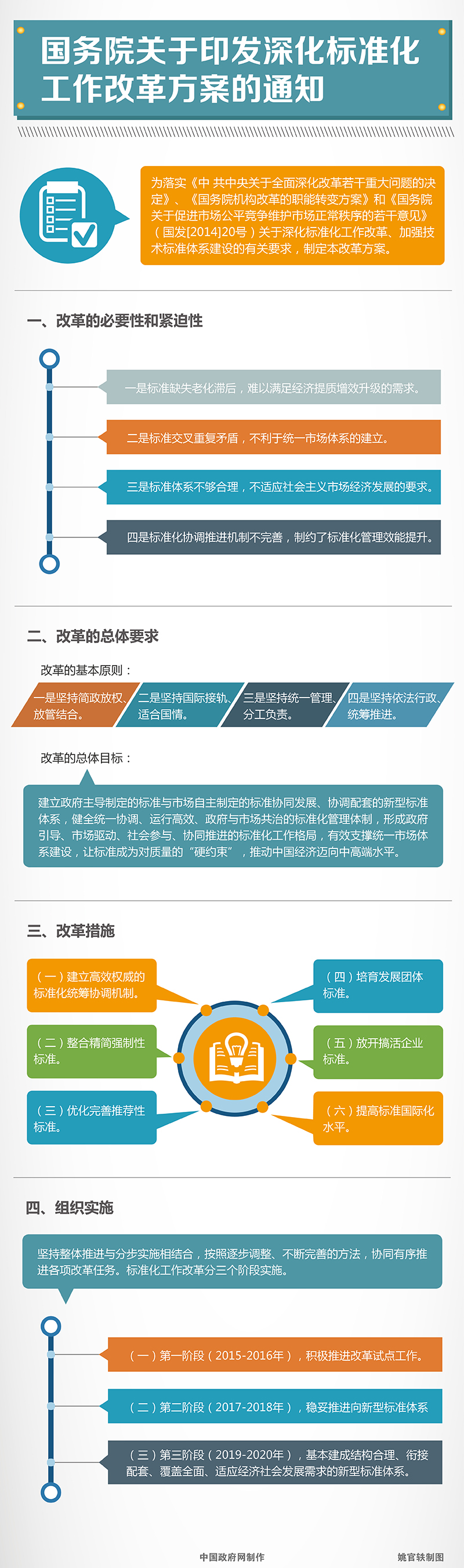
Illustration: Notice from the State Council on Issuing the Plan for Deepening the Reform of Standardization Work – China Government Network, drawn by Yao Guanyi |
Links:
Address: Room 909, 9th Floor, Science & Technology Building, Eastern Software Park, No. 90 Wensan Road, Hangzhou City, Zhejiang Province Telephone:0571-85115488

Scan with your phone
Open the mobile website