
浙江之源资产评估有限责任公司
Xi Jinping’s “Green Dialectics”
Release time:
2018-06-27
Source:
According to CCTV.com: There is only one Earth in the world. Protecting the environment and promoting harmonious coexistence between humans and nature is a shared aspiration of all humanity and a common wish of the international community.
What the people hope for is what the government strives for. In recent years, guided by General Secretary Xi Jinping’s vision of green development, a series of key projects in environmental governance and ecological restoration have been steadily carried out, and the institutional framework for ecological civilization has been accelerated.
The green development philosophy of Xi Jinping—rooted in the principle of putting the people at the center and upholding the harmonious coexistence of humanity and nature—embodies the profound philosophical essence of Marxism.
The dialectical unity of development and protection
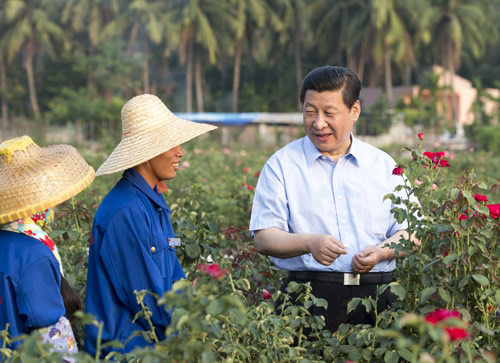
In April 2013, Xi Jinping inspected Hainan.
Looking at the history of global development, protecting the ecological environment is to protect productive forces, and improving the ecological environment is to develop productive forces.
— Remarks by Xi Jinping during his inspection tour of Hainan on April 10, 2013
Since the mid-20th century, China has undertaken large-scale development of the pristine forests in the Greater and Lesser Khingan Mountains. Among these, the key state-owned forest areas within Heilongjiang Province have cumulatively produced over 600 million cubic meters of timber since the founding of the People’s Republic of China. “Even the Greater Khingan Mountains now experience smoggy days,” and “The mountains can’t retain water anymore—back in the day, it would take three or four days of rain before the rivers rose; now, they swell up in just half a day,” some forestry workers used to say.
The traditional development model is becoming unsustainable, and the painful lessons it has taught serve as a stark wake-up call: sacrificing our green mountains and clear waters in exchange for mountains of gold and silver is no different than draining the pond to catch the last fish. On April 1, 2014, key state-owned forest areas in Heilongjiang Province completely halted commercial logging of natural forests. As a result, tens of thousands of forestry workers have since transformed from tree-cutters into tree planters and forest guardians.
“For human survival, while mountains of gold and silver are certainly important, green mountains and clear waters are an essential component of a happy life—something that money simply cannot replace. If you’ve earned a fortune but the air and drinking water are both substandard, where could any real happiness possibly come from?” Since the comprehensive halt to logging, by developing forest-understory economies and exploring diversified approaches to resource-city transformation, “green mountains and clear waters” have increasingly become a new advantage for the development of both the Greater and Lesser Khingan Mountains—and a new source of wealth for local residents. Ecological advantages are gradually being transformed into benefits for people’s livelihoods and competitive strengths.
In April of this year, Xi Jinping visited Hubei Province for a research trip and made his first stop to inspect the ecological restoration efforts along the Yangtze River. At present, China is at a critical juncture in shifting its economic development model and using innovation to drive industrial transformation and upgrading. Whether the Yangtze River Economic Belt can successfully achieve this transformation and upgrading is crucial to China’s overall development.
Xi Jinping explained very clearly: “By establishing rules and regulations, we can compel industries to undergo transformation and upgrading.” “We must designate ecological zones as no-development zones—this also points the way forward for how we should pursue development. The development and construction we engage in must be green and sustainable.”
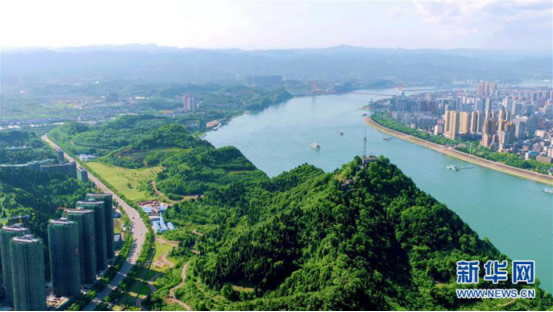
Photo: The Yichang section of the Yangtze River mainline.
In early 2017, the People's Congress of Hubei Province issued the “Decision on Vigorously Promoting Ecological Protection and Green Development in the Yangtze River Economic Belt,” thereby institutionally ensuring the green development of the Yangtze River Economic Belt.
In recent years, Hubei Province has launched a comprehensive initiative to shut down and relocate chemical enterprises located within one kilometer of the Yangtze River. The relocation of these enterprises has been a painful but necessary step for those companies along the river. Yet precisely this relocation has also spurred their transformation and upgrading, accelerating the adjustment of industrial structures. As a result, pollution from chemical enterprises has been significantly reduced, truly leading to clearer waters and greener land.
As General Secretary Xi Jinping has pointed out, protecting the ecological environment is to protect productivity, and improving the ecological environment is to enhance productivity. A sound ecological environment is the most equitable public good and the most universally beneficial welfare for the people. He not only elucidated the dialectical relationship between ecology and development but also provided clear guidance for advancing ecological civilization and offered valuable prescriptions for economic development.
The governance of mountains, rivers, forests, farmland, and lakes embodies “universal interconnectedness.”
We must recognize that mountains, rivers, forests, farmland, and lakes constitute a community of life. Human survival depends on farmland; the vitality of farmland depends on water; the vitality of water depends on mountains; the vitality of mountains depends on soil; and the vitality of soil depends on trees... If those who plant trees focus solely on tree planting, those who manage water focus solely on water management, and those who protect farmland simply focus on farmland protection, it’s easy to lose sight of the bigger picture and ultimately cause systemic ecological damage. It is therefore absolutely essential that a single agency assume responsibility for all land-use controls across the country, and carry out unified protection and restoration efforts for mountains, rivers, forests, farmland, and lakes.
— Xi Jinping delivered a statement on the “Decision of the CPC Central Committee on Several Major Issues Concerning Comprehensively Deepening Reform” at the Third Plenary Session of the 18th CPC Central Committee.
In April 2016, the "Thirteenth Five-Year Plan Outline for Land and Resources" was released, stipulating that during the 13th Five-Year Plan period, China will carry out unified property rights registration and confirmation for water flows, forests, mountains, grasslands, wastelands, tidal flats, and other such resources. This initiative aims to establish a natural resource property rights system with clearly defined rights and responsibilities, and to extend use-control measures to all natural ecological spaces. The outline proposes establishing a land-use control system for territorial space, building on the foundation of land-use control and extending these controls to all natural ecological spaces. It also calls for constructing a territorial-space development and protection system based on spatial planning and using use control as the primary means of implementation.
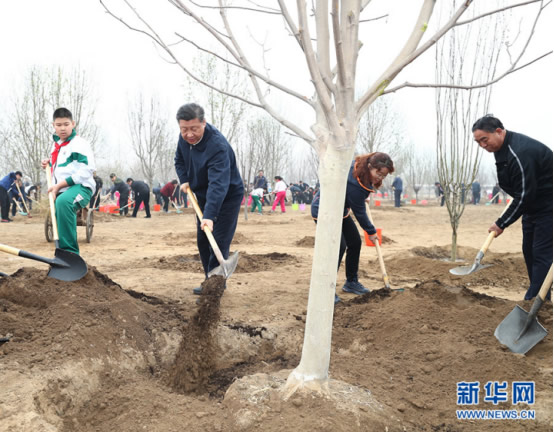
In April 2018, Xi Jinping participated in voluntary tree-planting activities.
Over the past years, environmental and ecological issues have never been out of General Secretary Xi Jinping’s sight for a single day. From conducting five field visits to Changting to inspect soil and water conservation efforts, to braving the bitter cold to visit forestry workers in the remote town of Arshan; from urging follow-up on wetland ecological protection along the shores of Erhai Lake, to participating in voluntary tree-planting activities in the capital—through continuous practice, Xi Jinping has developed a clear and comprehensive vision for ecological governance.
Mountains, rivers, forests, farmland, and lakes constitute a community of life. Xi Jinping once offered an insightful explanation of this community of life: “If we destroy the mountains and cut down all the forests, we will also destroy the water. The mountains will become bald, the water will turn into floods, carrying sediment and mud downstream, and the land will be reduced to barren wasteland devoid of nutrients—leading to soil erosion and the formation of deep gullies.”
“If plants and trees fail to thrive, the nation will be impoverished. But if plants and trees flourish, the nation will prosper.” A harmonious and balanced ecological environment is precisely what is needed for fully building a moderately prosperous society. By recognizing the strategic value of the ecological environment for China’s sustainable social development, we can also grasp the profound significance of currently accelerating the shift in economic development models and speeding up the transformation of China’s economic structure.
Historical Data: Green Development—Heading Toward the World
Promote environmental protection through the concept of “development.”
Ecological and environmental protection is a cause that benefits both the present generation and future generations. Building an ecological civilization is closely linked to the well-being of the people and determines the future of our nation.
— Xi Jinping presided over the sixth collective study session of the Political Bureau of the CPC Central Committee on May 24, 2013.
“The green waters wind their way onward, while green hills open up facing each other.” Building a sound ecological environment is an integral part of realizing the Chinese Dream. While accelerating economic development is undoubtedly important, it is an even greater responsibility to leave future generations a livable home surrounded by lush green hills and clear waters. As China’s principal social contradiction has shifted, people’s aspirations have evolved from “hoping for food and clothing” in the past to “hoping for environmental protection” today; from “seeking survival” in the past to “seeking ecological well-being” now.
When the ecosystem thrives, civilization prospers; when the ecosystem declines, civilization wanes. Throughout history, both at home and abroad, the harmonious relationship between humanity and nature has consistently demonstrated the profound impact of a healthy ecological environment on the survival and development of human society. Building a sound ecological civilization is a long-term strategic endeavor that is closely linked to the well-being of the people and the future of the nation.
The 18th National Congress of the Communist Party of China, held in November 2012, for the first time incorporated “Beautiful China” as a grand goal for ecological civilization construction into the report of the 18th Congress. This report, whose drafting group was led by Xi Jinping, reflects a deepened understanding among Chinese communists regarding the development and advancement of socialism with Chinese characteristics.
In April 2015, the CPC Central Committee and the State Council issued the "Opinions on Accelerating the Promotion of Ecological Civilization Construction," which outlined the overall requirements, vision, key tasks, and institutional framework for ecological civilization construction. In September 2015, the "Overall Plan for Reform of the Ecological Civilization System" was released, proposing measures such as improving the property rights system for natural resource assets, establishing a system for the development and protection of land space, and refining the performance evaluation, assessment, and accountability mechanisms for ecological civilization. In February 2017, the General Office of the CPC Central Committee and the General Office of the State Council issued the "Several Opinions on Delimiting and Strictly Adhering to the Ecological Protection Red Lines," specifying that by the end of 2020, China would have fully completed the delimitation, surveying, and marking of ecological protection red lines, and would have basically established an ecological protection red-line system.
Links:
Address: Room 909, 9th Floor, Science & Technology Building, Eastern Software Park, No. 90 Wensan Road, Hangzhou City, Zhejiang Province Telephone:0571-85115488

Scan with your phone
Open the mobile website