
浙江之源资产评估有限责任公司
A Brief Analysis of the Current Production Status of China’s 10,000-Ton Copper Mines
Release time:
2017-04-19
Source:
China’s demand for copper primarily stems from sectors such as power generation, construction, household appliances, and transportation. As China accelerates its industrialization and urbanization, the supply of non-ferrous metal minerals—including copper—has been unable to meet the growing needs of industrial development, leading to an ever-increasing reliance on foreign imports and placing China at the mercy of dominant overseas corporations. Fortunately, copper’s unique properties ensure that it can be 100% recycled. Recycled copper can serve as a substitute for primary copper, helping to ease the supply-demand imbalance. Currently, the output of recycled copper accounts for roughly 40% of refined copper production, enabling the full-scale recycling of copper resources.
Years of exploration and practice have shown that vigorously developing the secondary copper industry is an effective way for China to alleviate resource bottlenecks and achieve sustainable utilization; it is an important measure for promoting energy conservation, environmental protection, and transforming the economic growth model; and it is an inevitable requirement for facilitating industrial structural adjustment and promoting coordinated economic development.
It is both feasible and necessary for China to continue deepening the development of the secondary copper industry. Since last year, China’s secondary copper industry has been steadily advancing: the pace of optimizing and adjusting its industrial structure has continued to accelerate, the level of technology and equipment has kept improving, new technological applications have become increasingly widespread, and the agglomeration effect among secondary copper enterprises has gradually become evident. Looking ahead, recycled resources will become the mainstay of copper supply.
As the world’s largest producer and consumer of copper, China’s demand for copper concentrate containing copper has gradually risen to 4.989 million tons (2015), accounting for 33.1% of the global demand that year. However, China itself is relatively short of copper resources; its proven copper reserves amount to only 30 million tons, representing just 4.2% of the global total. In 2015, China’s output of copper concentrate containing copper reached 1.558 million tons, or 10.2% of global production—but this accounted for only 31.2% of the country’s total domestic demand, indicating an extremely high degree of reliance on foreign sources.
Due to limitations imposed by its resource endowment, China’s copper mines are characterized by a relatively dispersed distribution, low ore grades, and significant challenges in mining and beneficiation. Moreover, most of these mines are small-scale, with only a few being medium- or large-sized. As of the end of 2014, according to statistics compiled by the Department of Mineral Resource Reserves under the Ministry of Natural Resources, there were a total of 2,159 copper mining areas distributed across 30 provinces and autonomous regions nationwide. According to 2015 statistical data, only 18 copper mines in China had an annual copper concentrate production exceeding 10,000 tons. This article will primarily analyze the current operational and management status of these copper mines—those with an annual copper concentrate production exceeding 10,000 tons (referred to as “10,000-ton copper mines”), identify the major challenges they face, and propose some targeted recommendations.
I. Production and Operation Status of China’s 10,000-Ton Copper Mines
1.1 Distribution and Composition Status
From a geographical perspective, China’s 18 copper mines with capacities of 10,000 tons or more are mainly concentrated in the northwest (Xinjiang, Tibet, Qinghai, Bayannur in Inner Mongolia), eastern China (Jiangxi, Anhui, Fujian), northeast China (Heilongjiang, Hulunbuir in Inner Mongolia), and southwest China (Sichuan and Yunnan), with 6, 5, 3, and 3 mines respectively having capacities of 10,000 tons or more.
China’s large-scale copper mines—those with annual output exceeding 10,000 tons—are primarily concentrated within major metal conglomerates. Among them, Jiangxi Copper holds three mines (Dexing, Chengmenshan, and Wushan); Zijin Mining Group operates four mines (Zijinshan, Duobaoshan, Asheler, and Delni); China Gold Group owns three mines (Wunugutu Mountain, Hubei Sanxin, and Jiamama); Yuntong Group controls two mines (Dahongshan and Lala); Tongling Nonferrous Metals (Dongguashan), Jinchuan Group (Longshoushan), and Western Mining (Hogeqi) each operate one mine; additionally, there is a privately-owned, wholly foreign-owned Lujiu Copper Mine. Both the Longshoushan copper-nickel mine, operated exclusively by Jinchuan Group, and the Hubei Sanxin gold-copper mine, owned by China Gold Group, are associated copper deposits whose production levels rival those of mainstream copper mines and are therefore also classified as large-scale copper mines with annual outputs exceeding 10,000 tons.
1.2 Resource Status
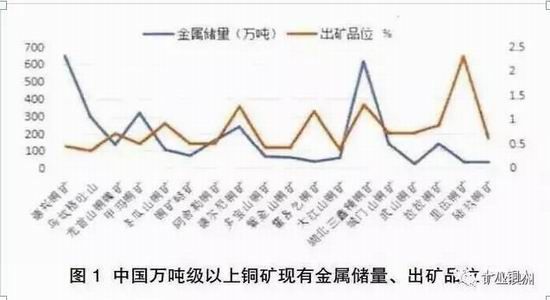
Currently, among China’s 18 copper mines with annual output exceeding 10,000 tons, the ore grades are relatively low, with an average grade of 0.75%. The highest grade is 2.3%, while the lowest is only 0.36%. Only three mines have grades above 1%; the remaining 15 mines all have grades below 1.0%, and eight of these mines even fall below the global average ore grade for copper mines, which stands at 0.6% to 0.8%. The total copper metal resources amount to 31.63 million tons, accounting for 32.6% of the country’s confirmed copper resources. The highest resource reserve reaches 6 million tons, whereas the lowest, at just 210,000 tons, has a remaining service life of only five years. The state of copper resources will be crucial to the sustainable development of copper mines with limited reserves.
In light of the current situation regarding copper resources, some open-pit mines such as Duobaoshan Copper Mine and Lala Copper Mine will shift from open-pit mining to underground mining as ore veins change. Underground mines will continue to deepen their operations; for instance, mines like Dahongshan and Dongguashan have already reached mining depths exceeding -1,000 meters. In 2016, a newly discovered western ore section at the Dahongshan Copper Mine revealed reserves of 54.6338 million tons of ore, containing 3.491 million tons of copper metal with an average grade of 0.64%, thereby extending the mine’s service life by another 24 years. All major copper mines are continuously overcoming the challenge of declining resources by expanding their mining operations deeper into the earth to replenish reserves and ensure long-term mine viability.
1.3 Current Production Status
Due to China's scarcity of copper mineral resources, the mining and beneficiation costs for large-scale copper mines are higher than those in foreign countries (the average full cost for China’s large-scale copper mines ranges from 33,000 to 35,000 yuan per ton). Moreover, these mines face significant social responsibilities and carry heavy historical burdens. Most of China’s large-scale copper mines are affiliated with major nonferrous metal groups (which also own smelting plants). As the demand for copper content in copper concentrates continues to rise, and given the declining self-sufficiency rate, these large-scale copper mines are currently operating at full capacity.
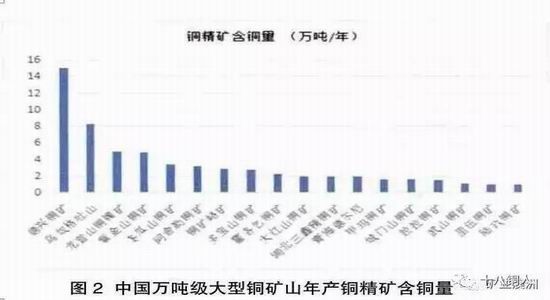
The large-scale mining model has not only enhanced the comprehensive utilization of resources and ensured an increase in copper production, but also effectively mitigated the impact of rising costs associated with low-grade ores, thereby maximizing mine profitability. According to production statistics from China’s 18 operating copper mines with annual output exceeding 10,000 tons, the total copper content in copper concentrates in 2015 amounted to 615,100 tons, accounting for only 39.5% of the nation’s total output. Among these mines, three enterprises produced over 50,000 tons of copper concentrate annually: Jiangxi Copper’s Dexing Copper Mine consistently ranked first, followed by the Wunugutu Mountain Copper-Molybdenum Mine of China Gold Group, and Jinchuan Group’s Longshoushan Copper-Nickel Mine, whose copper is recovered as a byproduct, all ranking among the top three. Together, these three mines accounted for 18.2% of the nation’s total output in 2015. The remaining 15 mines collectively contributed 21.3% of the nation’s total output.
1.4 Main Technical Specifications
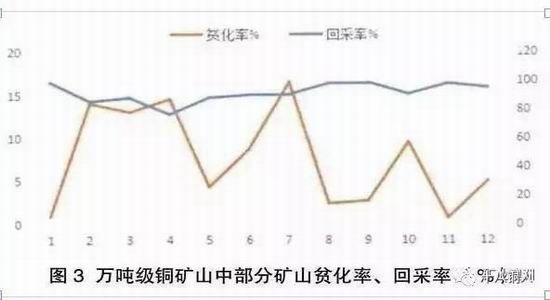
Production technology indicators for copper mines are key metrics that reflect the effectiveness of mineral resource development and utilization by copper mining enterprises, as well as their overall economic performance. Among China’s 18 large-scale mines—each with an annual output of over 10,000 tons—the lowest recovery rate is only 76.4%, while the highest reaches 98.89%. Of these mines, five have recovery rates below 90%; however, most mines achieve recovery rates of 95% or higher, effectively ensuring the full utilization of mineral resources. As for dilution rates, there is a significant disparity: the lowest rates are below 1%, whereas the highest approach around 15%. High dilution rates in certain mines degrade the quality of extracted ore, increase ore-processing costs, and negatively impact enterprise economic benefits. With the exception of differences arising from varying mining design approaches, mines such as the Wunugutu Copper-Molybdenum Mine, Chengmenshan Copper Mine, and Wushan Copper Mine all demonstrate advanced technological processes and high-level mining technical indicators.
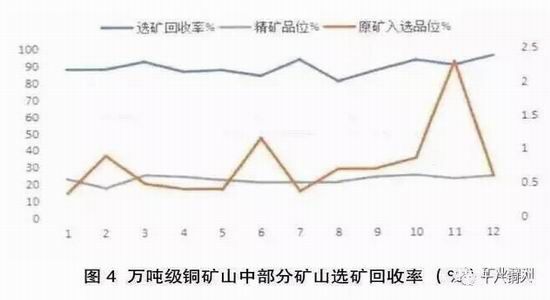
In terms of recovery rates, the average recovery rate for ore dressing is 88%. Due to variations in the grade of ore fed into the processing plant and differences in process technologies, there are significant disparities in recovery rates among different mines. The mine with the highest recovery rate can reach as high as 95%, while the mine with the lowest recovery rate stands at only 83.8%. Currently, mines such as Dahongshan, Tongkuangyu, and Lujiu all achieve recovery rates exceeding 90%. Whether it’s the use of flotation reagents or the control of equipment, these aspects represent critical factors for copper mining enterprises seeking to maximize their profitability. At Dahongshan Copper Mine of Yuntong Group and Tongkuangyu Mine of Zhongtiaoshan Group, despite relatively lower grades of ore fed into the processing plants, their recovery rates still show a clear advantage over other mines. Meanwhile, mines that initially have an advantage in ore grade but lower recovery rates are actively adjusting their ore-dressing processes.
Through refined management practices, China’s large-scale copper mines have effectively controlled per-ton mineral consumption of energy and resources, thereby enhancing the added value of their products. Not only are water and electricity consumption strictly monitored, but also the consumption of various materials—including grinding balls, explosives, diesel, lime, and beneficiation reagents—is rigorously managed. The effective control of material and energy consumption achieved via refined management has directly led to significant cost reductions per ton of ore processed. For instance, at the Tongkuangyu Mine, by precisely controlling the shift operation times of the rotary crushers and belt conveyor systems—major energy consumers in the beneficiation plant—the specific electricity consumption has been reduced from the original 2.25 kWh/ton to the current 2.19 kWh/ton. Additionally, through meticulous supervision and benchmarking with tunneling construction units, the over-excavation coefficient for the first ten months reached 1.16, a decrease of 0.06 compared to last year, resulting in a reduction of 6,035 cubic meters in excess excavation volume. Moreover, the specific consumption of blasting explosives per cubic meter has dropped by 0.29 kilograms compared to last year, truly delivering tangible results in cost reduction and efficiency improvement. Most underground mining operations have demonstrated outstanding performance in water recycling, achieving remarkably low per-ton water consumption by reusing circulating water and utilizing underground seepage water (under the precondition of controlling underground water inflow). Furthermore, material consumption has been effectively controlled through process improvements and refined management practices.
The comprehensive recovery of associated metals in polymetallic ores accounts for a significant share of enterprise output value. At polymetallic copper mines, through refined management and the efficient use of flotation reagents, further sorting of concentrate is carried out, enabling cost-effective recovery to the greatest extent possible. Similarly, Tongkuay Mine—the flagship mine of Zhongtiaoshan Group—achieves an annual gold production of over 100 kilograms even when the gold grade in the ore is extremely low, and it is equipped with processes that allow for the continued recovery of copper smelting slag. At Wunugutu Copper Mine, the recovery rate of the byproduct molybdenum concentrate has been increased from 30% to 70%. These measures have all enabled the effective recovery and utilization of valuable resources, thereby enhancing enterprise profitability.
1.5 Processes and Equipment
Open-pit mining offers significant advantages over underground mining in terms of higher efficiency and lower costs. However, the natural caving method is the only underground mining technique that can rival open-pit mining, sharing similar advantages (such as rapid production rates, low operating costs, and high labor efficiency). Among China’s copper mines with annual capacities exceeding 10,000 tons, most still rely on complex underground mining methods, while relatively few deposits are suitable for open-pit mining. Specifically, there are five open-pit mines, three mines combining open-pit and underground mining, and ten underground mines (including one mine using the natural caving method). Among these, the Tongkuay Mine of the Zhongtiaoshan Group is currently the only mine in China that employs the natural caving method. With a production capacity reaching 7 million tons per year, this mine boasts large scale, high efficiency, and low costs (its operating costs are about one-sixth to one-third those of the room-and-pillar or backfilling methods, and its production rate is two to five times faster). Through continuous exploration and refinement of its operations, the mine has accumulated valuable experience in the application of the natural caving method. Meanwhile, enterprises adopting backfilling methods in underground mining tend to face higher costs, especially at copper mines located in remote areas with long transportation distances. Although the room-and-pillar method used by some enterprises is relatively simpler, it suffers from similar issues as the natural caving method—namely, higher dilution and loss rates. Currently, all large-scale copper mines in China employ flotation processes in their ore-dressing procedures; however, each mine tailors its grinding and classification processes according to the specific characteristics of its own ore resources.
In terms of equipment assembly, large-scale copper mines in China—those with capacities of tens of thousands of tons—are now conducting production operations on a massive scale. Some of these mines have achieved significant advancements in equipment size, automation, and intelligence, effectively boosting production efficiency, optimizing material consumption, and enhancing the economic benefits of copper mining. However, currently, the equipment infrastructure in older mines lags noticeably behind that of newer mines.
In open-pit mines, large-scale mining operations feature significantly larger and more efficient equipment. For instance, the Dexing Copper Mine, with an annual copper production capacity of 150,000 tons, is equipped with 200-ton mine trucks and 35-cubic-meter electric shovels—far larger than the 100-ton mine trucks and 10-cubic-meter electric shovels used at the Wunugutu Mountain copper-molybdenum mine, which has a production scale of 80,000 tons. Even smaller mines typically rely on 15- to 35-ton mine trucks and 4- to 6-cubic-meter electric shovels. In underground mining operations, internationally advanced equipment such as loaders, haulage vehicles, and rock drills has been effectively adopted and widely applied in China’s large-scale copper mines with capacities of over 10,000 tons. These technologies have proactively transformed the underground working environment and greatly enhanced operational efficiency. In some large mines, electric shovels and modular rock-drilling equipment have completely replaced outdated diesel-powered machinery.
Taking the Nogetushan copper-molybdenum mine, where equipment assembly plays a particularly prominent role in ore dressing operations, as an example, the plant employs a semi-autogenous mill measuring 11 m × 5.4 m—the largest of its kind currently available in China’s similar mines. This significantly improves ore-dressing efficiency and substantially reduces energy consumption and material losses, enabling the efficient exploitation and utilization of low-grade copper resources. Compared to older mine equipment, this new setup demonstrates clear advantages: despite the raw ore's grade being more than three times lower than that of some older mines, the technological and equipment gap allows for a beneficiation recovery rate that is approximately 4 percentage points higher. As for flotation columns—equipment known for their large processing capacity and high production efficiency—due to the instability of the resulting products, enterprises equipped with flotation columns have not been able to fully utilize their equipment.
A copper mine with a capacity of 10,000 tons, equipped with an automated and intelligent system, has continuously optimized its staffing arrangements and stabilized its process flows through the automation and intelligent upgrading of its operations. A number of mines, including the Asheler Copper Mine and Tongkuangyu Mine in Xinjiang, have achieved workforce reduction and efficiency enhancement by implementing unmanned drainage systems that automatically control water pumps. Moreover, by adopting automated ventilation control systems that adjust airflow according to demand, these mines have successfully reduced costs and energy consumption. In ore-processing operations, intelligent control systems enable automatic fault diagnosis and analysis, thereby improving flotation recovery rates.
II. Main Challenges Facing China’s Ten-Thousand-Ton Copper Mines
2.1 Insufficient resource reserves affect the service life of mines.
As China’s copper mines, with capacities of tens of thousands of tons, continue to be exploited over the years, their resource reserves will decline. With the continued increase in mining depth and the ongoing expansion of mining areas, these mines—whose minimum service life is as short as five years—will face new challenges in terms of production output, profitability, and operational lifespan.
2.2 Insufficient processes and relatively outdated equipment negatively impact the economic benefits of mining operations.
In mining production, operational indicators directly affect the efficiency of comprehensive resource utilization. First, a low recovery rate and a high dilution rate result in relatively low ore recovery, thereby driving up costs. In the process of cost control, this is bound to lead to resource losses. Second, outdated equipment not only results in low production efficiency, high material consumption, and limited production capacity, but also negatively impacts ore dressing recovery rates, significantly affecting the economic benefits of the mine.
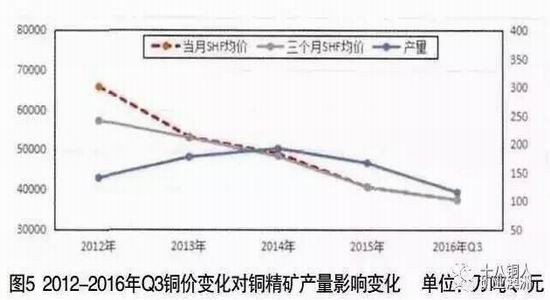
2.3 Copper price (45920, -370.00, -0.80%) Fluctuations in the cost range affect production stability.
The average full cost of production at China’s copper mines with capacities of 10,000 tons or more ranges from 33,000 to 35,000 yuan per ton. Newly built mines, mines with low ore grades, and older mines burdened with heavy costs have higher full costs, hovering around 38,000 yuan per ton. By contrast, relatively stable, older mines and mines with better ore grades have lower costs, around 31,000 yuan per ton. Consequently, fluctuations in metal prices will to some extent affect the production stability of China’s copper mines.
When metal prices fall to the point where they even approach the mine’s cost line, small copper mines—due to their higher costs and relatively lower mining value—will tend to put copper resources on hold. However, large copper mines lack the flexibility of smaller operations and bear significant responsibilities. If some mines start incurring losses and cost reductions fail to yield results, these mines will be forced to cut production passively. On the other hand, when prices remain above the cost line and generate substantial profits, this will boost production enthusiasm and encourage selective mining of copper resources, thereby maximizing overall efficiency.
2.4 The responsibility and pressure for mine environmental protection are significant and intense.
China’s large-scale copper mines face significant environmental responsibilities and immense pressure. The environmental challenges posed by tailings have long been a persistent issue. Their extensive land footprint and the dust generated by tailings carried by strong winds easily lead to air pollution. Improper management can also result in leaks and landslides, causing further environmental damage. Moreover, mining operations in these areas produce tens of thousands of tons of waste rock every day. If these waste rocks and residues containing heavy metal elements are left piled up for extended periods, the risk increases that heavy metals will leach into the surrounding environment with rainfall, potentially contaminating the local ecosystem.
III. Construction (and Expansion) Status of China’s 10,000-ton Copper Mines
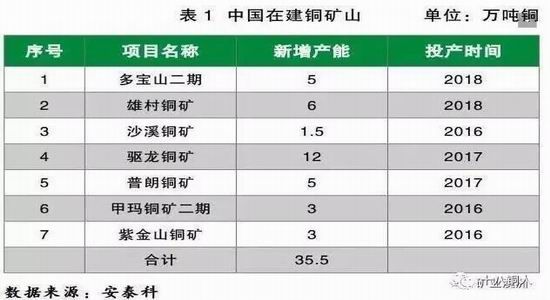
China has seven copper mines under construction (or undergoing capacity expansion) with a combined capacity of 10,000 tons each. These projects involve an additional 355,000 tons of copper content in refined copper concentrate and are expected to begin releasing new production capacity between 2017 and 2018.
Upon completion, the Pulang Copper Mine, owned by Yunnan Diqing Nonferrous Metals Co., Ltd., a subsidiary of YunTong Group, will become China’s largest mine—after the Tongkuayu Mine of the Zhongtiaoshan Group—to adopt the natural caving method. The mine’s annual mining capacity will reach 12.5 million tons, with an additional 50,000 tons per year of copper concentrate containing copper. In the second phase, the mine’s production capacity will expand to 18.75 million tons per year. (The environmental impact assessment report for the first-phase mining and beneficiation project—capacity of 12.5 million tons per year—was accepted by the Ministry of Environmental Protection in March 2013. On March 11, 2014, the project received approval from the Ministry of Environmental Protection, and construction commenced in June 2014.)
The Chilong copper mine of Tibet Julong Copper Industry, which employs open-pit mining technology, boasts reserves exceeding 10 million tons and will become China’s largest copper deposit. This project will add 120,000 tons per year of copper concentrate (the environmental impact assessment report for the Chilong copper mine project was accepted by the Ministry of Environmental Protection in December 2012, and on December 4, 2013, the Ministry approved the project).
The preliminary design of the Xiongcun copper mine operated by Tibet Tianyuan Mining specifies a mining and beneficiation capacity of 12 million tons per year, with an additional annual output of approximately 60,000 tons of copper concentrate. (The environmental impact assessment was approved in 2007, and the project was originally scheduled to begin trial operations in January 2016; however, due to issues with the tailings pond, the project’s commissioning date may now be postponed until 2018.)
In the expanded 10,000-ton copper mines, the second-phase expansion of China Gold Group’s Jiamu Copper Mine is expected to bring the total annual copper concentrate production to 72,000 tons. After the completion of the second-phase expansion of Zijin Mining Group’s Duobaoshan Copper Mine and the expansion of Zijinshan Copper Mine, their respective annual copper concentrate production will reach 80,000 tons and 50,000 tons, contributing a combined total of 110,000 tons of copper concentrate. All these mines will join the list of copper mines with annual production exceeding 50,000 tons.
Among the newly added production capacities, all the large-scale copper mines are located in high-altitude regions with relatively harsh production conditions. Once these mines are completed and put into operation, China will have 22 copper mines with annual output exceeding 10,000 tons, and the number of large-scale copper mines producing more than 50,000 tons of copper concentrate will increase to nine (including expansion projects). The expansion projects are mainly concentrated within the Zijin Mining Group, involving an additional annual copper concentrate production capacity of 80,000 tons.
IV. Summary and Recommendations
As China’s copper mines with annual capacities of 10,000 tons age, they are facing challenges such as dwindling resource reserves, increasing mining depths, and capacity constraints. In response, these mines are shifting their focus toward cost reduction and efficiency enhancement, exploration and discovery of new mineral deposits, and improvement of technical indicators—efforts aimed at ensuring both production levels and economic benefits meet targets. Currently, these mines have entered a stage of comprehensive advancement into deeper underground areas. While confronting numerous operational challenges, they are paying close attention to market changes and actively adopting advanced mining and beneficiation technologies. They are moving toward digitalization and intelligent operations, achieving higher efficiency at lower costs and reducing environmental pollution. This approach enables the mines to maintain quality, quantity, and profitability throughout their limited service lives. By analyzing the current operational and production status of China’s large-scale copper mines and identifying the key challenges they face, this paper proposes several targeted recommendations.
4.1 Further explore and search for copper resources, and strengthen reserves of copper resources.
Faced with the reality of dwindling copper resources, China’s large-scale copper mines should maintain a sense of vigilance and continue to explore and search for new copper resources. They should adopt an approach that combines mining with exploration, tackle key technological challenges, and innovate in mining practices to mitigate the impact of resource depletion and increasing mining depths on mine output and profitability, thereby maximizing the sustainable utilization of resources. In particular, mines equipped with their own smelters should actively develop new copper resource areas and strengthen their copper reserves. From a macro-strategic perspective, these mines should expand overseas to build international copper resource bases, securing a favorable position in global competition and opening up new avenues for growth.
4.2 Fine-grained management to reduce costs, improve efficiency, enhance quality, ensure quantity, and upgrade equipment.
Currently, China’s large-scale copper mines suffer from insufficient comprehensive resource utilization and relatively low production performance due to outdated production processes and equipment. Therefore, it is necessary to introduce advanced production technologies, adopt cutting-edge high-tech innovations, and enhance the level of refined management.
China’s large-scale copper mines still have considerable room for development in the comprehensive utilization of low-grade, residual, and tailings ores (China accounts for only about 0.067% of global production in wet-process copper smelting). Given China’s predominant reliance on sulfide ores, introducing and adopting bio-hydrometallurgical copper smelting can effectively recover valuable products from low-grade, residual, and tailings ores, thereby minimizing the loss of valuable metals and maximizing the economic benefits of resource utilization.
In large-scale production operations, focusing on the practical challenges faced in mining, we are strengthening the improvement of extraction methods, continuously enhancing management across all production stages, and reducing the inclusion of waste rock as well as ore losses during mining and transportation. In ore-processing operations, we are boosting recovery rates through refined management—this includes monitoring and controlling grinding concentrations and fineness in staged processes, managing flotation concentrations and pH levels, minimizing errors in reagent addition, and precisely controlling tailings concentrations.
The relatively outdated equipment leads to low production efficiency and high energy consumption. By continuously upgrading and modernizing the equipment, we can actively enhance its operational capabilities, providing the hardware support needed to improve efficiency and reduce energy use. Moreover, ongoing, meticulous management practices are crucial for elevating the overall process standards and achieving cost reductions and efficiency gains in manual operations. For example, Yun Tong Group implements daily, weekly, and monthly economic and technical indicator controls, reporting, and unified analysis for its own mines, thereby establishing a top-down, unified management system. Through innovative, refined management approaches, the group achieves its goal of reducing costs and boosting efficiency.
4.3 Resource integration to enhance the value of by-products
Chinese copper mines with annual capacities of tens of thousands of tons should actively integrate nearby small-scale copper resources to stabilize regional supply levels. Copper mines with by-product support should strive to maximize the output of associated metal products to offset the price impact of the primary metal, copper. They should also closely monitor market changes to effectively address the impact of metal price fluctuations on mine production stability. In 2016, when copper prices were hovering at low levels, the Wunugutu Mountain copper mine improved its ore-processing technology to enhance the recovery rate of molybdenum concentrate from 30% to 70% in order to better ensure stable production and profitability. This measure helped the company secure a more favorable profit margin.
4.4 Integrated Development and Governance: Achieving Dual Benefits—Environmental Protection and Economic Growth
The comprehensive development and management of tailings can be considered from multiple levels. First, given the ongoing production that inevitably leads to the need for expanding tailings storage facilities, it is crucial to proactively prepare for site selection and facility expansion, and to build robust tailings ponds with strong impermeability to prevent tailings from leaking and causing environmental impacts. Second, environmental issues associated with tailings should be addressed through various approaches:
(1) By developing a closed-loop water circulation system for tailings ponds, we can enhance the utilization rate of water recycling.
(2) Analyze and recover valuable products contained in tailings in small quantities. For example, magnetic separation can be used to recover magnetite, pyrite, and iron-bearing minerals from tailings. Additionally, using xanthate and pine oil, sulfur concentrate can be recovered from sulfur-containing tailings.
(3) For tailings with no recycling value, a paste backfilling method can be adopted, or, as in the case of Wunugutu Mountain, the “SABC” crushing and grinding process (coarse crushing—semi-autogenous grinding—ball milling—hard-rock crushing) can be used to discharge the tailings in paste form. This approach not only protects the environment but also reduces land occupation and lowers maintenance costs.
(4) Reclamation of tailings ponds for farmland development, combined with the cultivation of high-yield crops (some mines have experimented with growing food crops and cash crops), achieves both environmental protection and agricultural productivity—killing two birds with one stone. Waste rock and tailings should be promptly treated to prevent the release of heavy metal elements that could contaminate the surrounding environment, and targeted reclamation efforts should be carried out accordingly. For example, the Dexing Copper Mine has undertaken scientific research on ecological restoration and reconstruction of its mine site, planting different species of plants based on the specific conditions of each mountain slope and adopting a combination of trees and shrubs: first, grasses are planted; once the grasses wither and decompose into nutrients, shrubs are then introduced to improve soil acidity and alkalinity; finally, trees are planted to avoid potential environmental pollution caused by the accumulation of waste rock and tailings. To date, the Dexing Copper Mine has completed the reclamation of over 400 hectares of abandoned land, and more than 80% of all reclaimable abandoned land has undergone ecological restoration.
Links:
Address: Room 909, 9th Floor, Science & Technology Building, Eastern Software Park, No. 90 Wensan Road, Hangzhou City, Zhejiang Province Telephone:0571-85115488

Scan with your phone
Open the mobile website