
浙江之源资产评估有限责任公司
A Review and Outlook on the Reform and Development Trends of China’s Geological Exploration Industry in 2017
Release time:
2018-05-15
Source:
[Reading Tip] In 2017, China’s economy maintained steady progress and showed an overall positive trend. GDP grew by 6.9% year-on-year, with over 13 million new urban jobs created. The CPI rose moderately by 1.6%, and imports and exports expanded by 14.2%. Significant progress was made in supply-side structural reform, accelerating the shift from old to new growth drivers. The quality and efficiency of economic development continued to improve, marking the first acceleration in economic growth since 2010.
Under the current situation in which China’s economic development is smoothly transitioning from high-speed growth to high-quality growth and in response to the requirements of ecological civilization construction, the national geological exploration industry, taking supply-side structural reform as the main line, is implementing the new development philosophy, adjusting the structure of geological exploration work, actively exploring reform and development, and continuously promoting the optimization, upgrading, and transformation of the geological exploration industry’s structure.
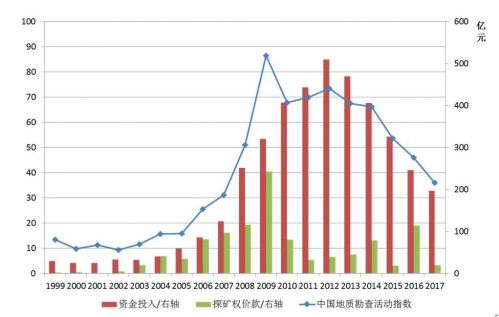
Changes in China's Geological Exploration Activity Index
Analysis of China’s Geological Exploration Situation in 2017
China’s geological exploration activity index has been on a downward trend for five consecutive years. After reaching an all-time high in 2009, China’s geological exploration activity index has experienced volatile declines ever since. Although exploration expenditures and personnel inputs increased from 2010 to 2012, indicators such as mining rights fees, newly discovered resource volumes, and the number of newly identified mineral deposits showed a marked decline. In 2016, despite a substantial increase in mining rights, China’s exploration expenditures and the number of exploration personnel both declined significantly, directly causing the exploration activity index to drop to 46 points—a 47% decrease from its peak in 2009. In 2017, exploration expenditures fell by 20% year-on-year, and mining rights fees plummeted by as much as 80%. As a result, China’s geological exploration activity index further declined to 36 points, representing a 22% reduction from 2016 levels.
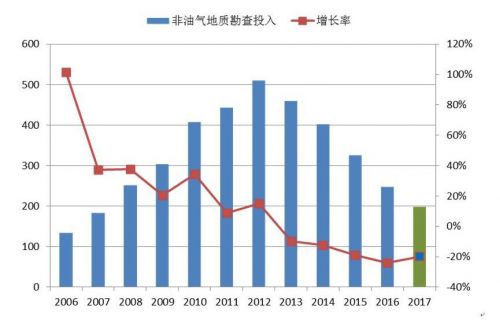
Trend in National Investment in Non-Oil and Gas Geological Exploration
The decline in China's investment in non-oil and gas geological exploration has narrowed, and its structure continues to optimize. According to data from the Development Center of the China Geological Survey, in 2017, China's investment in non-oil and gas geological exploration totaled 19.8 billion yuan, a year-on-year decrease of 20%, representing a reduction of 4.6 percentage points compared to 2016. Specifically: central government funding amounted to 5.865 billion yuan, down 7.2% year-on-year; local government funding reached 6.858 billion yuan, down 16.2% year-on-year; and social capital investment stood at 7.055 billion yuan, a year-on-year decrease of 31.2%. Social capital investment hit a new low in the past decade, underscoring the crucial role played by fiscal funding in stabilizing China's geological exploration market.
From the perspective of investment direction, investment in resource-oriented geological exploration continues to decline, while investment in environmental-oriented geological exploration keeps rising. In 2017, the nation’s total investment in mineral exploration amounted to 11.90 billion yuan, a year-on-year decrease of 29.9%. By contrast, investment in hydrogeological, environmental geological, and geological hazard surveys reached 2.534 billion yuan, up 0.8% over the previous year. The share of investment in hydrogeological, environmental geological, and geological hazard surveys has been steadily increasing—from 3.0% in 2006 to 12.8% in 2017. In the eastern region, the rise in environmental-oriented geological exploration has been particularly pronounced, with its share of total investment rapidly increasing from 12.7% in 2011 to 33.3% in 2017. Looking at specific mineral types, investment in exploration for bulk minerals such as coal and iron ore has continued to decline rapidly; investment in precious and non-ferrous metal exploration has slowed down and begun to stabilize; meanwhile, attention to strategic emerging minerals and unconventional energy sources has continued to grow.
The geological exploration industry is adjusting its development direction, and its industrial structure continues to optimize. In recent years, amid the downturn in the geological exploration economy, the industry has actively sought transformation and adjusted its development strategy, gradually expanding from traditional regional geology and mineral exploration into multiple new areas such as public-welfare geology and related geological services. According to statistical analysis, during the five-year period from 2013 to 2017, the proportion of geological exploration units engaged in regional geological surveys remained relatively stable, staying between 5.5% and 6.0%. The share of units engaged in solid-mineral exploration declined significantly, dropping from 27.4% to 23%. Meanwhile, the number of geological exploration units involved in hydrogeological and environmental surveys saw a slight increase, rising from 13.92% to 16%. The number of units engaged in marine geological exploration steadily rose, with their share increasing from 0.19% to 0.35%. These structural adjustments are beginning to yield positive results. In 2017, revenue from engineering surveying and construction reached 50.465 billion yuan, representing a year-on-year increase of 13.7%.
A survey of professionals in the geological exploration industry indicates that environmental geology, urban geology, and agricultural geology will become the three areas with the greatest potential. This survey result also suggests, to some extent, that the structure of the future geological exploration market will undergo changes or adjustments.
The number of geological exploration personnel has slightly decreased, while employees’ incomes have steadily risen. According to statistics, in 2017, the total number of employees in China’s non-oil and gas geological exploration sector was 798,500, of which 428,300 were currently employed (with 370,200 retirees). Among the employed staff, 212,000 were engaged in geological exploration activities, a decrease of 8.15% over the previous year. Of these employed personnel, 154,500 were technical staff, down 6.76% from the previous year. In 2017, the total revenue of the national geological exploration industry reached 160.987 billion yuan, with engineering surveying and construction revenues growing relatively rapidly to 50.465 billion yuan, an increase of 13.70% over the previous year. Employees’ living standards continued to improve; in 2017, the average annual remuneration per employee was 76,100 yuan, up 12.07% year-on-year—a growth rate that was 8 percentage points higher than in 2016.
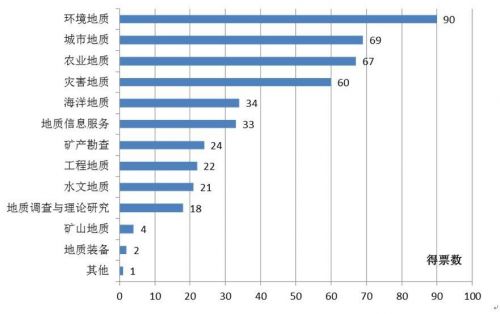
Ranking of Development Potential Across Different Areas in the Geological Exploration Industry
The total assets of geological exploration units nationwide saw a slight increase, while the net value of exploration equipment declined year-on-year. According to statistics, in 2017, the total assets of geological exploration units across the country reached 584.981 billion yuan, up 0.13% from the previous year; total liabilities amounted to 322 billion yuan, down 2.64% from the previous year. The asset-liability ratio rose slightly—from 54% in 2015 to 57% in 2016—and then fell back to 55% in 2017. In 2017, the net value of geological exploration equipment held by China’s geological exploration units was 12.928 billion yuan, a year-on-year decrease of 12.07%, accounting for only 4.9% of total net assets.
Geological exploration units should foster a spirit of innovation and continuously explore industrial transformation and upgrading.
As the traditional geological exploration economy declines, geological exploration units are shifting their conventional mindset, cultivating a spirit of innovation, continuously expanding their service areas, rising to meet multifaceted challenges, achieving new accomplishments, and making fresh contributions to China’s economic and social development.
By transforming the institutional mechanisms and driving innovation in systems and mechanisms through the reform of geological exploration units, we can enhance the service capabilities of geological work. The Jiangsu Provincial Bureau of Geology and Mineral Resources has established nine municipal-level technical centers for emergency geological disaster response and geological environmental protection, proactively providing technical support for local geological hazard surveys, emergency rescue operations, and ecological civilization development.
The Zhejiang Nonferrous Metals Geological Exploration Bureau has joined forces with the local government to establish an emergency technical service center for geological hazards, jointly deploying efforts in disaster prevention, mitigation, and post-disaster recovery. The Zhejiang Provincial Geological Exploration Bureau has established a system and mechanism suited to public-interest geological work, shifting away from the previous commercial management approach that relied primarily on contract-based responsibility systems. Adhering to the new working philosophy of "giving greater autonomy, exercising effective oversight, and providing excellent services," the bureau has devolved all powers that enterprises can decide on independently, while effectively managing common issues that affect enterprise development and providing robust support for enterprise reform and development.
After the four state-owned geological exploration units in Shaanxi Province were fully transformed into enterprises, they have continuously improved their corporate governance structures in accordance with the requirements of the modern enterprise system, strengthening their boards of directors, supervisory boards, and management teams. As a result, they have initially established corporate governance structures that are well-suited to the modern enterprise system. To further expand and strengthen their advantageous industries and leverage the role of capital as a connecting force, these units have either established provincial-level geological exploration and development groups or integrated and reorganized themselves with large-scale enterprise groups within the province, playing a significant role in enhancing the scale and competitiveness of their key industries.
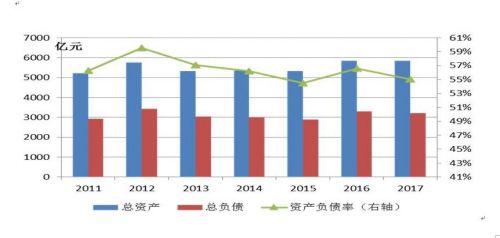
Changes in Assets and Liabilities of China's Geological Exploration Units from 2011 to 2017
Structural transformation, with the deepening of supply-side structural reform as the main thread, is focused on promoting industrial optimization and upgrading. The Tianjin Municipal Bureau of Geology and Mineral Resources has proposed a development strategy for geological services supporting urban development across four levels: the central urban area, planned new cities, integrated urban-rural development, and the Beijing-Tianjin-Hebei metropolitan circle. In the central urban area, a three-dimensional visualized urban geological data management and service system has been established to provide scientific geological information services for urban planning and construction; it also offers foundational geological technical support for key city-wide construction projects and ensures safety in site selection for major urban infrastructure projects. Furthermore, the bureau undertakes monitoring of groundwater, land subsidence, and the geological environment throughout the city, having initially established a citywide monitoring network that provides effective safeguards for urban social stability and people’s livelihoods. According to statistics, the current rate of land subsidence in Tianjin’s urban areas has decreased from 80–100 millimeters per year in the early 1980s to just 15 millimeters per year.
Based on the overall plan for building an ecological province, the 358 Plan for remedying mine environmental issues, and land balance measures, the Jiangsu Provincial Bureau of Geology and Mineral Resources is fully leveraging its geology and mineral resources brands—such as “mountain-and-water ecology” and “mountain-and-water land”—to tap into the markets for mine environmental restoration and land reclamation, thereby contributing to the construction of an ecological civilization. The East China Geological Exploration Bureau of Nonferrous Metals in Jiangsu Province has successfully improved coastal saline-alkali lands, which holds significant economic and social value for the development of reserve land resources in coastal areas. Moreover, its independently owned microbial-bacterial combined remediation method with plants demonstrates clear advantages in restoring soils contaminated by heavy metals. Through the implementation of these projects, the bureau has amassed data on deep geothermal water resources and shallow geothermal energy resources across most regions of the province, providing technical support for the development and utilization of clean energy throughout the province.
Anhui Province has fully leveraged the leading role of geological exploration units in such areas as ensuring energy and resource security, promoting ecological civilization, preventing and mitigating disasters, advancing new-type urbanization, industrialization, agricultural modernization, and major infrastructure projects. While consistently prioritizing mineral exploration as its core business, Anhui has also identified key breakthroughs and entry points by closely aligning geological work with major demands arising from economic and social development, actively broadening service channels and expanding service domains. Seizing the opportunity presented by the nation’s Yangtze River Economic Belt development strategy, Anhui has proactively planned major comprehensive geological survey projects for the Wanjiang Economic Belt, exploring new and more efficient ways for central and local public-interest geological work to better serve socio-economic development, thereby making significant contributions to supporting and facilitating the construction of the Wanjiang Economic Belt. The Anhui Provincial Bureau of Geology and Mineral Resources has established a framework characterized by diversified fields, priority given to public welfare, alignment with government needs, and services aimed at the general public. On the basis of comprehensive surveys and assessments, it has set up service platforms covering surveying and evaluation, monitoring, early warning and forecasting, and emergency response. The East China Metallurgical Geological Exploration Bureau has focused on actively expanding its services in areas such as disaster prevention and mitigation, environmental geology, urban geology, and agricultural geology. Meanwhile, the Anhui Coalfield Bureau has shifted from solely focusing on coal resource exploration to encompassing exploration of unconventional energy resources—including coalbed methane, shale gas, and geothermal energy.
Shaanxi Provincial Geological and Mineral Group, focusing on transformation and upgrading, has shifted its mineral resource exploration and development toward "high-quality, urgently needed, rare, and specialized" minerals. In 2012, the group discovered a large-scale, high-quality jade deposit in Nanzheng, Hanzhong. By the end of the 13th Five-Year Plan period, the group plans to invest 6.8 billion yuan to transform this deposit into a pillar industry for the group itself, a flagship industry for Hanzhong City, and an emerging jade culture industry for Shaanxi Province. Shaanxi Coalfield Group has entered the fields of shale gas and geothermal energy, conducting shale gas exploration in southern Hanzhong and actively applying for exploration rights. The group is also assisting in research on the distribution of geothermal resources in Shaanxi Province and has completed the preparation of the "Thirteenth Five-Year Plan Special Program for Geothermal Energy Development." Northwest Nonferrous Metals Group is emphasizing the development and R&D of new materials and new energy sources, particularly in the mineral products sector. The group is building six major industrial sectors: geological technical services, copper, lead, and zinc, gold, new energy, diversified operations, and the integration of industry and finance, thereby gradually enhancing its capacity for sustainable development. China-Shaanxi Nuclear Group takes people's livelihood-oriented geology as its primary driving force, strengthening environmental geological surveys, agricultural geological surveys, and geological hazard assessment and remediation efforts. By highlighting its broad-based geological business, the group aims to maximize the social benefits of state-owned enterprises.
Through innovative transformation, we are promoting scientific and technological innovation within geological exploration units and enhancing their core competitiveness. The Jiangsu Provincial Bureau of Geology and Mineral Resources has intensified its efforts in technological breakthroughs in areas such as airborne geophysical exploration, urban rail transit, geothermal new energy industries, investigation and remediation of soil and groundwater contamination, and processing of nuclear fuel storage devices. It has also submitted applications for and implemented a number of national, provincial, and municipal fund projects and research topics, with numerous achievements resulting in patent applications. Among these, the “integrated framework + modular storage sleeve” type spent-fuel storage rack for nuclear power plants and the “Jiangsu Province Urban Rail Transit Engineering Quality and Safety Management Information System” have filled domestic gaps. The No. 814 Geophysical Exploration Co., Ltd. of the East China Nonferrous Metals Geological Exploration Bureau in Jiangsu Province, leveraging its core technology of “three-dimensional gravity, magnetic, and electrical exploration” and the advantages of its new wide-area and time-frequency electromagnetic methods, is actively exploring entry into the field of deep-earth exploration. The Longsan testing instrument for shallow underground hazardous gas detection, developed by the First Geological Brigade of the Zhejiang Provincial Bureau of Geology and Mineral Resources, has been granted a utility model patent by the National Intellectual Property Administration and is widely used in underground engineering projects across the Yangtze River Delta region. Furthermore, a geoscience innovation and entrepreneurship park themed around underground space development and environmental geology has been established to foster the integration of innovation, entrepreneurship, and industry.
Through strategic transformation, we are actively embracing major national and regional strategies and expanding our openness to integrate into the global economy. The Tianjin North China Geological Exploration Bureau is focusing on “five key areas”—large-scale infrastructure, environmental protection, geospatial information, public safety, and comprehensive testing—and aligning its efforts with the coordinated development of the Beijing-Tianjin-Hebei region, the planning for the Xiong’an New Area, and the Belt and Road Initiative, thereby comprehensively promoting the industrial transformation and upgrading of geological exploration institutions.
The Jiangsu Provincial Bureau of Geology and Mineral Resources actively participates in major foundational projects such as the Yangtze River Economic Belt initiative and the comprehensive geological survey of the Suzhou-South Modernization Demonstration Zone. Seizing the significant opportunities presented by the Belt and Road Initiative and the strengthening of comprehensive economic cooperation between China and Africa and China and Latin America, the bureau continues to expand its overseas operations. Currently, five geological exploration units under the bureau have obtained foreign business operation licenses from the Ministry of Commerce and are engaged in projects in more than 50 countries. The Coal Geology and Geophysical Survey Team of the Jiangsu Coal Geological Bureau has vigorously expanded its overseas markets, undertaking two- and three-dimensional seismic surveys, as well as gravity, magnetic, and electromagnetic surveys for coal, potash, and metallic mineral resources in countries including Bangladesh, Laos, India, Malaysia, and Indonesia.
The Anhui Provincial Bureau of Geological Exploration has established contacts with more than 10 countries and holds 79 overseas mineral rights. It has also applied for support from the provincial geological exploration fund. The East China Metallurgical Geological Exploration Bureau and the Provincial Coalfield Bureau have likewise undertaken various initiatives to explore beneficial “going global” strategies.
As early as 2016, the Shaanxi Provincial Geological and Mineral Group signed a strategic cooperation framework agreement with Kyrgyzstan to jointly build the country’s national central laboratory. The group also applied for a metal exploration right covering an area of 153 square kilometers within Kyrgyzstan, thereby opening up the Central Asian geological exploration market and gradually establishing a commercially-oriented exploration team that is familiar with and adaptable to international mineral exploration standards and practices.
Guided by the national “Belt and Road” initiative, the Geological Bureau of the Ningxia Autonomous Region has prepared the “Ningxia Geological Work Plan for Building Strategic Pillars of the Silk Road Economic Belt” and the “Implementation Plan for Ningxia Geological Work to Support the Construction of Strategic Pillars of the Silk Road Economic Belt.” Leveraging the China-Arab Expo as a platform, the bureau is jointly establishing the China-Arab Geoscience Cooperation Research Center with the Research Center for Development of the China Geological Survey. This center will focus on promoting exchanges and cooperation between China and Arab countries in the field of geoscience, advancing the “Belt and Road” initiative between China and Arab nations, and contributing to the economic and social development of both regions.
Opportunities and Challenges Facing the Reform and Development of the Geological Exploration Industry
The 19th National Congress of the Communist Party of China clearly stated that socialism with Chinese characteristics has entered a new era, marking the beginning of a new journey toward building a modern socialist country. We must accelerate the reform of the ecological civilization system, build a beautiful China, and establish spatial patterns, industrial structures, production methods, and lifestyles that conserve resources and protect the environment, restoring tranquility, harmony, and beauty to nature. This poses higher demands on geological work and urgently calls for the geological exploration sector to play an even greater role and shoulder a new historical mission.
High-quality development places higher demands on the development of the geological exploration industry. The report to the 19th National Congress of the Communist Party of China pointed out that the principal social contradiction has evolved into one between the people’s ever-growing need for a better life and the imbalance and inadequacy of development. China’s economy has shifted from a stage of high-speed growth to a stage of high-quality development and is now at a critical juncture of transforming its development model, optimizing its economic structure, and shifting its growth drivers. This clearly outlines the direction for reform and development in the geological exploration industry and sets even higher requirements. Geological work must closely align with the needs of China’s high-quality economic development, shifting from extensive development toward precision-oriented services, thereby enhancing the quality of geological services and improving the ability to address key issues. Geological science and technology will continue to advance, and the importance of digital and intelligent exploration will become even more prominent.
The reform of the ecological civilization system has pointed out the direction for adjusting the structure of geological exploration. As the state tightens its policies on the protection of natural reserves, this has had a certain impact on investment in mineral exploration—particularly pronounced in China’s western regions. Green exploration will become the most fundamental requirement for geological work. The reform of the ecological civilization system has brought new development opportunities to the geological exploration industry, fostering emerging growth areas. Clean energy, strategic minerals, and deep-earth exploration will become new frontiers for China’s energy resource development. Meanwhile, new urbanization models and the integrated development and utilization of underground space are creating fresh opportunities for urban geological work. Geological work is shifting from its previous focus on addressing resource issues alone toward meeting the demands of economic and social development as well as ecological civilization construction. Geological exploration will transition from single-purpose surveys or explorations to comprehensive ones, and from being driven solely by resource needs to addressing multiple factors—including resources, environment, space, and disaster risks.
The unified management of natural resources is bringing new development opportunities to the geological exploration industry. In March 2018, the Central Committee of the Communist Party of China issued the "Plan for Deepening Reform of Party and State Institutions." The plan proposed establishing the Ministry of Natural Resources, clearly assigning it the responsibility of providing comprehensive support and coordinating the systematic governance of mountains, rivers, forests, fields, lakes, and grasslands. The ministry will assume the unified responsibility for surveying, managing, and restoring these resources, thereby effectively enhancing the carrying capacity of resources and the environment. These efforts will create new development opportunities for the geological exploration industry.
Promote transformations in quality, efficiency, and growth drivers to foster the industry’s sustained, steady, and healthy development.
As a foundational industry for economic and social development, the geological exploration sector should actively adapt to the requirements of development in the new era. In line with the spirit of the report to the 19th National Congress of the Communist Party of China, it should promote quality transformation, efficiency transformation, and power transformation within the geological exploration industry, fundamentally enhancing the quality and effectiveness of its growth and continuously fostering new growth areas for the geological exploration economy.
Drive the transformation and upgrading of geological exploration work through quality-driven change, continuously enhancing the comprehensive competitiveness of the geological exploration market. Geological work is fundamental and pioneering in nature, serving all aspects of economic and social development. The geological exploration industry must take the lead in shifting its development model—from a growth strategy centered on sheer volume to one prioritizing quality. It should move away from assessing economic growth solely based on quantitative indicators such as growth rate and scale, and instead focus on evaluating economic development quality indicators—including total factor productivity, social contribution, and profitability. Geological exploration units must embrace the principles of putting quality first, prioritizing efficiency, and fostering continuous innovation. They should embody the “craftsman spirit” inherent in geological work, rigorously uphold quality standards in market competition, and enhance their competitiveness and credibility in the marketplace.
Promote transformation and upgrading through efficiency-driven reforms, and continuously cultivate new growth areas for the geological exploration economy. Deepening supply-side structural reform is the main thread guiding the reform, development, and transformation and upgrading of China’s geological exploration industry both now and in the coming period. Geological exploration institutions should focus on national and local development strategies, tailor their efforts to regional and institutional realities, vigorously promote adjustments to industrial structures, further optimize and enhance existing advantageous industries, strive to foster new growth points, and expand the depth and breadth of transformation and upgrading. First, accelerate the development of high-productivity sectors such as digital information and high-end R&D; second, expand new technologies, new models, new business forms, and new brands under the “Internet + Geology” framework; third, improve the mechanisms and systems for opening up to the outside world, adapting to global exploration market rules; fourth, shift resource geology from traditional solid mineral resources toward clean energy minerals and strategic emerging minerals; and fifth, leverage the supporting and leading role of geological science and technology to address major resource and environmental challenges.
Leading transformation and upgrading through dynamic change, we must continuously spur technological innovation in the geological exploration industry. To achieve more efficient development, we need to make concerted efforts in innovation. The report of the 19th National Congress of the Communist Party of China pointed out: “Innovation is the primary driving force behind development and the strategic underpinning for building a modern economic system.” Against the backdrop of weakening traditional drivers in the geological exploration sector, we must reinvigorate the economy by cultivating new growth engines and competitive advantages, transforming the traditional drivers—such as resource endowments and labor—from mere factors of production into innovative drivers. Today, the cross-fusion of emerging technologies—including big data, the internet, and remote sensing—with geological exploration, coupled with the research, development, and application of digital and intelligent technologies and equipment, is making the new momentum of geological exploration increasingly robust. This opens up new frontiers for adjusting the structure of geological exploration, promoting industrial transformation and upgrading, and realizing innovative development. Geological exploration institutions must build independent and self-reliant innovation capabilities in core and critical technologies, further mobilizing the initiative, enthusiasm, and creativity of talent from all sectors, establishing mechanisms for cultivating innovative talent, and advancing scientific and technological innovation in geology. In particular, we must accelerate the establishment of a technology innovation system centered on geological exploration institutions (enterprises), market-oriented, and deeply integrated across industry, academia, and research.
Optimize service support to underpin transformation and upgrading, and continuously improve the environment for reform and development in the geological exploration industry. To promote the transformation and upgrading of geological exploration institutions, the government’s primary responsibility is to optimize management services and promptly remove unreasonable institutional barriers that hinder quality, efficiency, and dynamic transformations. It should also study and advance an indicator system, policy framework, standard system, statistical system, performance evaluation mechanisms, and official performance assessment systems tailored to high-quality development in geological work, thereby creating and refining the institutional environment and driving continuous new progress in China’s geological exploration economy toward high-quality development. First, we must leverage the overarching requirements of deepening reform to foster innovation and synergistic integration of the institutional mechanisms within geological exploration organizations. Second, we need to accelerate the construction of platforms for geological science and technology innovation, thereby stimulating a vigorous emergence of new technologies in the field of geological exploration. Third, we must effectively implement the “three-pronged approach” of streamlining administration and delegating power, combining deregulation with regulation, and optimizing services—thus easing market access for new industries and business models, optimizing government services and the market environment for the growth of these new industries, and fostering institutional mechanisms that are conducive to the development of advanced productive forces.
Links:
Address: Room 909, 9th Floor, Science & Technology Building, Eastern Software Park, No. 90 Wensan Road, Hangzhou City, Zhejiang Province Telephone:0571-85115488

Scan with your phone
Open the mobile website