
浙江之源资产评估有限责任公司
Taishan jade’s beauty rivals that of Tianhuang jade, yet its total output is one-thousandth that of Hetian jade.
Release time:
2016-08-19
Source:
www.jewellery.org.cn
Beneath the charred, glossy outer layer that had already been peeled away, there lay a piece of jade-like flesh—soft, delicate, and strikingly beautiful. If a child were to see it, they might mistake it for a special kind of jelly and simply can’t help but want to gobble it up in one bite.
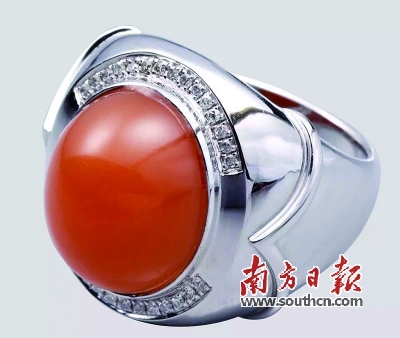
Fortunately, Ling Yutang, president of the Taishan Jade Association, was present. He told a reporter from the Southern Daily that this is the most famous type of Taishan jade. “ Raven skin ” Due to the special conditions under which Wuya Pi jade is formed and the unique properties of the Wuya Pi itself, Wuya Pi jade from Taishan often exhibits superior jade quality compared to non-Wuya Pi jade. As a result, Taishan Wuya Pi jade is exceptionally smooth, dense, and pure, earning it the reputation of being yet another rare and high-end jade sub-category—joining Shoushan Tianhuang, Hetian Yangzhi Jade, Changhua Dahongpao, and Qingtian Guangdengdong as one of the most coveted varieties in the world of jade.
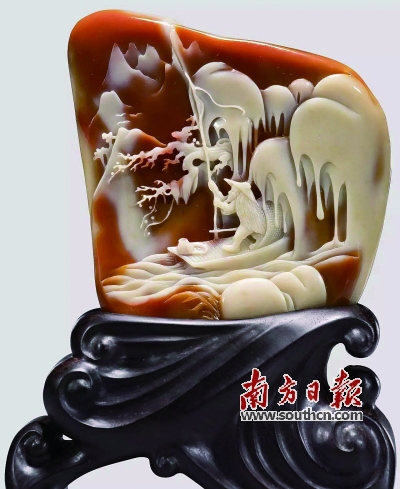
1996 In the autumn of that year, Chen Senyuan, a native of Chaozhou, discovered a golden-red stone in San Shiwan, Beidou, Taishan. “ Taishan wax stone ” As a result, there has been a surge in the development and utilization of this quartz-based jadeite—originating from coastal regions—within China. However, prior to the official issuance of the Guangdong provincial local standard for Taishan Jade earlier this year, this emerging jade variety had long suffered from a lack of scientifically established identification and testing standards, leading to volatile market prices and relatively low public recognition compared to other members of the same family, such as Huanglong Jade and Jin Si Jade.
Members of the quartz-jade family have a smooth, warm texture reminiscent of tianhuang.
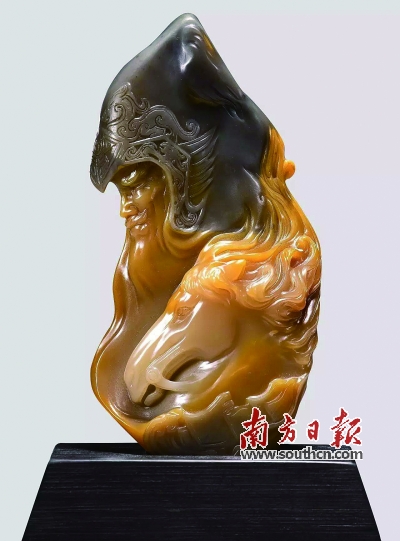
Taishan is a county-level city located along the southeastern coast of Guangdong Province and is renowned as a famous hometown of overseas Chinese. A year before Chen Senyuan arrived in Taishan, Ling Wenlong, a local collector, had also spotted this type of stone at a shop specializing in antique jade and jewelry in the Jiangmen Antique Jade Market. The shop owner happened to be from Beitou in Taishan, and under his guidance, Ling Wenlong managed to locate the original source of Taishan jade.
At first, when outsiders flocked to San Shi Wan and asked local fishermen to help collect these stones, they often faced ridicule from the locals. It wasn't until more and more people started buying these stones that everyone realized: those ordinary stones, once sold to others at rock-bottom prices, were actually rare treasures that could fetch high prices in the jade market. From then on, no longer relying on the encouragement of foreign traders, nearby fishermen eagerly rushed to San Shi Wan and Huang Hua Wan to dig for these stones. Over time, this activity even evolved into a thriving livelihood for the local coastal residents.
As more jade and geology experts joined the investigation, local residents soon learned that, based on the mineralogical composition of this beautiful stone, it is officially classified in gemology as cryptocrystalline sericite-quartzite—commonly known as quartzite jade. The primary minerals in this ore are cryptocrystalline quartz, sericite, chlorite, and trace amounts of iron-bearing minerals. The lower the content of sericite and chlorite, the higher the hardness and the stronger the luster. Its Mohs hardness is... 5.5 Degree to 6.5 Between these values, it’s similar to jadeite; its density is per cubic centimeter. 2.6 To 2.65 Gram.
According to Qiu Zhili, Deputy Director of the Professional Committee for Identification and Evaluation of the China Jewelry & Jade Ornament Industry Association and a professor at Sun Yat-sen University, Taishan jade, like jadeite, Hetian jade, and Tianhuang, are all masterpieces created by nature’s extraordinary craftsmanship—products of geological processes deep within the Earth. High-quality varieties among them have all undergone complex geological transformations and been refined over long periods under various surface conditions. Unlike Hetian jade and jadeite, Taishan jade is a quartz-based jade that forms in relatively pure conditions. SiO2 It is formed by the slow precipitation in solution. Similarly, quartz-jade also boasts a profound historical and cultural accumulation. As early as the Neolithic period—or even earlier—in Lingnan, there already existed a tradition of using quartz-jade. At the Henglingshan site in Boluo, southeastern Guangdong Province, dating back to the Shang and Zhou dynasties, numerous quartz-jade jade rings have been unearthed—among them, a pair of white quartz-jade rings whose texture rivals that of Hetian white jade.
The total industrial output is one-thousandth of that of Hetian jade.
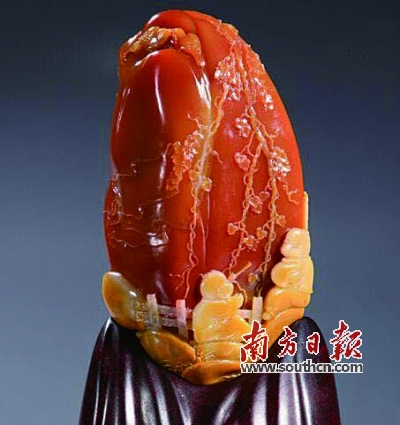
In the jade industry, there are numerous quartzite jades with mineral compositions similar to Taishan jade. In Guangdong Province, Zijin Jade and Chaozhou Jade have attracted widespread attention within the jade community. Across China, other notable examples include Huanglong Jade, Jin Si Jade, Tiger’s Eye Stone, Rose Quartz, Chalcedony, Agate, and Dongling Stone. And globally, there are even more varieties of quartz-based jades of this type.
Taishan jade has garnered attention as a distinct variety precisely because it is unique to China. “ Jade of the Sea ” It has the texture of Hetian jade, the hardness of jadeite, and the color of Tianhuang.
Taishan mentioned earlier in the previous text “ Raven skin ” The jade flesh boasts vivid and pure colors, predominantly yellow and red, yet also featuring dozens of other hues such as yellow-red blends and yellow-white blends. Combined with its mysterious outer layer resembling crow skin, it exudes a beauty and brilliance unmatched by any other jade variety.
Ling Yutang told reporters that the distinctive features of Taishan jade mainly lie in four aspects: First, its colors are rich and diverse. To the naked eye, most people might mistake it for Shoushan stone because its color is strikingly similar to that of Tianhuang. Indeed, although the colors found in Taishan jade—such as red, white, yellow, orange, brown, black, green, and gray—are not exactly identical to those of Shoushan stone, every color found in Shoushan stone can be traced in one or another variety of Taishan jade. Second, its texture is round, smooth, and silky; when you hold it in your hand, you’ll immediately feel this distinct quality—a result of high-grade Taishan jade having been immersed in seawater for long periods. Third, its luster is subtle and gentle, quietly restrained and never dazzling; it’s extremely comfortable to look at. From a gemological perspective, classified by luster, Taishan jade exhibits a wax-like to oily luster, very similar to both Shoushan stone and Hetian jade. It’s not highly transparent, yet it feels exceptionally warm and soothing. Fourth, it’s remarkably tough and resilient, making it ideal for crafting jade carvings and decorative pieces. In terms of its ability to render fine details, only Hetian jade can match it; and in terms of hardness and stability, it clearly surpasses Shoushan stone.
The reporter spoke with staff from the Sixth Geological Brigade of the Guangdong Bureau of Geology. 2015 An academic paper published this year indicates that Taishan jade can currently be categorized into types such as mountain material, mountain-flowing water material, and seed material. Mountain material is mostly found on mountains and tends to be of lower quality; mountain-flowing water material is typically found in pits and is of average quality; seed material is predominantly found along the seashore. Over years of weathering and water erosion, seed material develops a naturally beautiful shape and exquisite patterns, making it the most valuable type. Some pieces, without even needing carving, can be appreciated simply as remarkable natural stones. According to local development statistics, the total volume of seed jade is approximately... 150 To 200 tons, the deeply buried material is approximately in 150 To 250 Ton, the mountain-flow material is approximately 200 To 250 tons, mountain-sourced and sea-sourced materials are approximately 1000 Around tons, with total ore production approximately at 2000 Tonnes. Overall, the total output of Taisan jade is only one percent of that of Shoushan stone and one-thousandth of that of Hetian jade. According to local sources from Naqin Village, the origin of Taisan jade mines, the supply of raw Taisan jade is becoming increasingly scarce. The jade currently circulating in the market mostly consists of secondhand pieces previously held by collectors, while genuine, first-hand materials are extremely rare.
Despite its high quality and limited production, due to various reasons, Taisan jade is not as well-known in the market as other quartz-based jades such as Huanglong jade and Jin Si jade; for a long time, it has been treated merely as a more beautiful variety of yellow wax stone.
The future Taishan Jade local standard will promote the orderly development of the industry.

Taishan Yuzhen was first recognized by the market as a relatively independent variety when... 1998 Years later, officials from the Guangdong Ornamental Stone Association told reporters that a real market boom didn't actually occur until after the turn of the new century. In recent years, when social capital fervently chased Yunnan Huanglong Jade in the market, driving its price to soar, it indeed triggered a rise in prices for other similar jade varieties domestically as well. In this round... “ Jade Bull Market ” Meanwhile, Yushan jade from Taishan has also benefited, with its prices rapidly soaring. In just a few short years, some premium pieces have even seen their values increase by dozens or even hundreds of times.
Some Taishan jade enthusiasts analyzed for reporters that although the discovery and promotion of Taishan jade began no later than those of Huanglong jade, compared with other renowned jades such as Hetian jade, jadeite, turquoise, Dushan jade, and Xiuyu jade, Taishan jade’s development is still in its early stages. As a result, its current market prices are not yet particularly stable and tend to be somewhat low. Over the past decade or so, a group of enthusiasts—including Ling Wenlong and Ling Yutang—have spared no effort in promoting Taishan jade externally, enabling an increasing number of professionals to recognize its physical properties and unique aesthetic appeal. Nevertheless, industry insiders’ understanding of Taishan jade remains insufficient at present.
In addition to promotion issues, the long-term lack of scientific identification and testing standards is also considered a major factor hindering the development of Taishan jade. Ling Yutang frankly admitted that, under the guidance of the quality supervision and management authorities, experts, scholars, and industry professionals have made concerted efforts over the past several years, and finally, the Guangdong provincial local standard for Taishan jade was officially promulgated earlier this year. This standard provides a scientifically sound framework for the appraisal and trading of Taishan jade, and the next stage of development for the Taishan jade industry will become more orderly.
It is understood that currently, Jiangmen City has factories, enterprises, and research institutions engaged in the creation, production, and sale of arts and crafts. 4000 Multiple, with over ... practitioners 25 Ten thousand—Jiangmen’s annual sales of arts and crafts products are nearly... 200 Hundreds of millions of yuan—much of this figure can be attributed to the contribution of the Taishan jade industry. The Guangdong Provincial Local Standard for Taishan Jade clearly defines the quality indicators of Taishan jade, including its definition, chemical composition, and structure. It also establishes a corresponding grading system based on factors such as color, luster, water content, clarity, texture, craftsmanship, and overall quality of Taishan jade. Industry insiders predict that the promulgation and implementation of this standard will further regulate the market order for Taishan jade, reduce market乱象 such as counterfeit products masquerading as genuine ones and substandard goods passing off as high-quality, and ensure the sustained and healthy development of the Taishan jade cultural industry.
Some experts have also pointed out that Taisan jade is comparable in appearance to Tianhuang jade, and the diopside it contains is also a major mineral component of Tianhuang jade. For this reason, many local artisans have long used Tianhuang jade as a reference for developing Taisan jade—but in fact, this practice has been detrimental to Taisan jade. Yang Genlian, a master of Chinese arts and crafts, noted during a jade-carving competition held in Guangdong this year that he had a profound impression at the event. —— Some craftspeople have already begun to move beyond simply using Shoushan stone carving techniques to work on Taishan jade. Although this trend is still relatively small, it’s already showing signs of growth—and that’s incredibly significant. Taishan jade is not the same as Tianhuang; it deserves to develop its own unique style. This style must achieve a harmonious integration of cultural depth, artistic expression, and craftsmanship. Otherwise, the works will merely become commodities rather than true works of art. Especially when it comes to cultural significance: merely selling raw materials no longer aligns with the current direction of development in arts and crafts. Culture is a precious legacy left by our ancestors, and works that neglect craftsmanship are truly alarming.
Southern Daily Journalist Feng Shanshu
Links:
Address: Room 909, 9th Floor, Science & Technology Building, Eastern Software Park, No. 90 Wensan Road, Hangzhou City, Zhejiang Province Telephone:0571-85115488

Scan with your phone
Open the mobile website