
浙江之源资产评估有限责任公司
New Advances in CVD Synthesized Diamonds: Dark Gray CVD Synthesized Diamonds – Troy Ardon and Sally Eaton-Maga?a
Release time:
2015-07-08
Source:
China Jewelry Industry Network
Recently, two CVD-colored synthetic diamonds were detected at the GIA laboratory in Carlsbad, USA. These two diamonds exhibit a dark gray color. In the past, GIA has also examined a small number of dark-colored synthetic diamonds; however, most of these were brownish-red HPHT synthetic diamonds that had undergone post-treatment to create NV color centers. The two gray CVD diamond samples measure 0.80 ct and 1.50 ct, respectively (as shown in Figure 11).
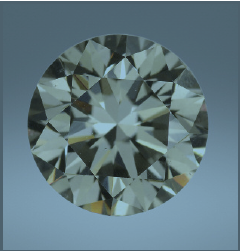
Figure 11: 1.5 ct dark gray CVD synthetic diamond
In addition to their similar colors, these diamonds also exhibit comparable spectral characteristics. Neither shows any distinct absorption peaks in the ultraviolet–visible–near-infrared region. The mid-infrared spectra reveal that both are Type IIa diamonds; however, they lack the characteristic absorption peaks typically found in CVD-grown diamonds. Both diamonds display similar photoluminescence (PL) spectra, suggesting that their synthesis methods are quite similar. Each exhibits a prominent double peak at 737 nm, which is a hallmark feature of CVD-grown diamonds (natural diamonds occasionally show weak SiV peaks, but these are usually accompanied by other characteristics typical of natural diamonds). Furthermore, DiamondView imaging confirms that both samples are indeed CVD-grown diamonds. Under DiamondView examination, the 1.50-carat diamond sample displays faint blue fluorescence and parallel growth striations—a feature commonly observed in CVD-grown diamonds (as shown in Figure 12, left; P. Martineau et al., “Identification of synthetic diamond grown using chemical vapor deposition (CVD),” Spring 2004 G&G, pp. 1–25). In contrast, the 0.80-carat sample presents a rather unique DiamondView image: it exhibits predominantly yellow fluorescence with visible purple spots. Although such purple spots occasionally appear in CVD-grown diamonds, the background fluorescence is typically pink (W. Wang et al., “Latest-generation CVD-grown synthetic diamonds from Apollo Dia- mond Inc.,” Winter 2007 G&G, pp. 294–312), rather than yellow. In the fluorescence image of the 0.80-carat synthetic diamond, certain areas resemble the fluorescence patterns typically seen in natural diamonds (as shown in Figure 12, right); however, upon closer inspection of its DiamondView fluorescence image and combined with the characteristic SiV peak, it remains unequivocally identifiable as a synthetic diamond.
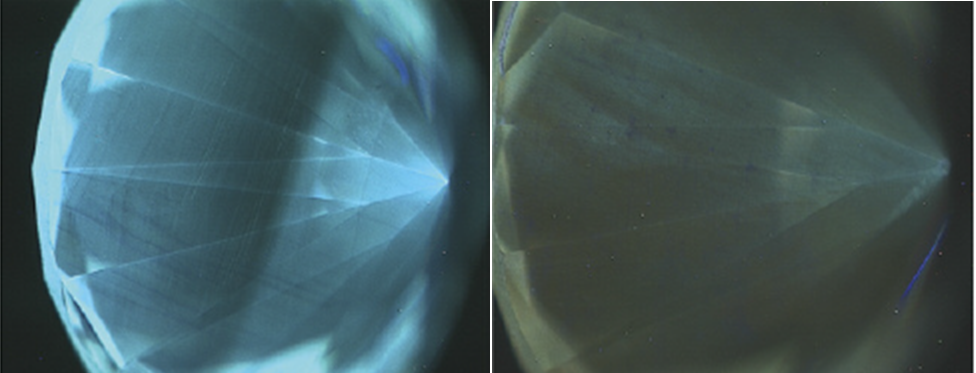
Figure 12
Both synthetic diamonds exhibit blue phosphorescence under DiamondView, a phenomenon primarily associated with boron impurities. However, no characteristic peaks related to boron were detected in either photoluminescence (PL) or Fourier-transform infrared (FTIR) spectra. Therefore, it is inferred that the boron content may be below the detection limit of FTIR spectroscopy. Characteristic boron-related peaks can be observed in natural and treated Type IIb diamonds, but they are generally absent in HPHT- and CVD-grown Type IIb diamonds. At present, it remains unclear whether small amounts of boron are intentionally added to enhance the growth rate and quality of these diamonds (S. Eaton et al., “Diamond growth in the presence of boron and sulfur,” Diamond and Related Materials, Vol. 12, 2003, pp. 1627–1632). Diamonds containing trace amounts of boron typically appear gray; this may well explain why these two diamonds have a gray hue.
Links:
Address: Room 909, 9th Floor, Science & Technology Building, Eastern Software Park, No. 90 Wensan Road, Hangzhou City, Zhejiang Province Telephone:0571-85115488

Scan with your phone
Open the mobile website