
浙江之源资产评估有限责任公司
What is the current coal price level? A comparative analysis from two perspectives will tell you.
Release time:
2016-10-24
Source:
China Coal Network, October 21, 2016
According to a report by Beidouxing Power Generation Network: Steel and power generation companies are crying out about coal shortages, and intermediaries, sensing the trend, are stockpiling coal. Everyone is saying coal prices have gone completely crazy? Here, we’ll provide a rational analysis to determine exactly what level coal prices are at.
Starting in July, the pace of domestic coal price increases has accelerated. In early and late September, relevant authorities twice relaxed restrictions on some production capacity, allowing certain enterprises to schedule production based on their approved capacity of 330 days. So, at what level are coal prices currently? The author conducted a comparative analysis from two perspectives: historical price trends and changes in costs.
Current coal prices have reached the level of June 2013.
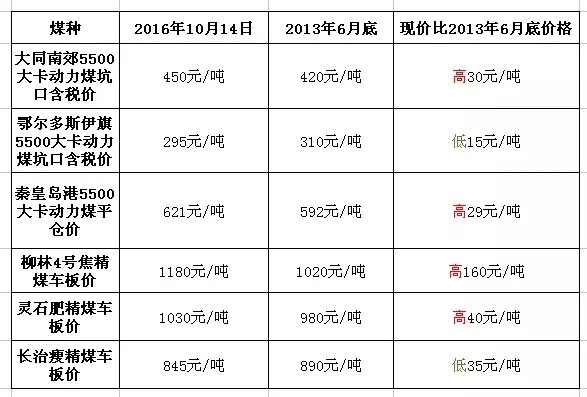
On an annual average basis for 2013, the average prices of the six representative coal types mentioned above were RMB 434, RMB 340, RMB 596, RMB 1,141, RMB 1,042, and RMB 953 per ton, respectively. Currently, coal prices are RMB 14 higher, RMB 45 lower, RMB 25 higher, RMB 39 higher, RMB 12 lower, and RMB 108 lower per ton, compared to these averages.
It can be seen that the prices of most representative coal types currently are already higher than the levels at the end of June 2013, and the prices of half of these coal types have even exceeded their average annual levels for 2013. In other words, assuming no reduction in coal enterprises’ costs and expenses, if current coal prices can remain stable, the total profits of the coal industry in 2017 will see a substantial year-on-year increase.
Coal companies’ production costs have slightly decreased.
The costs incurred by coal enterprises in selling coal can be broadly categorized into three major types: production costs, three types of expenses, and taxes and fees.
In recent years, enterprises have achieved certain progress in cost reduction, and currently, the production costs of most companies have declined compared to 2013 levels. Take a large state-owned enterprise in China as an example: in 2013, the company’s self-produced coal had a unit cost of 124.5 yuan per ton; in the first half of this year, that cost has dropped to 105.1 yuan per ton. The primary drivers behind this cost reduction are lower expenditures on raw materials, fuels, and power, as well as reduced depreciation and amortization expenses. Since the second half of this year, as coal prices have rebounded, enterprises may see a slight increase in costs related to raw materials, environmental protection, and labor. Nevertheless, it remains highly likely that the overall cost of producing coal per ton will still be lower than in 2013.
Regarding the three types of expenses, in recent years, as corporate asset-liability ratios have continued to rise and financing costs have increased, coal enterprises’ financial expenses have generally risen. However, thanks to proactive efforts to reduce administrative and sales expenses, the overall level of the three types of expenses has not changed significantly. For instance, a state-owned coal-listed company in Shanxi reported that in 2015, its consolidated three expenses, averaged over raw coal production, amounted to 102 yuan per ton of coal—comprising 66 yuan for sales expenses, 24.5 yuan for administrative expenses, and 11.5 yuan for financial expenses. In 2013, the total three expenses per ton of coal were 103.6 yuan, broken down as follows: 64 yuan for sales expenses, 37.4 yuan for administrative expenses, and 2.2 yuan for financial expenses.
After the coal industry entered a downturn in 2012, governments at all levels have been working hard to reduce the tax and fee burden on the coal sector. Although, starting from December 2014, the coal resource tax was changed from being levied based on quantity to being levied based on value, resulting in a slight increase in the resource tax burden, for most regions, the reductions in previous taxes and fees have more than offset this increase in the resource tax burden. Consequently, compared to 2013, the overall tax and fee burden on coal enterprises has now been reduced.
Railway freight costs are relatively high.
In addition to the production cost of raw coal, three types of expenses, and taxes, the total cost of coal shipped from ports includes two further components: transportation costs and port transshipment costs. Following the National Development and Reform Commission’s increase in railway freight rates on February 20, 2013, railway coal freight rates were raised again on February 25, 2014, and February 1, 2015. Although railway freight rates were reduced earlier this year, as the coal market has begun to recover, railway freight rates have started to rise once more. Taking Ordos thermal coal shipped from Qinhuangdao Port as an example, based on a transport distance of 1,000 kilometers, the current railway freight rate for transporting one ton of coal is still about 25 yuan higher than the freight rate in effect in 2013.
The primary cost of coal transshipment at ports consists of port miscellaneous charges levied by various terminals. From April to June 2016, in response to the continued decline in transshipment volumes, ports such as Qinhuangdao Port and Guotou Caofeidian Port introduced preferential rates of 3 yuan per ton for lump-sum port operation fees on transshipped coal. However, as coal prices rebounded rapidly starting in July, all ports around the Bohai Sea simultaneously canceled these preferential policies in September, causing port miscellaneous charges for coal transshipment at these ports to return to previous levels.
Upon comprehensive analysis, while production costs for coal have declined somewhat, railway freight rates remain relatively high. Taking as an example a privately-owned coal mine in Ordos, where coal deposits are relatively favorable, the current all-inclusive cost—including taxes—of selling 5,000 kcal coal per ton ranges from 150 to 160 yuan. The short-distance road transportation fee from the mine mouth to the railway platform is about 20 yuan per ton. Adding the railway freight from the mine to the port of Qinhuangdao, plus other associated expenses, brings the total cost per ton to roughly 140 yuan. On top of this, there’s a port miscellaneous fee of 23.5 yuan per ton. Thus, the total cost per ton of coal delivered to the port comes to between 330 and 340 yuan.
Previous page
Links:
Address: Room 909, 9th Floor, Science & Technology Building, Eastern Software Park, No. 90 Wensan Road, Hangzhou City, Zhejiang Province Telephone:0571-85115488

Scan with your phone
Open the mobile website