
浙江之源资产评估有限责任公司
Snow Wave Stone
Release time:
2022-10-26
Source:
China Mining News
Xuelang Stone is primarily produced in mountainous river valleys located in Dingzhou City, Quyang County, and Fuping County in Hebei Province.
Xuelang stones are river-washed pebbles found in mountainous river sections. Their defining characteristic is that, against a dark black background, they feature white or pale-yellow veins and patterns—winding, varying in width, discontinuous, and endlessly diverse—exuding a rugged yet graceful elegance. They resemble rolling snow waves or the fluid strokes of cursive calligraphy. In a broader sense, Xuelang stones are akin to Taishan stones, typically presenting multi-layered landscapes of towering, overlapping mountains.
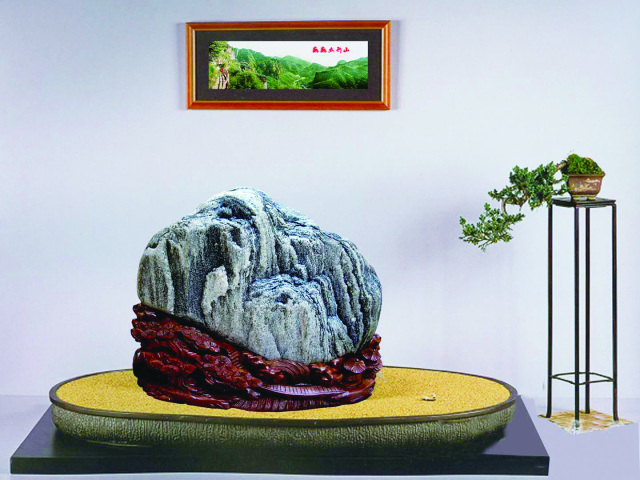
The original rock of Xuelang Stone is migmatite and banded gneiss. Its mineral composition mainly consists of feldspar, quartz, hornblende, and biotite. The crystals are coarse-grained and the texture is extremely hard. Because Xuelang Stone is similar to Tai Shan Stone, some pieces of Xuelang Stone have been acquired by Shandong stone merchants and brought back to Shandong, where they are sold as Tai Shan Stone.
Snow-wave stones typically range in size from 1 to 5 meters and weigh anywhere from several tons to dozens of tons. Most are used as landscape stones in gardens. There are also smaller, pebble-like specimens measuring just a few dozen centimeters, which can be placed indoors in halls or on desks for decorative display and enjoyment.
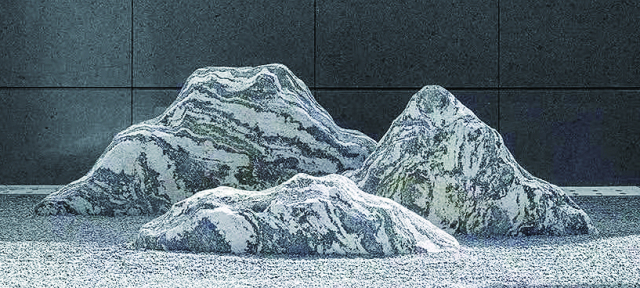
The name “Xuelang Stone” originates from the renowned literati Su Dongpo of the Song Dynasty. According to historical records, during the Northern Song Dynasty, the great literary master Su Dongpo discovered a stone in Dingzhou whose black base was adorned with white veins resembling surging snowflakes. He had this stone moved to his residence and named it “Xuelang Stone,” also christening his study as “Xuelang Studio.” Today, this “Xuelang Stone” stands 76 centimeters high and 80 centimeters wide, and is displayed at the “Xuelang Pavilion” in Dingzhou City. In Du Wan’s “Yunlin Stone Catalogue” from the Song Dynasty, the Xuelang Stone is described as follows: “A stone emerges from the earth in Zhongshan Prefecture (present-day Dingzhou, Hebei Province), its color grayish-black, dry yet silent, with a naturally unified texture. Its patterns are predominantly composed of white veins that intertwine and curl like strands of hemp spiraling and winding. When Su Dongpo served as governor of Zhongshan, he placed such a stone in his study and called it the ‘Xuelang Stone.’” In modern times, the term “Xuelang Stone” has come to refer to similar types of stones found across China, with numerous production sites nationwide—including Xining in Qinghai, the Qinling Mountains in Shaanxi, and Mao County in Sichuan.
Selected from the popular science series on ornamental stones, "Appreciation of a Hundred Stones."
Links:
Address: Room 909, 9th Floor, Science & Technology Building, Eastern Software Park, No. 90 Wensan Road, Hangzhou City, Zhejiang Province Telephone:0571-85115488

Scan with your phone
Open the mobile website