
浙江之源资产评估有限责任公司
Analysis of China’s Metal Mineral Resource Situation and Market Outlook
Release time:
2023-02-21
Source:
China Mining News
I. Affected by the black metals industry, China’s metal mining industry profits declined year-on-year.
According to statistics from the National Bureau of Statistics, affected by the overall downturn in the macroeconomy, in 2022, industrial enterprises above a designated size across the country achieved cumulative operating revenues of 13,790.984 billion yuan and total profits of 8,403.85 billion yuan, down 4.0% year-on-year. The industry profit margin stood at 6.1%. Since 2015, when looking at year-on-year changes in profits of industrial enterprises above a designated size in China, the overall business performance of China’s industry has now basically returned to pre-2020 levels. Among these, the metal mining industry achieved cumulative operating revenues of 1,720.577 billion yuan, accounting for 12.5% of the total cumulative operating revenues of industrial enterprises above a designated size nationwide; its cumulative profits amounted to 427.54 billion yuan, a year-on-year decrease of nearly 51%; its cumulative profits accounted for 5.1% of the total profits of industrial enterprises above a designated size nationwide, with an overall industry profit margin of only 2.5%, 3.6 percentage points lower than the average profit margin for industrial enterprises above a designated size. Specifically, the ferrous metal smelting and rolling processing industry generated profits of just 36.55 billion yuan, with an industry profit margin of only 0.4%; the ferrous metal mining and beneficiation industry earned profits of 59.49 billion yuan, a year-on-year decline of over 23%, with an industry profit margin of 12.1%; the nonferrous metal smelting and rolling processing industry generated profits of 257.15 billion yuan, down nearly 18% year-on-year, with an industry profit margin of 3.4%; and the nonferrous metal mining and beneficiation industry earned profits of 74.35 billion yuan, up nearly 45% year-on-year, with an industry profit margin of 20.5%.
II. In 2022, the non-ferrous metals industry showed significantly stronger performance than the ferrous metals industry.
In terms of output, in 2022, China produced a total of 863.83 million tons of pig iron, 1,013 million tons of crude steel, 1,340.34 million tons of steel products, and 473.44 million tons of coke—down 0.8%, 2.1%, and 0.8% year-on-year, respectively, while coke production increased by 1.3%. In the nonferrous metals sector, China’s total output of 10 types of nonferrous metals in 2022 reached 67.74 million tons, including 40.21 million tons of electrolytic aluminum—a year-on-year increase of 4.3% and 4.5%, respectively. Judging solely from the output data, in 2022, the black metals sector as a whole performed weaker than the nonferrous metals sector, and within the black metals sector, raw materials showed a notably stronger performance than smelting processes.
From the perspective of price trends, prices of China’s five major categories of steel and steel billets have been fluctuating downward, reaching levels seen in 2019, with average annual price declines exceeding 13.5%. Although price trends for major non-ferrous metals have shown some divergence over the year, most varieties have still exhibited a volatile upward trend. Among these, the prices of lithium carbonate—the representative metal for the new energy sector—as well as cobalt and nickel, rose by 310%, 14%, and 46% year-on-year, respectively.
III. The price of iron ore, a representative variety of ferrous metals, may continue to decline toward the long-term average level.
Affected by downward pressure on steel prices, the Platts iron ore price in 2022 followed a “high-before-low” trend throughout the year. The Platts iron ore price index for 2022 reached a high of US$162.8 per ton and a low of US$79.5 per ton, with an average annual price of US$120.1 per ton—a 24.7% decrease compared to 2021.
Judging from the decline in Platts iron ore prices, the drop in iron ore prices in 2022 was significantly greater than that of steel products and steel billets. However, from the perspective of commodity profits, the average price level of $120.1 per ton in 2022 represented an excess over the global average FOB cost of iron ore in 2022—reaching nearly 200%. Even after factoring in shipping costs and port handling fees, the excess over China’s landed cost still amounted to more than 120%.
In terms of iron ore imports, in 2022, China’s cumulative iron ore imports reached 1,106.864 million tons, a decrease of 1.5% year-on-year. The average import price for the year totaled $115.7 per ton.
Regarding domestically produced ores, according to statistics from the China Metallurgical Mining Association, as of the end of November 2022, China’s output of raw iron ore reached 889.046 million tons, a year-on-year decrease of 0.5%. The cumulative full production cost of iron concentrate was 511 yuan per ton, equivalent to over 73 U.S. dollars per ton when converted into U.S. dollar terms—a figure that still ranks last among all iron ore-producing countries worldwide.
Looking at the long-term price trend of the Platts iron ore index, a long-term average price center of $108.2 per ton has been established since June 2008. Moreover, since 2015, the bottom of iron ore prices has been steadily rising—a trend that is particularly evident. At present, as long as China’s crude steel production and market supply-demand dynamics do not undergo significant adjustments, the likelihood of disrupting the overall long-term trajectory of iron ore prices remains relatively low. It is expected that in 2023, the annual average price of Platts iron ore will likely fall back into the range of $100 to $110 per ton—close to the long-term price center.
IV. Basic industrial metals, represented by copper and aluminum, are likely to experience volatile pullbacks due to ample supply.
(1) Copper prices may experience wide-ranging, high-level fluctuations and a downward trend as the supply-demand dynamics improve.
In 2022, amid global inflation and U.S. interest-rate hikes, copper prices showed a “high-first, then low” trend. Throughout the year, the highest copper price reached $10,600 per ton, while the lowest fell to $7,104 per ton. The average annual price was $8,786 per ton, down 5.5% year-on-year.
In 2022, as the world’s largest consumer of copper, China’s copper demand was somewhat restrained by a variety of factors. Moreover, in several downstream sectors, significant reductions in copper usage and material substitutions have further curbed copper consumption. On the supply side, although global copper mine supply improved to some extent in 2022 as newly built and expanded projects in various countries gradually came on stream over recent years, major copper-producing countries such as Chile and Peru experienced lower-than-expected copper supplies due to changes in government policies and shifting attitudes toward mineral resources. Under the combined pressure of declining supply and demand, copper prices achieved a relatively weak balance in 2022 and, with the support of capital, managed to hold firm at high levels. Looking ahead, global copper production is expected to continue recovering in 2023, as new and expanded projects increase the overall supply of copper resources. Meanwhile, demand will largely depend on the extent of the global economic recovery and the growth of Chinese demand. From the current perspective, the overall copper supply situation in 2023 is likely to become more relaxed. However, it is crucial to pay close attention to the ability of capital markets to manipulate commodity prices. As the most capital-intensive among bulk metals, the copper market may continue to receive strong support from capital markets, keeping copper prices firmly anchored at higher levels. Consequently, the copper market in 2023 is likely to experience broad fluctuations at relatively high levels, with the overall price range possibly easing downward from 2022 to below $8,000 per tonne.
(2) Aluminum prices may stabilize and gradually decline under expectations of a looser supply-demand structure.
As the most widely used nonferrous metal, aluminum experienced a year-on-year price trend in 2022 characterized by high prices in the first half and lower prices in the second half. This was driven by a short-term supply-demand imbalance in overseas aluminum markets triggered by various events, as well as multiple domestic factors. The highest price during the year reached $3,840.5 per ton, while the lowest price was $2,102 per ton. The average annual price was $2,713 per ton, representing a 9.1% increase compared to 2021.
In 2023, global alumina and primary aluminum production will remain in a phase of high-capacity commissioning, meaning supply-side pressures will continue to be significant. Regarding alumina, the global market is expected to maintain ample supply. According to data from the National Bureau of Statistics, from January to November 2022, China’s cumulative alumina output reached 75.341 million tons, representing a year-on-year increase of 5.8%. As for primary aluminum, it is anticipated that the release of new production capacity in the second half of 2023 could drive a slight increase in primary aluminum output. Overall, the aluminum market in 2023 is likely to gradually show a more balanced supply-demand situation compared to 2022. On the demand side, uncertainties in global economic development may restrain aluminum consumption. Consequently, aluminum prices in 2023 are expected to remain weak due to the relatively abundant supply, with the average annual price likely to fall back to around USD 2,400 per ton.
V. As a representative of energy metals, lithium’s “frenzied” market performance may be hard to sustain.
In 2022, the shortage of lithium carbonate resources intensified significantly. Coupled with the ongoing disruption of global lithium pricing mechanisms caused by frequent auctions of lithium concentrate from Australia’s Pilbara region, lithium prices spiraled into a frenzy, reaching as high as 597,500 yuan per ton—at one point representing an increase of over 117% compared to the year-beginning price of 275,000 yuan per ton. Throughout the year, China’s average annual price for lithium carbonate was 488,000 yuan per ton, up more than 310% year-on-year from 2021.
In 2022, the rapid expansion of China's production capacity for ternary materials and lithium iron phosphate spurred terminal demand for lithium resources to reach approximately 640,000 tons, representing a year-on-year increase of 42%. Adding this to the total inventory levels, apparent demand could exceed 760,000 tons. Meanwhile, the supply side has been growing at a significantly slower pace than demand, leading to a severe imbalance between supply and demand in the lithium carbonate market. In 2023, the global new-energy vehicle industry is expected to remain robust, further driving apparent lithium demand to around 950,000 tons. Under the influence of high demand and elevated lithium prices, lithium resource producers and lithium salt plants will rapidly expand production and compete fiercely for market share. As a result, substantial volumes of lithium resources will enter the market, alleviating the supply-demand imbalance and helping to bring lithium carbonate prices back to a more rational level. However, given the continued preference for lithium in capital markets, the average annual price of lithium carbonate is likely to hover around 450,000 yuan per ton.
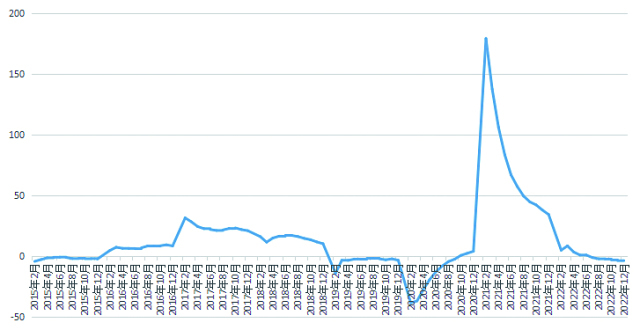
Cumulative year-on-year growth in profits of China’s large-scale industrial enterprises from 2015 to 2022, unit: %; Data source: Metallurgical Industry Planning and Research Institute.
Six, the prices of China’s scarce metals—represented by nickel, cobalt, and chromium—are expected to decline slightly amid a broadly balanced supply-demand situation.
(1) As supply and demand gradually come into balance, nickel prices will gradually return to a rational range.
In 2022, influenced by malicious speculation in the capital markets, nickel prices once reached an all-time high before gradually declining. Additionally, Russian nickel announced in March 2022 that the average price of London nickel in February would serve as the benchmark for annual transaction settlements. As a result, throughout 2022, nickel prices remained largely at around USD 22,000 per tonne. The average nickel price for the entire year was USD 26,943 per tonne, representing an increase of nearly 46% compared to the same period in 2021.
From a supply-and-demand perspective, according to statistics from the Stainless Steel Branch of the China Special Steel Enterprises Association, in the first three quarters of 2022, China’s crude stainless steel production totaled 23.6346 million tons, a decrease of 1.3019 million tons compared to the same period in 2021, representing a year-on-year decline of 5.22%. Among this total, Cr-Ni-based stainless steel production reached 11.9667 million tons, down by 2.406 million tons, or a year-on-year drop of 1.97%, accounting for 50.63% of total stainless steel output. Calculations show that China’s nickel consumption for nickel-based stainless steel in 2022 decreased by only about 30,000 tons compared to 2021, translating into a global reduction in stainless steel nickel demand of roughly 50,000 tons. In terms of nickel use in batteries, although the market was impacted in 2022 by the growing share of lithium iron phosphate batteries, demand for ternary power batteries continued to grow rapidly. With the rapid advancement of high-nickelization, battery nickel demand is expected to surge, with global nickel demand for batteries reaching between 260,000 and 270,000 tons—a year-on-year increase of 30%. However, in terms of overall nickel consumption, global nickel demand in 2022 increased by only about 20,000 tons compared to 2021. On the supply side, 2022 marked a peak period for the commissioning of Chinese-Indonesian laterite nickel mining investment projects in recent years. Coupled with the successful pilot testing of the “laterite nickel—high-grade nickel matte—nickel sulfate” process by China’s Tsingshan Group, China’s longstanding shortage of nickel raw materials may now be effectively addressed thanks to another technological breakthrough in laterite nickel processing, gradually bringing the supply landscape closer to balance or even easing. In 2023, the biggest factors disrupting nickel prices will remain the LME’s handling of Russian nickel products, the pricing mechanisms for Russian nickel, and the market’s attitude toward accepting Russian nickel products—these factors will serve as a “floor” supporting nickel market prices. Overall, it is expected that in 2023, nickel prices will generally exhibit a volatile downward trend, settling around an annual average of USD 21,000 per ton.
(2) Loose market supply and demand may continue to drive down cobalt prices.
In 2022, cobalt prices followed a trend of high at the beginning and low at the end of the year. At the start of the year, they rose in tandem with market speculation on lithium prices, but then quickly fell and continued to hit new lows. Throughout the year, the price of Shanghai Nonferrous Electrolytic Cobalt (99.8%) ranged from a high of 573,500 yuan per ton to a low of 314,000 yuan per ton, with an average annual price of 425,000 yuan per ton—a year-on-year increase of nearly 14% compared to 2021.
In 2022, influenced by factors such as the ongoing transition toward high-nickel, low-cobalt ternary batteries and a decline in cobalt lithium-ion battery consumption in the smartphone sector, the growth in demand for cobalt was somewhat restrained. Globally, annual cobalt consumption was estimated at approximately 174,000 tons, representing an increase of less than 10,000 tons. Meanwhile, global cobalt production is expected to reach as much as 194,000 tons. In contrast, the supply-demand imbalance is particularly pronounced, with supply significantly exceeding demand. It is anticipated that in 2023, the supply-demand situation in the cobalt market will remain difficult to improve effectively, and the oversupply trend will persist. As a result, cobalt prices are likely to continue their weak downward trend compared to the average price level of 2022, with the annual average price falling to around 350,000 yuan per ton.
(3) Although the factors disrupting the industrial chain have eased, chromium prices are likely to remain relatively high due to continued strong demand from China.
In 2022, due to extreme weather in the Southern Hemisphere, union activities, and the impact of domestic and international pandemics, China's imported chrome ore prices experienced volatile upward trends. The highest price for the year reached $327.5 per ton, while the lowest was $202.5 per ton. The average annual price was $263.4 per ton, representing an increase of nearly 43% compared to 2021.
On the consumption side, China’s stainless steel production has slightly declined, which is expected to reduce annual chromium (metal) consumption by 300,000 tons. On the supply side, disruptions in supply—largely due to transportation and port-related issues—have been the primary factor. Looking ahead to 2023, the chromium market is forecast to improve. However, chromium supply has never been a major issue; provided that the industrial chain remains smooth, chromium prices could generally fall back to around USD 240 per ton—a level still above the 75th percentile of long-term chromium ore prices.
7. China’s advantageous metals, represented by tungsten and antimony, are likely to experience high-level fluctuations with slight declines.
(1) In 2022, the central price of tungsten markets rose overall, and in 2023, prices are expected to remain relatively high.
In 2022, domestic tungsten prices generally showed an upward trend, with the price center significantly rising. The average annual price of tungsten concentrate was 114,000 yuan per ton, up more than 12% year-on-year; the average price of APT was 173,000 yuan per ton, up 13% year-on-year. Both tungsten product prices remained above the 75th percentile of their 10-year long-term price range.
In 2022, the supply side of the domestic tungsten market remained largely unchanged. The annual quota for total tungsten concentrate mining was set at 109,000 tons, an increase of only 1,000 tons compared to 2021. On the consumption side, demand in the cemented carbide sector rose, while consumption in the ferroalloy sector declined. As a result, imports and exports of tungsten products surged significantly.
In 2023, against the backdrop of slowing global economic growth and declining exports, domestic tungsten consumption recovered relatively slowly and remained volatile. The issue of upstream tungsten prices—which had persisted throughout 2022—failing to be effectively passed down to the mid- and downstream sectors remains unresolved. With no significant increase in supply expected, any additional supply from overseas will exert considerable elasticity on tungsten prices. Meanwhile, as resource grades gradually decline and production costs rise sharply, this will provide some support for tungsten prices to a certain extent. Overall, the tungsten market in 2023 is likely to follow a pattern of lower prices in the first half and higher prices in the second half, with average annual prices for scheelite concentrate remaining at around RMB 93,000 per tonne.
(2) The antimony market may continue to operate at high levels.
In 2022, the antimony market followed an inverted “V” pattern. Supported by geopolitical conflicts and tight supply of raw materials, antimony prices once surged to high levels, driving a substantial increase in the price center and placing it at a relatively high position on the long-term price curve.
As the world’s largest producer and consumer of antimony, China remains the decisive factor in the global antimony market. Meanwhile, disruptions to Russia’s industrial antimony resources have prompted the global shift toward sourcing from China, driving up antimony prices and, to some extent, mitigating the impact of the domestic economic downturn on the antimony market. In 2023, the antimony market will continue to depend on the rebound, recovery, and strengthening of China’s real estate and infrastructure sectors. On the supply side, the increase in overseas antimony concentrate supplies will determine the supply-demand dynamics in the global antimony market in 2023. Currently, it appears that the production ramp-up from Huayu Mining’s gold-antimony project in Kyrgyzstan will help ease the tight supply situation of domestic antimony resources, potentially alleviating upward pressure on antimony prices. Moreover, amid increasingly stringent environmental regulations, the cost floor for domestic antimony products has risen, thereby limiting the room for further declines in antimony prices to some extent. Overall, we expect antimony prices to remain relatively high in 2023, with an average annual price for antimony ingots around 73,000 yuan per ton.
8. In 2023, the overall performance of the metals and mining industry is likely to be somewhat pessimistic, though non-ferrous metals will continue to outperform ferrous metals.
Based on the above analysis, since 2022, the metals and mining industry as a whole has continuously faced challenges such as sluggish downstream demand and hindered price transmission, owing to the sudden impact of various unexpected events and uncertain factors. It is expected that in 2023, under the backdrop of increasing global economic uncertainties, these issues will remain prominent. Under the pressure of a generally upward global economic trend in 2023, effectively facilitating the rational return of downstream consumption will continue to pose significant challenges, and overall sentiment within the metals and mining industry remains relatively pessimistic. As the world’s largest consumer of metals and mining products, China’s implementation of a series of key measures aimed at stimulating economic growth and expanding domestic demand will play a crucial role in boosting the domestic economy and driving positive global economic development.
Overall, the metals and mining industry in 2023 is likely to perform weaker than in 2022, with heightened risks. Among them, non-ferrous metals will continue to outperform ferrous metals, and the resource side will remain stronger than the metal smelting, rolling, and processing sectors.
(Author’s Affiliation: Economic Research Institute, China Minmetals Corporation)
Links:
Address: Room 909, 9th Floor, Science & Technology Building, Eastern Software Park, No. 90 Wensan Road, Hangzhou City, Zhejiang Province Telephone:0571-85115488

Scan with your phone
Open the mobile website