
浙江之源资产评估有限责任公司
With tight supply and demand for sand and gravel aggregates, Hangzhou plans to advance the construction of 500 major projects, requiring sand and gravel aggregates to attract suppliers from "all four directions."
Release time:
2017-09-19
Source:
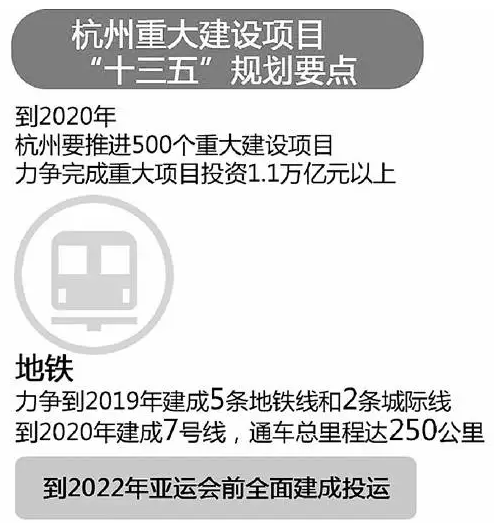
What will Hangzhou look like five years from now? The blueprint for its future development has already been drawn up. Recently, the “13th Five-Year Plan for Major Construction Projects in Hangzhou” was approved by the municipal government and officially released for implementation. Over the next five years, Hangzhou will follow this blueprint and advance the construction of 500 major projects.
However, since the beginning of 2017, China has been facing a shortage of sand and gravel aggregates in some regions due to the combined effects of restrictions on natural sand mining, crackdowns on illegal sand extraction, and intensified environmental inspections. As a result, locally sourced sand and gravel aggregates in Hangzhou are no longer sufficient to support the large-scale infrastructure projects underway, forcing construction companies to source materials from distant locations. The Hangzhou sand and gravel market is poised to become a hub attracting suppliers from all over the country—creating a scenario where “four parties converge.”
The rail transit system will be fully completed and put into operation in 2022, with the West Railway Station being developed into a national-level railway hub.
To drive urban development, transportation must take the lead. During the 13th Five-Year Plan period, Hangzhou will focus on building itself into an international regional transportation hub, stepping up efforts to develop its rail transit system and vigorously constructing a modern, integrated transportation network centered on high-speed railways, aviation, waterways, and expressways.
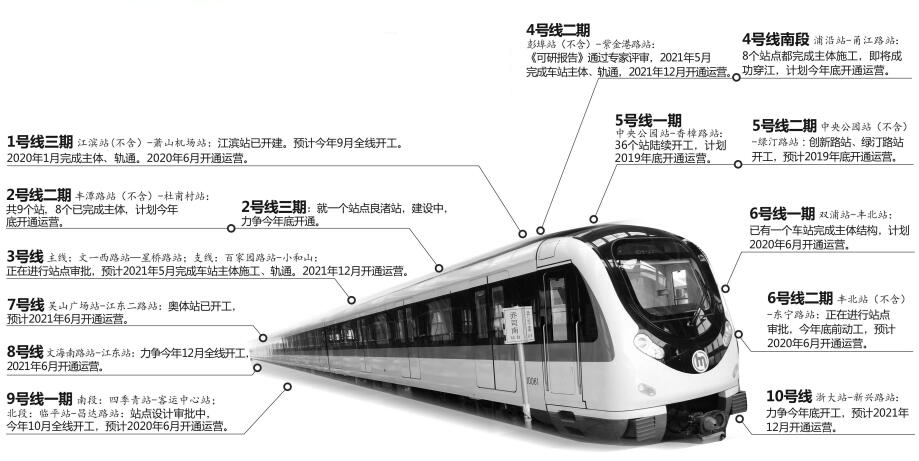
The subway has significantly shortened commuting times, expanded the city’s urban footprint, and created new development space—making it a key focus of Hangzhou’s transportation infrastructure development. During the 13th Five-Year Plan period, Phase I and Phase II of the subway project will be fully completed, and construction of the Fuyang and Lin’an suburban rail lines will be actively promoted. The goal is to have five subway lines and two intercity lines in operation by 2019. The implementation of the third-phase subway project will be accelerated, with Line 7 scheduled for completion by 2020, bringing the total operational mileage to 250 kilometers (currently, the subway’s operational mileage stands at 82 kilometers). By the time of the 2022 Asian Games, the entire third-phase project will be fully completed and put into operation.
For detailed construction plans for the Hangzhou Metro, please see the diagram:
Meanwhile, Hangzhou will also launch new modern tram projects in areas such as the Future Science and Technology City and the Dajiangdong Industrial Cluster Zone, and is conducting planning studies for straddle-type monorails.
Urban transportation hubs and high-speed railways will also be accelerated. The Hangzhou West Railway Station is expected to be completed and put into operation before the 2022 Asian Games. At the same time, multiple high-speed rail lines—including the Hangzhou-Huangshan, Shangqiu-Hangzhou, and Hangzhou-Wenzhou lines—will be introduced. A connecting line between Hangzhou West Station and the Hangzhou-Huangshan line will be planned and constructed concurrently, aiming to transform the West Railway Station into a national-level railway hub.
The city station will also begin undergoing renovation, and plans are underway to build a new railway line connecting it to the Dajiangdong railway hub.
Construction will also begin on the Shanghai-Zhajiang Railway, the Hangzhou-Shaoxing-Taizhou Railway, and the Jinhuang Railway (the section from Jinhua to Jiande). We aim to start construction on projects such as the Shanghe-Hangzhou Railway (the section from Huzhou to Hangzhou) and the Hangzhou-Wenzhou High-Speed Railway (Hangzhou-Yiwu), and to launch preliminary work for the high-speed railway connecting Hangzhou to Wuhan.
By then, the functions of Hangzhou’s five railway stations—Hangzhou East Station, Hangzhou Station, Hangzhou South Station, Hangzhou West Station, and Jiangdong Station—will be reorganized and optimized to create a high-speed rail network that enables one-hour travel from Hangzhou to all prefecture-level cities in Zhejiang Province.
Create a one-and-a-half-hour transportation circle within the city area.
During the 13th Five-Year Plan period, 365 kilometers of new and renovated expressways will be constructed, further enhancing the backbone network of urban expressways. The western duplicate section of the Hangzhou Ring Expressway—specifically its Hangzhou segment—is slated for completion and opening to traffic by 2020. The expansion project of the Hangzhou section of the Hangzhou-Jinhua-Quzhou Expressway will also be completed. Construction will commence on and complete key road networks such as the Linjin Expressway and the Chun'an section of the Qianhuang Expressway. Plans are underway to build the “Hangzhou Third Ring Road” (a ring road connecting urban clusters in Hangzhou). As a result, a transportation network enabling travel within one and a half hours across the entire municipal area will be essentially established.
As an important window for Hangzhou’s internationalization, Xiaoshan Airport will launch more international routes to key cities in Asia, Africa, Europe and the Americas, as well as Australia. At the same time, seizing the opportunity presented by the nation’s opening up of low-altitude airspace, the airport will expand Jiande Qiandao Lake General Aviation Airport and plan to advance the development of a number of general aviation airports in areas such as West City and Tonglu.
Addressing “urban ills” is a crucial direction for enhancing the people’s sense of gain. During the 13th Five-Year Plan period, Hangzhou will strive to tackle the issues that concern the public most directly, realistically, and urgently.
Among these measures, tackling traffic congestion is a crucial component. Hangzhou has fully implemented the three-year “Smooth Western Region” action plan. By 2020, the city’s rapid road network within the ring expressway will be largely completed, enabling a “one-hour” spatial and temporal travel circle between the city center and its outskirts.
Construct the Wenyi Road underground passage and its western extension project, the Tianmu-Huanbei-Genshan Expressway, and the western extension of Liuxiang Road. Upgrade Fengqing Avenue, Tongcheng Avenue, and Shidai Avenue to expressways.
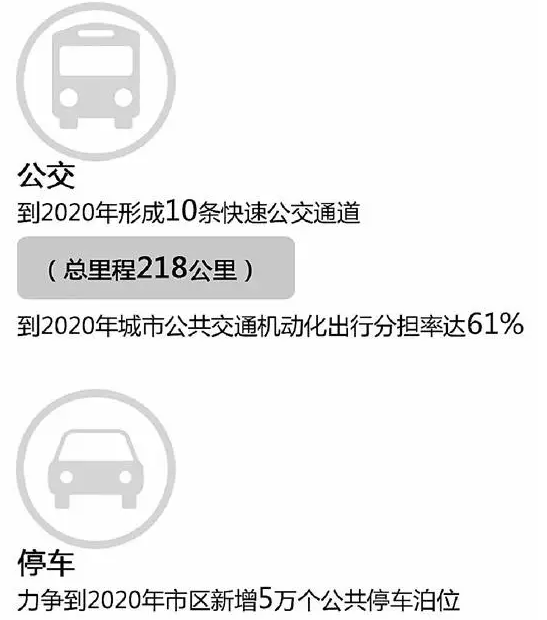
Accelerate the construction of P+R parking spaces around new urban areas, scenic spots, and subway stations. In 2020, the city added 50,000 public parking spaces to address the difficulties residents face in finding parking.
Establish a National Pilot Zone for Ecological Civilization
A large number of educational and medical facilities will transform our lives.
In terms of the environment, by 2022, Hangzhou will have established itself as a national demonstration zone for ecological civilization. The sky will be bluer, the land cleaner, the mountains greener, and the water clearer. Per capita park green space will reach 15 square meters, making the region’s overall ecological environment even more beautiful and livable. We will be drinking water from Thousand Island Lake, and the quality of our tap water will reach internationally advanced standards.
A large number of project constructions will transform our lives.
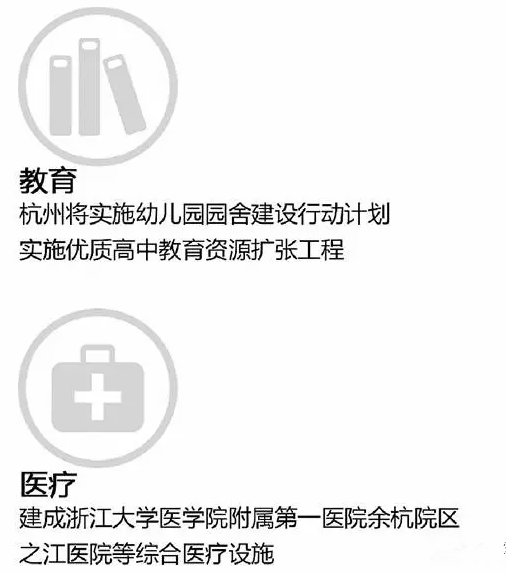
Education: A number of key high schools have been established, including the Xuejun Haichuang Garden Branch School, the Hangzhou No. 2 High School Xiaoshan Branch School, and the Hangzhou High School Dajiangdong Branch School.
Promote the development of West Lake University, Lakeside University, and Zhejiang Institute of Engineers.
Commence construction and complete vocational high schools such as Jianqiao and Kangqiao, and accelerate the launch of construction for the Light Industry Advanced Technical School and the branch campus of Zhongce Vocational School in Dajiangdong.
A number of international schools have been completed and put into operation, including Yungu International School, the International Education Park in Future Science City, and the Hangzhou Foreign Languages School Affiliated to Beijing Foreign Studies University.
Healthcare: The Yuhang Branch of the First Affiliated Hospital of Zhejiang University School of Medicine and Zhijiang Hospital have been completed. We are accelerating the allocation of specialized medical resources, including the Xiaoshan Branch of the Provincial Maternal and Child Health Hospital, the Municipal Geriatric Hospital, the Municipal Children’s Hospital, and the Dingqiao Branch of the Municipal Traditional Chinese Medicine Hospital.
Sports: Complete the construction of venues for the Asian Games; finish building the National Fitness Centers, and actively promote the construction of sports facilities at the district and county (city) levels in areas such as Binjiang and Gongshu. The per capita area of sports facilities will reach 2 square meters.
Culture: Promote the protection of major cultural heritage sites such as the Great Ruins of the Southern Song Imperial City and the Liangzhu Culture Site, and strive to build a world-class cluster of cultural and natural heritage sites.
Commencement of construction of the Municipal Urban Archives Center, with a focus on implementing projects such as the Xihu District Cultural and Sports Center and the Yuhang Culture and Art Center.
Ecological Environment: Completely eliminate black and odorous rivers and surface water sections classified as inferior to Class V, achieve swimmable conditions throughout the entire region, and essentially realize zero landfilling of primary waste.
A number of parks, including the Citizen’s Park and the Central Canal Park, are being constructed, and the urban area adds 2 million square meters of green space each year. Plans are underway to promote the conservation and development of the Dajiangdong Wetland Park and the Tonglu Nanbao Wetland Park.

Previous page
Links:
Address: Room 909, 9th Floor, Science & Technology Building, Eastern Software Park, No. 90 Wensan Road, Hangzhou City, Zhejiang Province Telephone:0571-85115488

Scan with your phone
Open the mobile website