
浙江之源资产评估有限责任公司
What’s driving the new momentum behind China’s mining industry? Let’s take a look at the three regions in China that have seen the hottest investment activity in recent years.
Release time:
2018-07-23
Source:
Eastmoney.com, July 13, 2018
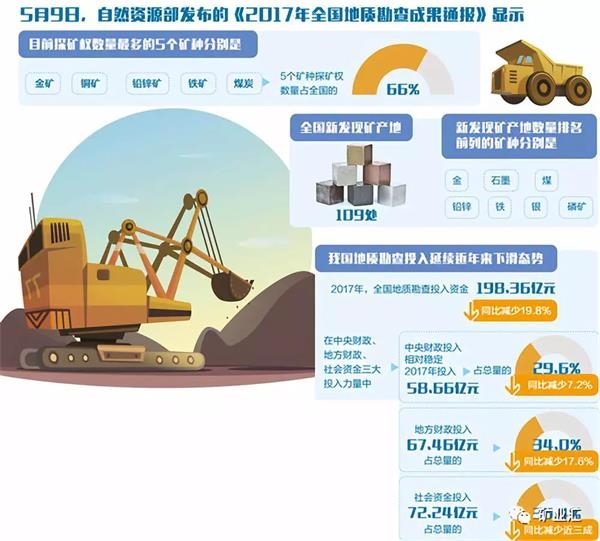
In 2017, the areas of China’s mineral resource exploration investments were primarily focused on gold, copper, lead-zinc, coal, and uranium, accounting for 62% of the total investment. Currently, the five mineral types with the largest number of exploration rights are: Gold mine 、 Copper mine 、 Lead-zinc ore 、 Iron ore and Coal The number of exploration rights for five mineral types accounts for 66% of the national total.
From the perspective of capital investment, Xinjiang 、 Inner Mongolia 、 Yunnan These are the three hottest regions for China’s mineral resources!
Xinjiang
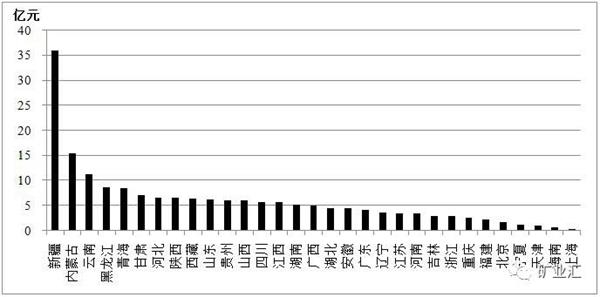
Xinjiang boasts a wide variety of mineral resources, with large reserves and favorable ore-forming conditions. Xinjiang is rich in oil, natural gas, coal, gold, copper, lead, zinc, asbestos, salt minerals, bentonite, limestone, vermiculite, and other minerals—many of which are either urgently needed or critically important domestically.
Xinjiang’s proven reserves of mineral resources hold an important position not only in the northwest region but also nationwide. For example, the proven reserves of iron-rich ores account for one-quarter of the country’s total iron ore reserves, while the Ashalé copper-rich deposit and the Kalatongke copper-rich deposit boast exceptionally high-grade ore, a rarity nationwide. Xinjiang is also rich in coking coal resources, with reserves totaling 8.7 billion tons—representing 9.16% of the country’s total proven coal reserves—and the quality of its power-coal is also excellent.
Compared with neighboring countries, 16 of the 32 mineralization belts extend into Xinjiang, including such world-renowned mineral belts as the Altai nonferrous metal belt, which hold great potential for mineral exploration.
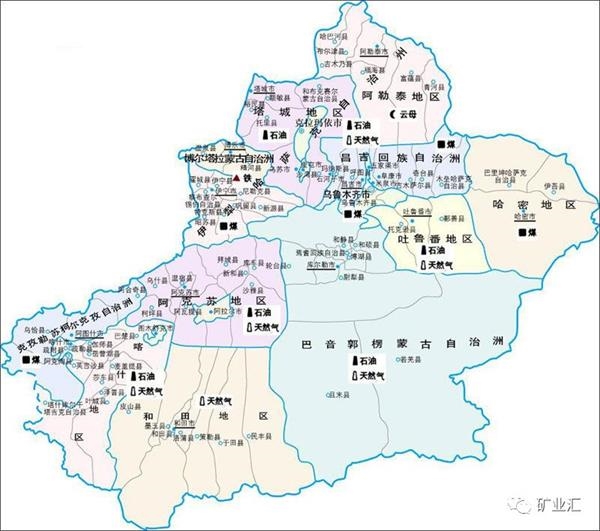
In 2017, Xinjiang invested 3.605 billion yuan in geological exploration, significantly ahead of Inner Mongolia, which ranked second with 1.543 billion yuan, and Yunnan, which came in third with 1.133 billion yuan.
Coal: The San Daoling exploration area in Hami City, Xinjiang, has added 10.1 billion tons of reserves; the Sitanhu Kumu Su No. 4 wellfield in Barkol County has added 1.5 billion tons of reserves.
Lead-zinc deposits: New reserves of 93,400 tons of lead and 33,800 tons of zinc have been discovered in the Chigu area of Hetian County, Xinjiang.
Nickel Deposits: One mining area (exploration stage completed) has been identified, with an additional 280,000 tons of nickel discovered in Pobei, Beishan Area, Ruoqiang County, Xinjiang.
Inner Mongolia
Similar to Xinjiang, Inner Mongolia has become the main battleground for mining investments in China in recent years!
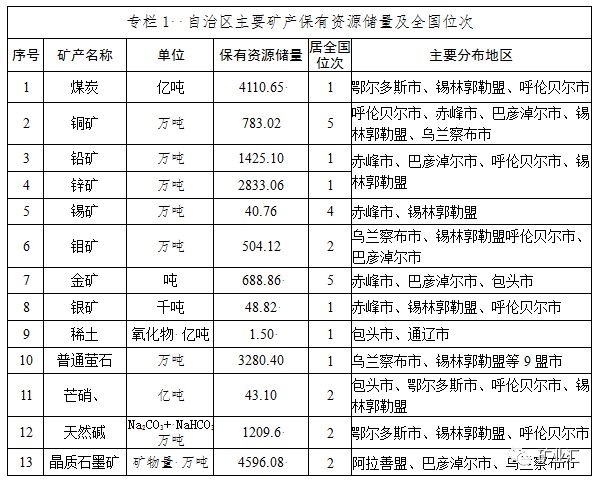
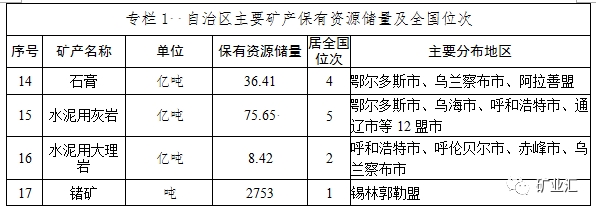
Inner Mongolia boasts distinct advantages in energy and mineral resources, with coal being the dominant resource. The region’s cumulative estimated total coal reserves amount to 851.88 billion tons, of which the proven reserves stand at 411.065 billion tons, ranking first in the country. Moreover, the region holds the largest known uranium reserves in China and has preliminarily established itself as an important base for uranium exploration and development in northern China.
Non-ferrous metals are primarily represented by copper, lead, zinc, tin, and molybdenum ores, while precious metals are mainly gold and silver. These resources are concentrated in the Wolf Mountain–Wula Mountain region in central and western China and in the central-southern section of the Greater Khingan Range in the east, possessing natural endowment conditions that are conducive to large-scale mining.
Rare earth resources are uniquely endowed; the proven reserves of rare earth oxides account for over 98% of the nation’s total, placing China first in the country and giving it the potential to dominate the domestic market.
Non-metallic mineral resources are diverse and widely distributed, and most of them can meet the needs of national and autonomous region economic development.
In 2017, the Galutu wellfield in the Nalin River mining area of the Dongsheng Coalfield in Inner Mongolia added 1.3 billion tons of coal reserves, while the Bujinhui mining area in West Ujumqin Banner added 170,000 tons of zinc, 90,000 tons of lead, and 448 tons of silver.
Yunnan
Yunnan boasts a complex geological structure and is rich in both metallic and non-metallic mineral resources. Among the non-metallic minerals, coal is the most widely distributed; among the metallic minerals, non-ferrous metals predominate, with a wide variety, extensive distribution, and substantial reserves. As a result, Yunnan has long been known as the "Kingdom of Non-Ferrous Metals."
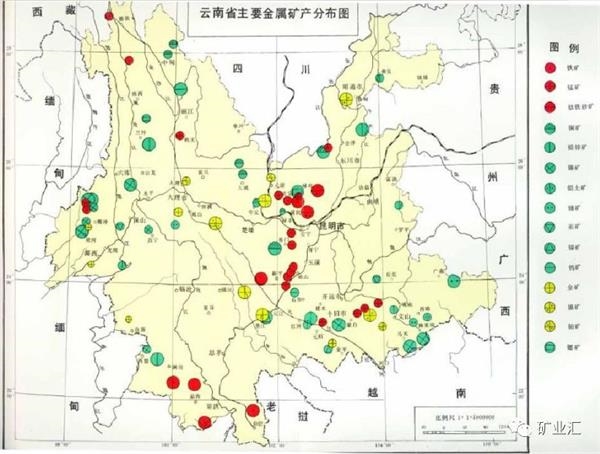
Yunnan is the country’s largest tin-producing base, and its proven tin reserves rank first nationwide. These reserves are concentrated in the regions of Gejiu, Wenshan, and Baoshan. The Gejiu tin mine is China’s largest tin mine, accounting for 18% of the nation’s total proven tin reserves.
The Dongchuan Copper Mine, located within Dongchuan City in Yunnan Province, comprises large- and medium-sized copper deposits—including Luoxue, Tangdan, Yinmin, Lanniping, Shijiangjun, Baixila, and Xintang—as well as several smaller ones, forming the Dongchuan Copper Ore Field. It is one of China's renowned copper mining areas.
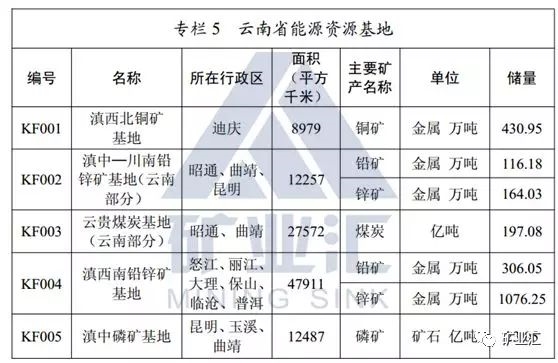

In 2017, Yunnan invested 1.133 billion yuan in geological exploration, ranking third among all Chinese provinces. Notable achievements include the discovery of an additional 1.15 million tons of zinc in the Wanlongshan mining area of Maguan County, Yunnan, and an additional 130,000 tons of antimony in the Muli mining area of Guangnan County, Yunnan.
Links:
Address: Room 909, 9th Floor, Science & Technology Building, Eastern Software Park, No. 90 Wensan Road, Hangzhou City, Zhejiang Province Telephone:0571-85115488

Scan with your phone
Open the mobile website