
浙江之源资产评估有限责任公司
Starting July 1, the average reduction in import tariffs for jewelry and accessories will be 67.75%.
Release time:
2018-06-27
Source:
Guangzhou Diamond Center 2018-06-11
Which product categories are closely related to the jewelry and accessories industry?
There are 18 tariff items involving jewelry and jewelry accessories subject to reduced import tariffs. The tariff rate for gold and silver jewelry products has been lowered from 20% to 8%; the tariff rate for platinum and other precious metal products has been reduced from 35% to 10%; and the tariff rate for natural or cultured pearl products, as well as gemstone or semi-precious stone products, has been cut from 35% to 10%. As a result, the average import tariff rate for these 18 tariff items has dropped from 30.67% to 9.89%, representing an average reduction of 67.75%.
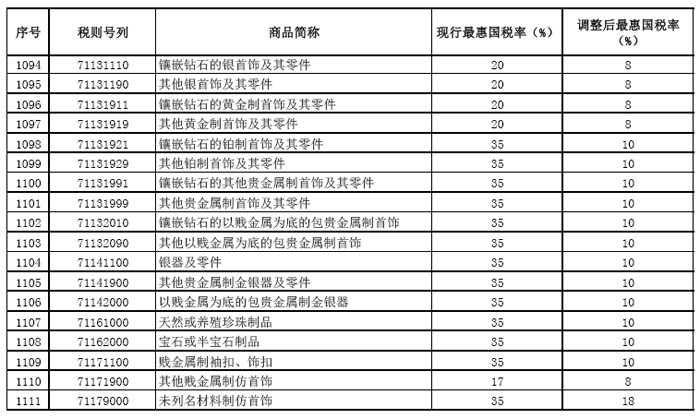
General import duties are mainly divided into Most-Favored-Nation (MFN) tariffs and ordinary tariffs. The former apply to imported goods from countries (or regions) that have signed trade treaties (or agreements) with the country granting them MFN treatment, while the latter apply to imported goods from countries (or regions) that have not signed such treaties (or agreements) with the country.
The tax reduction discussed here refers to the former—most-favored-nation (MFN) tariffs. Regardless of the type of goods being imported, both tariffs and value-added tax must be paid. However, the collection of these two taxes is not simply a matter of adding them together; rather, it involves a comprehensive tax rate calculated using the following formula:
1. For products not subject to consumption tax at the import stage, the comprehensive tax rate calculation formula is: Import tariff rate + Value-added tax rate + (Import tariff rate × Value-added tax rate).
2. For products subject to consumption tax at the import stage, the comprehensive tax rate calculation formula is: (Import tariff rate + Consumption tax rate + Value-added tax rate + (Import tariff rate × Value-added tax rate)) / (1 - Consumption tax rate)
In practical applications, how can this be demonstrated? Let’s take an example!
Take, for example, gold jewelry set with diamonds, cataloged as 71131911 (no consumption tax is levied at the import stage). With a value-added tax rate of 17% and a most-favored-nation tariff rate that has been reduced from the original 20% to 8% effective July 1, the overall tax rate will drop from the current 40.4% to 25.28%. For goods valued at RMB 1 million, the taxes and fees paid under general trade imports will decrease from RMB 404,000 to RMB 252,800, representing a reduction of 37.42%.
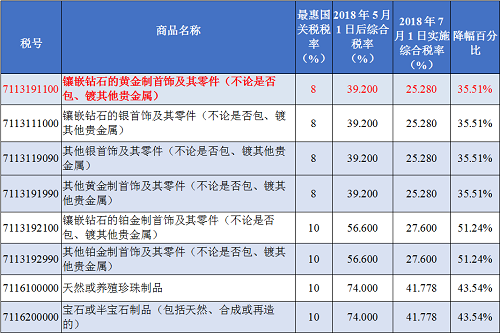
Principles for Applying the Most-Favored-Nation Tariff Rate
Most-Favored-Nation (MFN) Tariff Rate: The MFN tariff rate applies to imported goods originating from World Trade Organization member countries or regions that jointly apply the MFN treatment provisions with China, or to goods originating from countries or regions that have signed bilateral trade agreements with China providing for mutual MFN treatment.
Most-favored-nation treatment is one of the fundamental rules of the World Trade Organization (WTO), under which all WTO member countries enjoy MFN treatment among themselves. MFN treatment means that any preferential treatment or exemption—whether now or in the future—that a contracting party grants to any third country in areas such as trade, tariffs, shipping, and the legal status of citizens will also be extended to the other contracting party. A country that enjoys MFN treatment is referred to as the beneficiary country; this treatment is typically provided for under bilateral or multilateral treaties.
The most-favored-nation clause is not intended to secure special treatment; rather, it aims to ensure equal and non-discriminatory treatment, thereby guaranteeing free and fair competition in trade under conditions of equal opportunity.
According to the "Customs Tariff of the People's Republic of China," goods imported from WTO member countries or from countries or regions that have signed bilateral trade agreements of mutual benefit with China shall be subject to the most-favored-nation (MFN) tariff rate. For a list of countries or regions eligible for the MFN tariff rate, please refer to the "Country (Region) Code Table" in the "Practical Handbook for Customs Declaration of the Chinese Customs." Currently, virtually all countries' imports are subject to the MFN tariff rate.
For the vast majority of jewelry enterprises, importing the aforementioned jewelry categories subject to tariff reductions via general trade will significantly reduce overall tax and fee costs, further boosting domestic market demand for imported jewelry products.
Previous page
Links:
Address: Room 909, 9th Floor, Science & Technology Building, Eastern Software Park, No. 90 Wensan Road, Hangzhou City, Zhejiang Province Telephone:0571-85115488

Scan with your phone
Open the mobile website